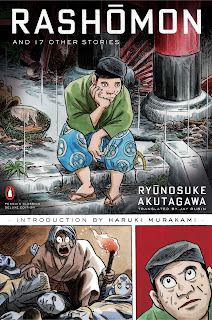
The book in front of me is Rashōmon and 17 Other Stories by Akutagawa Ryūnosuke, the cute 2006 Penguin with the manga cover and Murakami Haruki introduction, translated by Jay Rubin. I’m trying to stick to the Japanese convention where the family name comes first, but I make no promises about consistency.
I liked it a lot, enough that I immediately
started another, earlier collection, Rashomon and Other Stories (Liveright,
1952, tr. Takashi Kojima), to fill in some gaps. Murakami insisted on a story called “Yam
Gruel,” not in the book he introduced.
He was right, “Yam Gruel” is good, from the title on. Apparently yam gruel was a Heian delicacy,
as unlikely as that sounds.
Akutagawa only wrote for twelve years before, physically and
mentally ill, killing himself in 1927 when he was 35. With such a short life, I was not expecting
his writing to have phases, but they are pretty clear. He had some big hits right away, famous
stories like “In a Bamboo Grove” and “Hell Screen,” modernized versions of
grotesque old tales, generally set, like those two, in the decadent end of the
Heian period. He also has a set of 17th
and 18th century stories, often about Christian martyrs. The attraction is clearly to the martyrdom, the
tortures, another form of grotesquerie.
Many of these stories are horror stories, really, “Hell Screen” most
obviously, where a lunatic painter commissioned to depict Hell tortures his
assistants and worse in the name of realism:
And the kinds of torture were as numberless as the sinners themselves – flogging with an iron scourge, crushing under a gigantic rock, pecking by a monstrous bird, grinding in the jaws of a poisonous serpent… (51, ellipses in original)
But the painter can only paint what he has seen, so the
story fills in how he saw some of those horrors. And worse.
I can see how this 1918 story, and others like it, made Akutagawa a
star.
I could almost see the literal, experiential painter as some
kind of parody of Naturalism, which leads to phase three (phase two is a crisis
in the early 1920s). Late in his life –
what turns out to be late – Akutagawa turns to autobiographical writing,
whether as fiction or memoir or unusual fragments. The Penguin collection gives a third of its
pages to “Akutagawa’s Own Story” in six varied texts, a chronicle of the author’s
anguish and fear, aside from the interesting details about Tokyo and its
literary scene, including the complex integration of European literature,
especially French and Russian, by a generation of Japanese writers.
Bringing to mind the paper rose petals on the street, however, I decided to buy Conversations with Anatole France a d The Collected Letters of Prosper Mérimée. (223)
But as the writer’s mental health fails he shifts from his
early French influences to Dostoevsky and Strindberg. In a curious scene, the author picks up Crime
and Punishment but finds himself reading The Brothers Karamazov:
The bindery had accidentally included pages from the wrong book. That I had, in turn, accidentally opened the book to those misbound pages: I sensed the agency of the finger of destiny and felt compelled to read that passage. Before I had read a single page, however, my entire body began to tremble. It was the scene in which the devil torments Ivan. Ivan, Strindberg, and Maupassant – and, here in this room, me… (231, ellipses in original)
Another kind of horror literature, that of incipient
schizophrenia.
Dolce Bellezza’s Japanese Literature Challenge, running through
March, is in its 15th year! That is
impressive. I had better go register
this piece.