Showing posts with label APOLLINAIRE Guillaume. Show all posts

Thursday, April 21, 2011

This inhuman monster is I - adorable Apollinaire, with bonus Raoul Dufy

Did I say something about writing about Goethe?  I’m too fidgety.  I need something lighter.  Something easier.  Something fluffier.
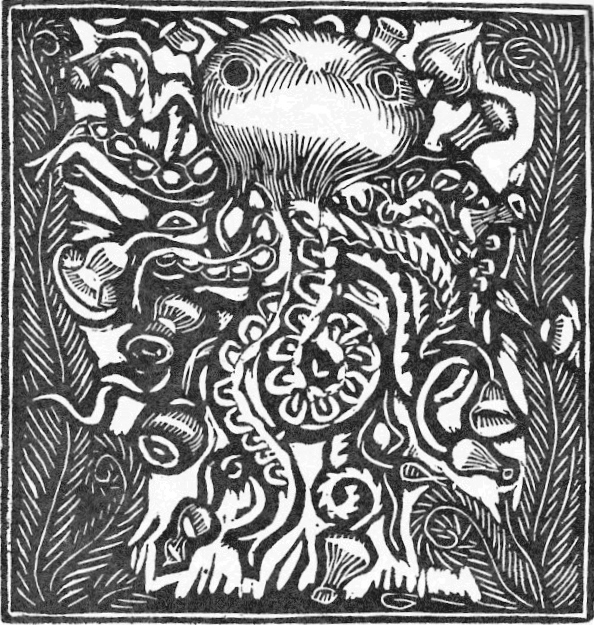

Devilfish (Le Poulpe)

Squirting his ink to the sky,
Sucking his lovers’ blood,
Finding the taste of it good,
This inhuman monster is I.

Well, that’s not all that fluffy.

The poem is by Guillaume Apollinaire, and translated by X. J. Kennedy.  The woodcut is by Raoul Dufy.  They can be found side by side, along with the French poem, in The Bestiary, or Procession of Orpheus (John Hopkins University Press, 2011).  It is Apollinaire’s first book of poems, originally published in 1909, just thirty little poems, one woodcut per poem, and it is not particularly innovative or odd.

I had read a couple of the poems in an Apollinaire anthology, and they slipped past me.  They make sense as a book.  In three poems, Orpheus introduces animals by group – mammals, then insects, then fish, then birds, roughly.  The ox is a bird.  Look, the classifications have some problems.  Some of the poems have some allegorical significance (see above), some are merely clever.

Maybe I can find one fluffier than that devilfish.


Cat (Le chat)

I hope I may have in my house
A sensible right-minded spouse,
A cat stepping over the books,
Loyal friends always about
Whom I couldn’t live without.

That’s nice.  Honestly, though, Raoul Dufy steals the show (click for more Dufy, courtesy of The Blue Lantern).  My favorite is this Art Nouveau peacock.


Peacock

When opening his fanlike tail
This bird whose plumes behind him trail
Looks lovelier than when it’s shut,
But he reveals his naked butt.

That really is pretty much how the French goes (“Mais se découvre le derrière”).

Ask your library to buy this book for you.  Don’t buy it yourself – it’s, like, $45 for a comic book.  Nuts.  While you’re at it, ask for X. J. Kennedy’s little book of selected poems, too, The Lords of Misrule (2002), which includes “The Ballad of Fenimore Woolson and Henry James” and is generally excellent, even better than Apollinaire’s Bestiary, although not half as cute.


Thursday, January 20, 2011

Oh the autumn the autumn has been the death of summer - an Apollinaire poem

Autumn, Guillaume Apollinaire, from Alcools (1913)

A bow-legged peasant and his ox receding
Through the mist slowly through the mists of autumn
Which hides the shabby and sordid villages

And out there as he goes the peasant is singing
A song of love and infidelity
About a ring and a heart which someone is breaking

Oh the autumn the autumn has been the death of summer
In the mist there are two gray shapes receding

Another W. S. Merwin translation, p. 130 of Selected Translations 1948-1968.  I also just finished Roger Shattuck’s book, Selected Writings of Guillaume Apollinaire (1948), which does not include this poem but is full of other original and amazing things.

Does this Apollonaire poem seem particularly original?  Observed scene followed by small revelation about the poet – that’s an old form.  How many T’ang Dynasty poets wrote how many variations of this form?  The French poem looks even more conventional, by which I mean, it rhymes:

Dans le brouillard s'en vont un paysan cagneux
Et son bœuf lentement dans le brouillard d'automne
Qui cache les hameaux pauvres et vergogneux

Et s'en allant là-bas le paysan chantonne
Une chanson d'amour et d'infidélité
Qui parle d'une bague et d'un cœur que l'on brise

Oh ! l'automne l'automne a fait mourir l'été
Dans le brouillard s'en vont deux silhouettes grises

Merwin only hints (-ing, -ing, -ing) at the French rhyme scheme (ABA BCD CD).  The sounds of the rhymes are wonderful, and it’s a shame to lose them.  The switch from the dark, round (-eux, -onne) to the bright, sharp (-é, -ise) vowels is pleasing.

Shattuck helpfully informs me that Apollinaire’s rhymes violate all sorts of rules of classical French prosody, which is a nightmarish tangle that I don’t pretend to understand.  He also identifies Apollinaire’s expungement of punctuation marks, even at the occasional expense of sense.

Apollinaire repeats “Dans le brouillard” in the first and last lines.  Merwin repeats “receding.”  He can’t repeat “brouillard / mist” because, curiously, he has rearranged the first two lines to emphasize the repetition – “Through the mist slowly through the mist of autumn.”  Odd.  But he is then able to keep the ox and the peasant together in the first line, more closely resembling the two silhouettes grises at the end.

I’m fussing around, ignoring what I really like.  Two things, the obvious ones.  First, the peasant’s song, which the reader can never quite hear, but which now has a tune, almost, and all because of the single concrete object, the ring.  That one small addition turns a generic song into the suggestion of a specific one.

And second, of course:  “Oh the autumn the autumn” etc.  Poor mournful poet.  What happened last summer?  He’ll never tell.  Or, he has already told all he can.