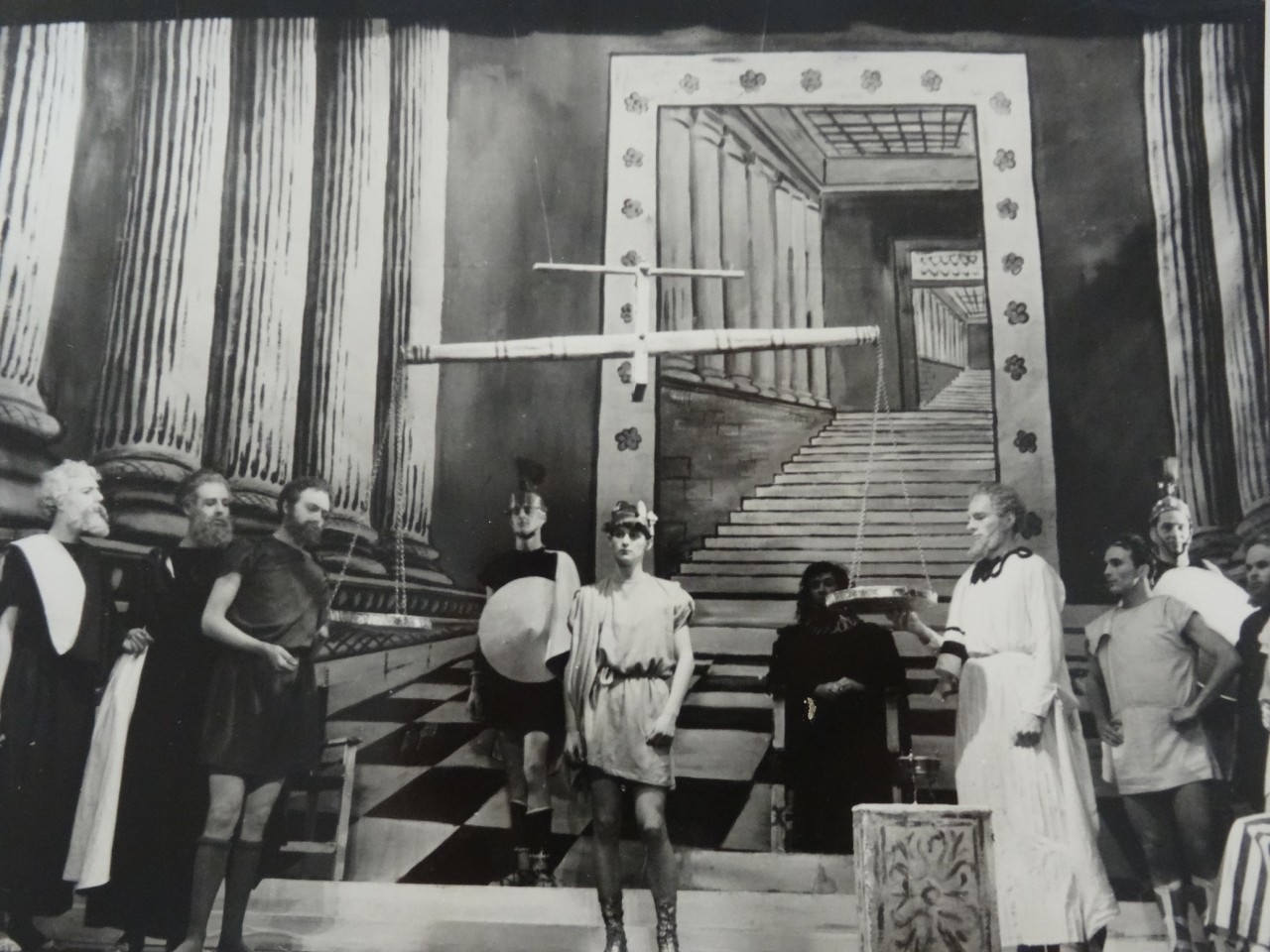
I am quoting the end of Alcestis by Euripides, his early whatever it is, not a tragedy, not a satyr play, not a comedy. Admetos has won back his wife and the play is at its end, so he declares “a feast of thanks and praise” (tr. Arrowsmith), which is what I want to do. If we had done all this in a real-life book group I would take you all out for gyros. But Admetos ends the play with this:
From this day forth we must remake our lives,
And make them better than they were before.
We can only try.
So, first, many thanks to anyone who participated in any
way, on your own, in the comments section, or otherwise. Anyone who wanders around in the comments of
my posts will find some superb responses and insights; anyone who follows the
links to posts people wrote will find the same.
Intellectually, this exercise was very good for me. I hope for you, too. Endless thanks to everyone.
I had read all of the plays, except Menander’s Dyskolos,
about 25 years ago, and had reread a few since then. Antigone I knew from much earlier,
from Western Civ in college. The core stories
and myths and characters I knew from childhood, and they are as familiar to me
as another set of stories and characters I was absorbing at the same time, “Bible
stories.”
What did I learn this time?
First, there was my epistemological crisis, visible in my
earlier posts before I got over it. The
evidentiary base for what we know about classical Greek plays was much weaker
than I had previously understood. For
example, we all know that each playwright directed three tragic plays and a
satyr play, like the Cyclops of Euripides, full of booze and
nonsense. But Alcestis was
presented in the “satyr” spot, and thus the evidence is actually half satyr and
half not-satyr. What was the real
ratio? How often did writers use the
satyr spot for something more unusual and innovative? Alcestis is unique among the surviving
plays, but what does that tell us.
So, second, this time I understood how we were reading these
extraordinary plays in a massive void of lost plays. Nine tragedies a year, plus
three satyr plays, and an indeterminate number of comedies (four to six?) every
year, and we have almost none of them, even by the most famous
playwrights. For the first twenty-eight
years of Sophocles’s extraordinarily long career, we have Ajax. He did not necessarily submit plays every
year, but we could easily be missing eighty or ninety early Sophocles plays,
pre-Antigone. How I would like to
get to know young Sophocles.
The remarkable thing, and I think everyone saw this, was how
easy it was, after a couple of plays, to get a sense of the personality and
sensibility of the author: rough, mythic Aeschylus; methodical, pious
Sophocles, the perfect candidate to invent the detective story; turbulent, to
use William Arrowsmith’s favorite word, Euripides. With Euripides, we are lucky to have enough
plays to even see his progression, to watch him become angrier with Athenian
wartime politics until he becomes disgusted with the entire Athenian, or
possibly human, experiment, culminating in his astounding late works of
pessimism like Orestes and Bacchae.
But this is all a construction, the reader inferring the
author from the available evidence, when most of the evidence is missing. Who knows what Aeschylus or Sophocles would
look like if we had seven more plays. It
is hard to believe that there are too many more masterpieces at the level of Agamemnon
or Oedipus the King among the lost plays.
Given how much we have lost, the twenty-seven year or so
stretch between the Medea of Euripides (431 BCE) and Oedipus at
Colonus by Sophocles (say 404 BCE) where we have a play, sometimes two,
almost every year, takes on enormous meaning, especially when these plays are
contemporary with the Athenian history described in detail by Thucydides. The narrative is very strong. Honestly, this is why I got so excited by
reading the plays in chronological order, which I had not done before. Just watching the hilarious one-sided duel between
Aristophanes and Euripides.
Then, in a coda, Menander and the New Comedy come along,
thinner but less alien, leading to Roman comedy, Shakespearean comedy, and television
comedy.
Favorite (or favourite, I don't care) classical Greek playwright. Menander and Agathon fans will have to leave a comment.
— Amateur Reader (Tom) (@AmateurReader) November 25, 2022
Sophocles won
solidly. My favorite, easily, is Euripides,
the huge screwball, the messy one. What
innovators they all were.
Prmoetheus chained to the rock, Cassandra declaiming her own
death, Oedipus learning the truth, Antigone arguing ethics with her uncle, the
entrance of the chorus of the birds, Dionysus outsinging the chorus of the
frogs, Medea murdering her children, Orestes burning it all to the ground,
Dionysus dressing up Pentheus. What
things we saw. The chorus in Agamemnon
claims that Zeus “las it down as law / that we must suffer, suffer into truth”
(tr. Fagles), but I feel we found a great deal of truth without much suffering,
which is how great literature usually works.
I am thinking of writing a longer essay on our experience this
year, and sending it – who knows – somewhere – so if you have any ideas you do
not mind me stealing, please let me know.
Another debt. My deepest thanks,
as it is.