Showing posts with label SOPHOCLES. Show all posts

Thursday, December 1, 2022

Thanks and praise to celebrate the happiness of this great event – the end of the Greek play readalong

I am quoting the end of Alcestis by Euripides, his early whatever it is, not a tragedy, not a satyr play, not a comedy.  Admetos has won back his wife and the play is at its end, so he declares “a feast of thanks and praise” (tr. Arrowsmith), which is what I want to do.  If we had done all this in a real-life book group I would take you all out for gyros.  But Admetos ends the play with this:

From this day forth we must remake our lives,

And make them better than they were before.

We can only try.

So, first, many thanks to anyone who participated in any way, on your own, in the comments section, or otherwise.  Anyone who wanders around in the comments of my posts will find some superb responses and insights; anyone who follows the links to posts people wrote will find the same.  Intellectually, this exercise was very good for me.  I hope for you, too.  Endless thanks to everyone.

I had read all of the plays, except Menander’s Dyskolos, about 25 years ago, and had reread a few since then.  Antigone I knew from much earlier, from Western Civ in college.  The core stories and myths and characters I knew from childhood, and they are as familiar to me as another set of stories and characters I was absorbing at the same time, “Bible stories.”

What did I learn this time?

First, there was my epistemological crisis, visible in my earlier posts before I got over it.  The evidentiary base for what we know about classical Greek plays was much weaker than I had previously understood.  For example, we all know that each playwright directed three tragic plays and a satyr play, like the Cyclops of Euripides, full of booze and nonsense.  But Alcestis was presented in the “satyr” spot, and thus the evidence is actually half satyr and half not-satyr.  What was the real ratio?  How often did writers use the satyr spot for something more unusual and innovative?  Alcestis is unique among the surviving plays, but what does that tell us.

So, second, this time I understood how we were reading these extraordinary plays in a massive void of lost plays. Nine tragedies a year, plus three satyr plays, and an indeterminate number of comedies (four to six?) every year, and we have almost none of them, even by the most famous playwrights.  For the first twenty-eight years of Sophocles’s extraordinarily long career, we have Ajax.  He did not necessarily submit plays every year, but we could easily be missing eighty or ninety early Sophocles plays, pre-Antigone.  How I would like to get to know young Sophocles.

The remarkable thing, and I think everyone saw this, was how easy it was, after a couple of plays, to get a sense of the personality and sensibility of the author: rough, mythic Aeschylus; methodical, pious Sophocles, the perfect candidate to invent the detective story; turbulent, to use William Arrowsmith’s favorite word, Euripides.  With Euripides, we are lucky to have enough plays to even see his progression, to watch him become angrier with Athenian wartime politics until he becomes disgusted with the entire Athenian, or possibly human, experiment, culminating in his astounding late works of pessimism like Orestes and Bacchae.

But this is all a construction, the reader inferring the author from the available evidence, when most of the evidence is missing.  Who knows what Aeschylus or Sophocles would look like if we had seven more plays.  It is hard to believe that there are too many more masterpieces at the level of Agamemnon or Oedipus the King among the lost plays.

Given how much we have lost, the twenty-seven year or so stretch between the Medea of Euripides (431 BCE) and Oedipus at Colonus by Sophocles (say 404 BCE) where we have a play, sometimes two, almost every year, takes on enormous meaning, especially when these plays are contemporary with the Athenian history described in detail by Thucydides.  The narrative is very strong.  Honestly, this is why I got so excited by reading the plays in chronological order, which I had not done before.  Just watching the hilarious one-sided duel between Aristophanes and Euripides.

Then, in a coda, Menander and the New Comedy come along, thinner but less alien, leading to Roman comedy, Shakespearean comedy, and television comedy.

Prmoetheus chained to the rock, Cassandra declaiming her own death, Oedipus learning the truth, Antigone arguing ethics with her uncle, the entrance of the chorus of the birds, Dionysus outsinging the chorus of the frogs, Medea murdering her children, Orestes burning it all to the ground, Dionysus dressing up Pentheus.  What things we saw.  The chorus in Agamemnon claims that Zeus “las it down as law / that we must suffer, suffer into truth” (tr. Fagles), but I feel we found a great deal of truth without much suffering, which is how great literature usually works.

I am thinking of writing a longer essay on our experience this year, and sending it – who knows – somewhere – so if you have any ideas you do not mind me stealing, please let me know.  Another debt.  My deepest thanks, as it is.

Friday, October 28, 2022

Oedipus at Colonus by Sophocles - indeed his end / Was wonderful if ever mortal’s was

Oedipus at Colonus by Sophocles is one of the plays that got me excited about the entire project of reading or re-reading the complete plays.  The last surviving tragedy, even if it hardly recognizable as a tragedy, it provides a coherent ending to the tragic tradition.  It is perhaps a play of reconciliation.

Old, blind Oedipus, led in his wanderings by his daughter Antigone (this play precedes the events in Antigone), find himself in the grove of the Furies, just outside of Athens.  How often have the plays featured an altar as the center of the action?  We have a slightly different holy place this time.  Oedipus realizes that this is the destined place of his death and apotheosis.  The Thebans want him back, though, for vague oracle-related reasons. 


The cursed Oedipus, near his end, is curiously transformed into a holy object.  That is what I mean by “reconciliation.”  A happy ending for Oedipus, of all people, given that to the Greeks it is as important to die well as to live well.

MESSENGER:            But in what manner

Oedipus perished, no one of mortal men

Could tell but Theseus… 

For he was taken without lamentation,

Illness or suffering; indeed his end

Was wonderful if ever mortal’s was.  (150, tr. Robert Fitzgerald, in the Sophocles I University of Chicago edition)

The religious rituals preceding leading to the death of Oedipus are described in some detail; Sophocles believed in them.  The transformation of Oedipus into a cult figure, a mystery, is the sublime core of the play, as much as it was in The Eumenides of Aeschylus, which is an origin story: how Athens (old Sophocles, unlike Euripides, still believes in Athens) becomes the home of the Furies.  The Furies in another aspect are The Kindly Ones, welcoming Oedipus into their holy site and ending his wandering.

As is often the case with ancient Greek religion, I find all this alien but also moving.


Elsewhere in the play, for example the conflict between the sons of Oedipus, which we saw performed in Seven Against Thebes and The Women of Trachis, reconciliation is refused.  Perhaps Antigone, in this version, succeeds in her mission of peace, although I doubt it.

Oedipus at Colonus features many extraordinary poetic passages, often voiced by the Chorus, like this surprising eruption of flowers in the grove of the Furies:

Here with drops of heaven’s dews

At daybreak all the year,

The clusters of narcissus bloom,

Time-hallowed garlands for the brows

Of those great ladies whom we fear.

The crocus like a little sun

Blooms with its yellow ray… (111)

The song climaxes in a very Athenian paean to the olive tree, “The blessed tree that never dies!”

Oedipus is given an interesting speech about entropy:

OEDIPUS:              The immortal

Gods alone have neither age nor death!

All other things almighty Time disquiets.

Earth wastes away; the body wastes away;

Faith dies; distrust is born.  (107)

Oedipus at Colonus was produced posthumously, in 404 BCE or perhaps 401 BCE.  I prefer the earlier date for its horrible irony, since 404 was when Athens was conquered.  Many things ended in 404, including the Peloponnesian War and Athenian democracy, so it seems fitting that Greek tragedy ended, too, although of course it did not.  The annual Dionysia continued with new plays, all lost to us, and my understanding is that it was in the 4th century BCE that the old plays began to be produced frequently, spreading to theaters throughout the Greek-speaking world and eventually to us.

I borrowed a pair of 18th century prints from the Metropolitan Museum of Art.  “Oedipus before the Temple of the Furies between his Daughters Antigone and Ismene” is by Anton Raphael Mengs and “Oedipus at Colonus, Cursing his Son Polynices” is by Henry Fuseli.

Next week – wait, aren’t we done?  We now skip ten or twelve years and things have changed.  Comedy has changed, enough that the last two surviving Aristophanes plays are sometimes called “Middle Comedy,” transitioning from the Old Comedy we have been reading to the immensely popular and influential New Comedy of Menander.  Let’s read The Assemblywomen (392 BCE) and see if we can spot the difference.  It is, as is obvious from the title, a companion of Lysistrata and The Poet and the Women.  How different can it be?  It also features the Longest Word in Greek – possibly the longest word in literature – so don’t miss that.

Friday, September 23, 2022

Philoctetes by Sophocles - Let me suffer what I must suffer

Philoctetes by Sophocles (409 BCE), performed when the author was 87, which is perhaps why he is in a mood of reconciliation and healing. 


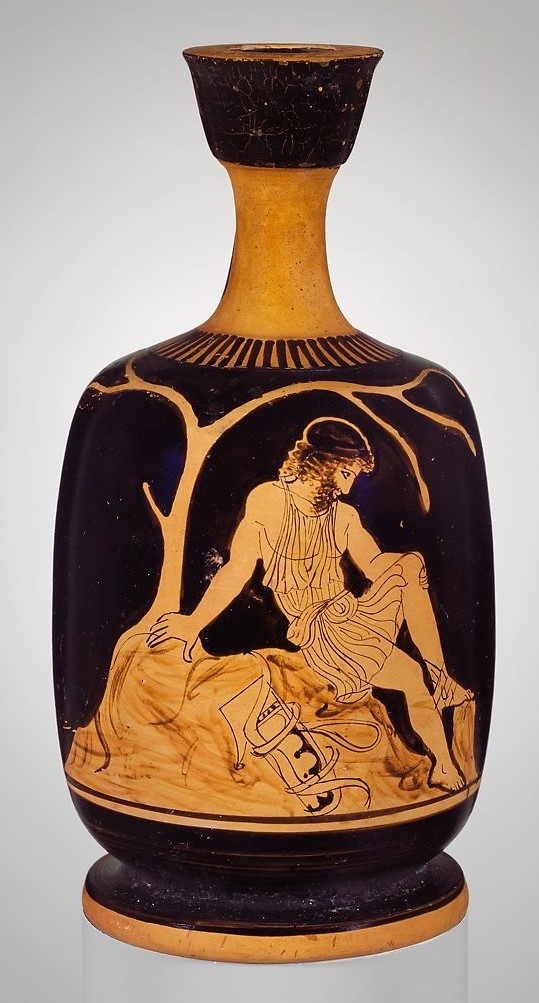
Literal healing.  Philoctetes possesses the bow of Hercules.  Either the bow, or Philoctetes himself, or both – prophecies are ambiguous – are necessary parts of the conquest of Troy by the Greeks.  But Philoctetes has spent the war abandoned on an island nursing his poisoned foot, injured when he was bit by a snake in a sacred grove.  You can see his bandaged foot on the far right in the beautiful painting of Philoctetes, contemporary with the play, on an oil flask on display at the Metropolitan Museum of Art.

The injury is so severe – so disgusting, so bad-smelling – that Philoctetes’s fellow soldiers abandoned him on the island.  But now there is a new prophecy, and they need him back, even if by treachery or force.  I was not surprised to learn that in the 21st century the play has been performed for American soldiers injured in Iraq and Afghanistan.  The relevance is direct.  The wound and its effects are described in detail with the greatest seriousness.  Neoptolemus has just taken Philoctetes’s hand when an attack of pain comes:

PHILOCTETES: Now – take me away from here –

NEOPTOLEMUS:                                           What do you mean?

PHILOCTETES:                                                                                Up, up.

NEOPTOLEMUS: What madness is upon you? Why do you look

    on the sky above us?

PHILOCTETES:             Let me go, let me go.

NEOPTOLEMUS:  Where?

PHILOCTETES:               Oh, let me go.

NEOPTOLEMUS:                                Not I.

PHILOCTETES:  You will kill me if you touch me.

NEOPTOLEMUS:  Now I shall let you go, now you are calmer.

PHILOCTETES:  Earth, take my body, dying as I am.

                           The pain no longer lets me stand.  (p. 227, tr. David Grene)

There had been other plays on the story of Philoctetes, by Aeschylus and Euripides, among others.  I’ll bet they did not include a scene so, to use a word that makes me nervous, realistic.  Sophocles himself was an adept in the cult of Asclepius, the great hero-doctor of Greek mythology.

Odysseus tricked Philoctetes onto the island, and now plans to trick him off of it.  His tool is Neoptolemus, the honest, patriotic son of the recently killed Achilles,  So this is a three-character play, Scheming, righteous Odysseus versus bitter, suffering Philoctetes with Neoptolemus in the middle, like the audience full of sympathy for Philoctetes and his suffering.  He makes his decision in the end, and in a way that greatly resembles Existentialism – Philoctetes often feels quite modern – Philoctetes makes his (“Let me suffer what I must suffer,” 251) before the deus drops from the machina, or flies over on the crane, or whatever the stage business is, and ruins the play, or shades it with significant irony, by declaring that villainous Odysseus was right all along, and none of you have any choice, really, which makes Philoctetes and his great refusal of the premise even more of an Existentialist, right?

A wonderful play, far from whatever idea I might have about what a Greek tragedy is supposed to be.  It will be useful to look at Aristotle’s Poetics and see where that “supposed to be” comes from.  Which reminds me, I plan to write about Plato’s Symposium next week, so I had better get reading.

Next we have three Euripides plays in a row, the end of Euripides: Orestes (408) and The Bacchae and Iphigenia in Aulis (both performed, posthumously, in 405).  Euripides, in his old age, was not in a mood of reconciliation and healing.  Great masterpieces, all of them.  Next week, let’s say farewell to Orestes.

Friday, July 1, 2022

Electra by Sophocles - Nothing less than this / can cut the knot of evils / inside me

Peace follows Peace and we find a gap in the plays from approximately 420 to 417 BCE, where otherwise we have close to one surviving play per year from 431 to 404 or so.  Probably coincidence, but given that the next Euripides play saved by the anthologists is an explicitly anti-war play – peace did not last long – I wonder.  Maybe the anthologists were also interested in how Euripides knocked up against Thucydides.

I put the loosely dated Electra of Sophocles in the gap, so it is today’s play.  Maybe it is a little later, or a little earlier.  It’s The Libation Bearers of Aeschylus revisited, the murder of Clytemnestra by Orestes, but with a large shift of emphasis to Electra, the suffering, vengeful daughter.  It is another perfect Sophocles play, balanced in pace and mood, troubling yet moving, built of rhetorical figures and imagery that move it in a single coherent direction.  None of that Euripidean raggedness.  Aristotle will approve.


Electra
is as purely psychological of a play as any we have read so far. “Why are you so in love / with things unbearable?” (56, tr. Anne Carson), as the chorus asks Electra.  Our heroine does almost nothing but exist, and compare her existence to those of others around her.  The limited action of the play, like the detailed chariot race, with a spectacular crash, belongs to other characters.  Is the space given to the chariot race an aspect of the alienness or the universality of ancient Greek culture?

I think I will just shake some of Electra’s, and Anne Carson’s, great lines from my notes:

Never

will I leave off lamenting,

never.  No.  (54)

I ask this one thing:

let me go mad in my own way.  (55)

Kill him at once.

Throw his corpse out

for scavengers to get.

Nothing less than this

can cut the knot of evils

inside me.  (110)

That last one is a good example of what I mean by “purely psychological.”  Is there even a hint that the killing of Clytemnestra and even, at this moment in the play, Aegisthus, is about justice or the will of the gods?  Or about healing Electra’s wounds, perhaps only by creating new ones?

Anne Carson’s translation was a pleasure to read.  Her mix of strange and familiar registers is a strength.  The arguments between, for example, Electra and her mother would not sound too out of place in a contemporary drama, say by a weirdo like Sam Shepherd.  Here is some strange Carson:

Already the sun is hot upon us.

Birds are shaking, the world is awake.

Black stars and night have died away.  (51)

An odd way to say it is morning.  David Grene has:

                                                  Already the sunlight,

brightening, stirs dawning bird song into clearness,

and the black, kindly night of stars is gone.  (127, U of C edition)

So whatever Carson is doing is somewhere in the Greek.  She just shades everything a little weirder.

For an illustration, I chose a 6th century (BCE) relief of the murder of Clytemnestra, owned by the Getty, in which only Electra’s feet are still visible, on the left.  But she’s there.

Our next play will be a shocking contrast to Electra.  It is the Heracles of Euripides, c. 416, maybe; it is utterly anti-Aristotelian, as if written, decades before Poetics, as a rebuttal, not a Euripidean mess but an example of a competing aesthetic.  It also contains some things that are almost too painful to read.  Poor Heracles.  Poor everybody.

Friday, June 10, 2022

The Women of Trachis by Sophocles - the death of Herakles - And I thought that then I would be happy.

Sophocles’s The Women of Trachis is usually dated to the early 420s, so in the same period as the string of Aristophanes and Euripides plays we have been reading.  I put it at this point in the schedule because I thought we might want a break from those two high-energy, high-concept playwrights.  A good idea!  Compared to frenetic Aristophanes and hysterical – or “turbulent,” to use William Arrowsmith’s term – Euripides, The Women of Trachis is so calm, so logical, even though the events of the play are horrible enough.


The extremely busy Greek vase, owned by the Met, shows the apotheosis of Herakles, the moment when he is transformed by death from human to god.  He is already in the chariot, above his funeral pyre.  Curiously, Sophocles ignores the apotheosis.  He is writing about the death of a human, not the birth of a god.  As the son of Herakles says, at the end of the play:

No one can foresee what is to come.

What is here now is pitiful for us

and shameful for the Gods;

but of all men it is hardest for him

who is the victim of this disaster.  (119, tr. Michael Jameson)

I suppose I am dwelling on this, rather than, for example, the jealousy of Deianira, because the aspect of the play that most impresses me is the depiction of the suffering of the hero, practically the only element that qualifies as “action” on the stage, and even it is static, as his flesh and life are slowly burned away by the poison of an old enemy.  Entering late in the play, we only see the hero in the act of dying.  I wonder if there is a risk of his long death scene becoming ridiculous.

Come then, O my tough soul,

before this sickness is stirred again,

set a steel bit in my mouth

hold back the shriek, and make an end

of this unwanted, welcome task.  (118)

I find his pain believable enough.  And of course his death is also, by definition, the final labor of Hercules.  He was promised rest after finishing them, and he will get it:

And I thought that then I would be happy.

But it only meant that I would die then.  (114)

Was it odd to return, after those action-packed Aristophanes plays, to one where everything happens offstage, and many of the characters are messengers describing some earlier action?  I had to make a mental adjustment.

In four weeks, we will look at the Herakles of Euripides, a quite different creature.  Thank goodness the action is offstage in that one.  We will see Herakles again in Sophocles, too, in Philoctetes, but as a god.

Next week we are back to Aristophanes, The Wasps (422 BCE), a satire of courts and juries and that demagogic bastard Cleon, how we hate him.

Friday, April 22, 2022

Oedipus the King by Sophocles - Aren't you the great solver of riddles? Aren't you Oedipus?

Sophocles, Oedipus the King, performed c. 426.  A perfect work of art, although hardly the perfect play.  We have read enough to see that form of Greek tragedy had room for many things.  It is hard to separate Oedipus the King from its reception, from Aristotle and Freud, except by reading it, or presumably seeing it, and enjoying the amazing thing itself.

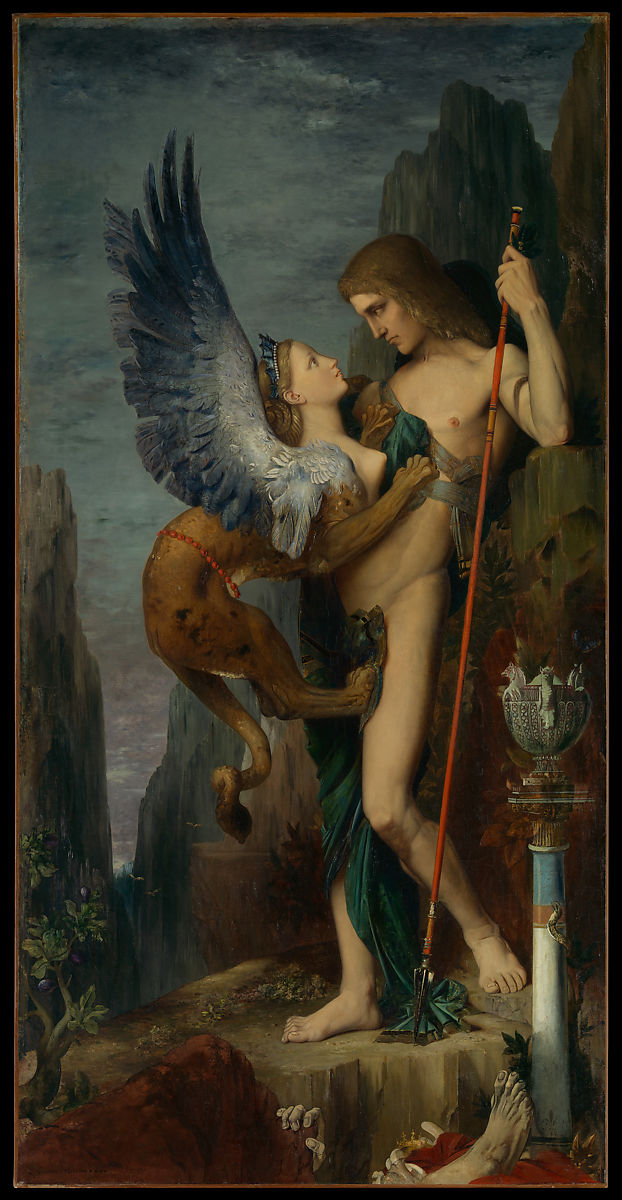
All of my quotations will be form the Stephen Berg and Diskin Clay translation, another of those Oxford editions matching a classicist and a poet.  Off to the side I put another famous response to the Oedipus story, Gustave Moreau’s 1864 Oedipus and the Sphinx (hanging at the Met), backstory for the Sophocles play.  Happier times, when sexy Oedipus was making out with the sexy Sphinx.  Or whatever is going on there.  Dig that creepy ravine full of corpses.

Oedipus was the great Greek monster-killing hero who won not through feats of strength or the seduction of helpful women – we’ve seen all of that lately – but through his intelligence, so he is a good choice for the invention of the detective novel by Sophocles.  The Delphi oracle tells King Oedipus that the plague tormenting Thebes will only subside when the murder of the previous king, Laios, is solved.  And Oedipus is just the man to solve a cold case:

Now I am here.

I will begin the search again, I

will reveal the truth, expose everything, let it all be seen.  (29)

And although Oedipus turns out not to be such a good detective, he does solve the case.

The perfection of the play, what makes it an exemplar, is its use – its embodiment – of dramatic irony, brilliant at every level from the plot, well known to every Greek, down to the individual lines, often written as if to make the audience wince, or howl.  Just a few lines below the detective manifesto above:

The man who killed Laios might take revenge on me

just as violently.

And Oedipus is right, the killer of Laios takes a terrible revenge on Oedipus.  One theme is about knowledge and truth.  In the first few lines, before he knows about the oracle, Oedipus says:

I am king, I had to come.  As king,

I had to know.  Know for myself, know for me.  (23)

The knowledge theme is linked to another complex system of imagery full of light and sun and sight:

KREON: Once everything is clear, exposed to the light,

we will see our suffering is blessing.  All we need is luck.  (27)

But as the clues appear (DETECTIVE OEDIPUS: “One small clue might lead to other,” 28), characters begin to doubt the light, to doubt the oracles of Apollo the sun god.  The chorus begins to get freaked out:

nobody prays to the god of light no one believes

nothing of the gods stays (63)

A theme of darkness intrudes, as when Jocasta, wife and mother of Oedipus, reassures Oedipus:

Why should men be afraid of anything?  Fortune rules our lives.

Luck is everything.  Things happen.  The future is darkness.  (66)

Another line where the audience softly, or for all I know loudly, moans in horror.  The blinding is still ten pages away in my edition.  The fact that both Kreon and Jocasta invoke luck, which Oedipus, convinced of his autonomy, rejects, suggests one line towards interpreting his terrible fate.  Jocasta turns against knowledge, too, by the end of the play.  What good did it do her?

The last time I read Oedipus the King, it was Oedipe roi, translated by Didier Lamaison, the text included as a supplement to his ingenious 1994 conversion of the play into an actual detective novel (also titled Oedipe roi), published in a line of detective novels, shelved with the mysteries in the bookstore where I bought it.  Sadly this novel is not yet in English.  It’s good.

The title quotation is from the great fight between Oedipus and Teiresias early in the play, p. 43.

The next play is Andromache by Euripides.  We have enough Euripides plays that we can observe, or invent, artistic phases, and I remember Andromache, Hecuba, and The Suppliants, all performed within three years, feeling like they belonged together.  We will see.

Friday, February 11, 2022

Ajax by Sophocles - Shall I not learn place and wisdom?

We have reached our first Sophocles play, Ajax, generally thought to be “early.”  Putting it before Aeschylus’s Oresteia (458 BCE) gives me the first eighteen years of Sophocles’s long career, which should be enough.  Aside from Ajax, we are missing the first thirty-two years of Sophocles.

Things have changed.  Now there are clearly three actors, outside of the chorus, with speaking parts, while the early Aeschylus plays (probably) always used just two speaking actors.  I have been struck by the number of non-speaking parts, like the grieving Tecmessa at the end of Ajax, who only contributes to the tableau because the three actors are used for other parts.  Aristotle says that the third actor is an innovation of Sophocles.  Here it is.

The skene, the structure in the middle of the stage, is definitely there now, too.  It may have been present in the Aeschylus plays we have read, but now there is no ambiguity.  There is a structure, it has doors, actors can appear on top of it, it may well support wheeled platforms.  The sophistication or gimmickry of the stage business has moved up a notch.

I would love to have a better idea of what the Greek audience saw.  Ajax, the hero described by Homer as “gigantic,” the shield of the Greek army, a warrior second only to Achilles, has gone mad as a result of losing the armor of dead Achilles to Odysseus.  Thinking that he is taking revenge on his enemies – meaning, his Greek allies, which is crazy to begin with – he instead, in a frenzy, slaughters and tortures a herd of livestock.  The play is about the perfect soldier coming to terms with his madness and shame.  With minor changes, the play could be about a good soldier who snaps under stress.  Perhaps with no changes.

Ajax first appears, near the beginning of the play, surrounded by mutilated animals, covered with their blood.  With what detail, I wonder; how much blood?  The moment of his appearance is built up to be shocking.  The audience is warned, but here he is:

AJAX: Look at this swirling tide of grief

    And the storm of blood behind it,

    Coursing around and round me.

CHORUS:  Horrible!  (20)

But how horrible?  I have no idea.

Ajax’s madness is complicated by the fact that Athena directly intervenes in events, perhaps as punishment for Ajax’s impiety and arrogance, or what I would call his individualism and humanism.  He is fool enough to think humans govern their own affairs, or at least he governs his own.

AJAX:                Don’t you know by now

    That I owe the gods no service any more?  (29)

This way well count as a “tragic flaw.”  Madness is a central epistemological issue.  However hardheaded an empiricist I might be, I know that there are people who experience reality in different ways than I do.  However “real” reality seems, there is always, logically, doubt.  Attributing this doubt to the actions of gods is perhaps just a question of definition. I love the odd detail – Sophocles is full of such touches – that the rational, pious Odysseus, who frequently speaks with his protector Athena, can never see her, while the cursed, visionary Ajax can.

Ajax has a magnificent speech in the exact center of the play that is a monument of literary irony.  The hero is planning his suicide, but telling his family and followers the opposite.

Strangely the long and countless drift of time

Brings all things forth from darkness into light

That covers them once more. Nothing so marvelous

That man can say it surely will not be –

Strong oath and iron intent come crashing down. (31-2)

What a beginning.  Every line has two meanings.

I must give way, as all dread strengths give way…

Shall not I learn place and wisdom? (32)

In death, Ajax means, but his audience hears something else.  And when he leaves, the chorus of the sailors who follow him “shudder and thrill with joy” (32).  That won’t last.


The story of the death of Ajax was for a time a popular subject for vase painting.  I’ve borrowed a remarkable example from the Getty, a shallow wine cup, which shows Tecmessa covering Ajax’s body in the bowl.  The sides of the cup show two other scenes from the story, including the voting for the armor of Achilles that launches the tragedy.  Another irony is that armor ends up at the bottom of the Mediterranean.  Nobody gets it.  All a waste, like the entire Trojan War.

I’ve stuck to the John Moore translation (University of Chicago Press), but I also read the Helen Golder and Richard Pevear version (Oxford) which was punchier and had better annotation.

Next we return to Aeschylus for Agamemnon, the beginning of the Oresteia.  If you haven’t read it, don’t miss this one.  I have the ubiquitous Robert Fagles translation at hand, but I also plan to read the Ted Hughes version.

Wednesday, December 8, 2021

The ancient Greek plays, in chronological order - a readalong for next year - cry, cry in triumph, carry on the dancing on and on!

Let’s read the ancient Greek plays next year.  All of them.  There are not so many, and they are generally short.

I’ll read them all, one per week, and put up some kind of post on Friday, where anyone can join in.  Of course anyone can do whatever they want, on their own blog or on Twitter or in quiet communion with nature.  Below, we can see my schedule, but everyone is welcome to dip in as they like.

I have no Greek and no expertise, except that I read through the plays over twenty years ago, and have read several on occasion since.  They are, overall, fundamental texts in my understanding of literature, not just theater.  They are also full of great characters, exciting stories, extraordinary language (even in translation), and conceptual innovations of the greatest importance.

We are lucky to have seven surviving plays by Aeschylus, seven by Sophocles, nineteen by Euripides (one of which is perhaps by someone else), eleven by Aristophanes, and one by Menander, with one more close enough to complete that I am including it.  Forty-six plays in forty-six weeks.

I have made an educational and perhaps foolish attempt to put the plays in chronological order, relying mostly on the Penguin and University of Chicago editions.  My chronology is likely full of errors – please correct – and anyways should be often taken as guesswork.  But once we get into the 420s the mix gets pretty interesting.  405 is a landmark in literature.  All years are BCE.

A

Aeschylus (524-456)

S

Sophocles (496-405)

E

Euripides (480-406)

Ar

Aristophanes (446-386)

M

Menander (341-290)


472

A

The Persians


470


first Sophocles play

467

A

Seven Against Thebes


463

A

The Suppliants


???

A

Prometheus Bound


Early?

S

Ajax


458

A

Agamemnon


A

The Libation Bearers


A

Eumenides


441

S

Antigone


Before 440?

"E"

Rhesus


438

E

Alcestis

Death of Pindar

431

E

The Medea


430


Death of Herodotus

c. 429

E

The Heracleidae


428

E

Hippolytus


c. 426

S

Oedipus Rex


c. 425

E

Andromache


425

Ar

The Acharnians


c. 424

E

Hecuba


424

Ar

The Knights


c. 423

E

The Suppliants


423

Ar

The Clouds


c. 420s

S

The Women of Trachis


422

Ar

The Wasps


421

Ar

Peace


Late - 420-414

S

Elektra


c. 416

E

Herakles


c. 415

E

The Trojan Women


c. 414

E

Iphigenia in Tauris


414

Ar

The Birds


c. 413

E

Ion


c. 413

E

Electra


412

E

Helen


411

Ar

Lysistrata


411

Ar

The Poet and the Women


c. 410

E

The Phoenician Women


Late ?

E

The Cyclops


409

S

Philoctetes


408

E

Orestes


405

E

The Bacchae

 Death of Sophocles


E

Iphigenia in Aulis


Ar

The Frogs


404

S

Oedipus at Colonus


400


Death of Thucydides

399


Death of Socrates

392

Ar

The Assemblywomen


388

Ar

Wealth


347


Death of Plato

323


Death of Alexander

322


Death of Aristotle

316

M

Dyskolos


c. 315

M

The Girl from Samos


Just putting the list together got me excited to read the plays along with whoever is interested.  Perhaps half of them are among the greatest works in literature.  But we can chat about that later.


As for translations, I have no advice.  The University of Chicago series has been a standard for a long time.  The Oxford series with the black covers always seemed excellent, and have more notes.  Every Penguin Classics I have tired has been good.  Any of these will have adequate notes for most people.  I am curious about some of the “celebrity” versions – Seamus Heaney’s Antigone, or Wole Soyinka’s Antigone, for example.  H.D.’s Ion is a good one.  But all of that can wait, too.

I plan to start in January, with the first post on The Persians up on January 14.

The title of the post uses the last line of The Eumenides as per Robert Fagles.