Showing posts with label KIPLING Rudyard. Show all posts

Sunday, June 25, 2017

so long as we do not interfere with the traffic - Kipling rides "With the Night Mail"

The real masterpiece of Actions and Reactions, I thought, was “With the Night Mail,” a science fiction story about a mail run from London to Quebec in a lighter-than-air craft powered by a magic ray.  The narrator is a journalist along for the ride; the text is his article, written, apparently, for some kind of aircraft trade journal.  Commenter Katy yesterday called the story “steampunk as written by John McPhee,” which is just right.  We learn everything we wanted to know about oranges or Wyoming geology or futuristic aircraft – more than we want, honestly – as told by the men who grow oranges or geologize in Wyoming or operate those dirigibles.  Unlike the diligent McPhee, Kipling just makes it all up.

The eye detects no joint in her skin plating save the sweeping hair-crack of the bow-rudder – Magniac's rudder that assured us the dominion of the unstable air and left its inventor penniless and half-blind.  It is calculated to Castelli's "gull-wing" curve.  Raise a few feet of that all but invisible plate three-eighths of an inch and she will yaw five miles to port or starboard ere she is under control again.

Etc., etc., sure, why not.  Kipling approaches the unreadable.  This is his feat of technical heroism akin to the great pilots and engineers about whom he writes.  Just as they approach disaster during storms and so on, Kipling approaches pure gibberish.  The art is two-fold, at least; first, continuous touches like that bit about the fate of the inventor – imagery, character moments, little ingenuities.  Little handholds to delight the baffled reader. Then second, his total commitment to his concept, to the fantasy world he has created, a commitment rare, in my experience, among science fiction writers, who are seldom quite so unfriendly to their poor readers.

This commitment is clearest once the future story has ended but the actual story continues with a series of announcements, advertisements, a book review, and an advice column.  Although the spirit is comic, none of the extra material is exactly meant to be a joke.  It is all part of the commitment, part of Kipling’s unwillingness to leave the world he has invented.  He is like Tolkien working up Elvish.

Is this meant to be a joke?  (I am back in the “article,” the main text):

She is responsible only to the Aërial Board of Control – the A. B. C. of which Tim speaks so flippantly.  But that semi-elected, semi-nominated body of a few score persons of both sexes, controls this planet.  “Transportation is Civilization,” our motto runs.  Theoretically, we do what we please so long as we do not interfere with the traffic and all it implies.  Practically, the A. B. C. confirms or annuls all international arrangements and, to judge from its last report, finds our tolerant, humorous, lazy little planet only too ready to shift the whole burden of private administration on its shoulders.

“With the Night Mail” is not just science fiction but Utopian fiction, with a rather specialized Utopia appealing to writers who think the engineers should run things.  What looks like a conceptual, idea- driven piece is in fact pure self-expression.  Kipling creates a world in which he would like to live and then lives in it for a bit.  He is – or would become? – sufficiently aware of the dangers of his Utopia that a few years later he would write a sequel upending the whole thing.

One odd feature of the story is the use of mail delivery as the epitome of technocratic heroism, but I have just read Antoine de Saint-Exupéry’s little first novel, Night Flight (1931), which is specifically about the heroism of nighttime mail runs by early aviators, and boy does Saint-Exupéry mean it, so Kipling was not being idiosyncratic but prescient.

Saturday, June 24, 2017

empty, but still magnificent - Kipling's Actions and Reactions

Rudyard Kipling’s Actions and Reactions (1909) is the weakest of his short story collections that I have read, and I think that I just have three more to go.  It is nevertheless fascinating, often most so when it is most wrong-headed.  Complete mastery, ingenious and artful, applied to exasperating material.  This book is the most wrong-headed Kipling I have read; maybe that is what I mean.

The perfect example is “The Mother Hive.”  The second paragraph:

A young bee crawled up the greasy trampled alighting-board.  “Excuse me,” she began, “but it’s my first honey-flight.  Could you kindly tell me if this is my –”

Yes, this story is about and from the point of view of a bee hive.  It is being invaded by parasitic wasps.  The characters are various bees and wasps.  It is an allegory.  A political allegory.  The parasites, who introduce Reforms, are Liberals, the weak-minded bees Tories, or something like that.  The story ends in apocalypse, as a bee-keeper smokes everyone out and destroys the hive.  The natural history, the bee-keeping stuff, is fantastic:

…  two-inch deep honey-magazines, empty, but still magnificent, the whole gummed and glued into twisted scrap-work, awry on the wires; half-cells, beginnings abandoned, or grandiose, weak-walled, composite cells pieced out with rubbish and capped with dirt.

Kipling had recently become interested in bee-keeping.  If anyone has earned the right to animal allegories, it is author of Just-So Stories, but this one makes no sense.  What is the parasitic wax-moth supposed to do?  It is her nature to invade bee hives.  She can do nothing else.  Maybe that is Kipling’s point.

Two stories are not allegories but parables of imperialism, as usual complicating my ideas about Kipling’s ideas without making me any less – I would not normally say appalled, but “Little Foxes” is appalling.  The new English governor of the new English colony of – something near Ethiopia; this is all made up – discovers that his new country has foxes.

The Great River Gihon, well used to the moods of kings, slid between his mile-wide banks toward the sea, while the Governor praised God in a loud and searching cry never before heard by the river.

The poor fox “could not understand the loud cry which the Governor has cried.”  He cannot guess what is about to hit him.  The English proceed to organize the entire country on an English fox-hunting basis.  In many ways it works.  There is an insight here about the value of the rule of law, however arbitrary its basis.  Kipling may well have meant for me to find this story appalling.  I am not sure.  The main plot as such is just one of Kipling’s prank plots, thin stuff.

“A Deal in Cotton” is a narratorial masterpiece, with an Englishman describing a colonial African incident that he does not fully understand, because he was feverish when it happened, and his Indian servant re-telling the story in a way that contains its own elisions, with a let’s call it “true” story emerging out of the combination; it is more or less about competing kinds of imperial rule.  The game here, the skill, is in the omission of information.  No one was better at that game, not even Henry James.

What else.  “Garm – a Hostage” is a perfect dog story, and “The House Surgeon” is a perfect ghost story.  My doubt is if they are anything else, not that they need to be.  I have avoided mentioning the single story that seemed to me like a narrow, frustrating, surprising masterpiece, “With the Night Mail,” a science fantasy that is also perhaps nothing else.  I want to save it for tomorrow.

Technically, Actions and Reactions is almost beyond belief.

Tuesday, February 28, 2017

Kipling's Rewards and Fairies - music, history, dying children and another heroic seal - the broad gentle flood of the main tune

Some easier Kipling, Rewards and Fairies (1910).  It’s a book for children, so I hope it’s easier.

What children, though.  In each story a pair of perfect children, from the Kipling point of view, I mean – “Dan had gone in for building model boats” – encounters a figure from history who tells about his encounter with a more important figure from history.  A local shipbuilder tells about Francis Drake, before he was a Sir.  A young smuggler meets President Washington in one story and General Bonaparte in the next.  The children are already sufficiently educated to follow the stories.  So am I, now, somewhat older.

Although a sequel to Puck of Pook’s Hill (1906) and similar on general principles, the fairy aspect is muted.  Just a little touch of “then they woke up” to wave away pointless questions of actuality.

“The Conversion of St Wilfrid” is about a super-intelligent pet seal.  What kind of seal, I don’t know.  His heroism converts the saint.  This is Kipling’s second story about a heroic seal, the other being “The White Seal” from The Jungle Book.  The other that I know of, I mean.  Maybe there are more.  How many writers have written even one.  The frame of this story is extraordinary, with the medieval saint, the Shakespeare fairy and the Kipling children listening to an old church organ played by a professional organist.

The music had turned soft – full of little sounds that chased each other on wings across the broad gentle flood of the main tune.  

As in the story, the combination of beauty and belief is hard to untangle.

“Marklake Witches” also ends with music.  It is almost too sad to read, with a story-teller who is a vivacious teenager who does not know that she is mortally ill, and an auditor, little Una, who does not know that she is a stand-in for Kipling’s daughter who died of pneumonia.  Everyone else in the story knows that the narrator is doomed; only she and Una never figure it out.  She sings a song about a dying flower and thinks that everyone is so deeply affected by the beauty of her performance.

‘And what did Dr Break do?’

‘He got up and pretended to look out of the window, but I saw his little fat shoulders jerk as if he had the hiccoughs.  That was a triumph.  I never suspected him of sensibility.’

‘Oh, I wish I’d seen!  I wish I’d been you,’ said Una, clasping her hands.

And this is where Puck ends the story, presumably on the verge of tears himself.  Irony is so sad.

The poems Kipling attaches to his so-called adult stories are often oblique, even cryptic, in their connection to the proses text.  The poems in Rewards and Fairies are clear, direct, and often beautiful –  the old lost road in “The Way through the Woods,” or Father Eddi’s Christmas sermon to an ox and an ass in “Eddi’s Service:”

And when the Saxons mocked him,
    Said Eddi of Manhood End,
‘I dare not shut His chapel
    On such as care to attend.’

Kipling is unafraid of sublime effects, but the generosity of Rewards and Fairies tempers the fear.  It’s a children’s book, sort of.

Sunday, February 26, 2017

Oh! / The differential gear! - that huge mass of Kipling poems

Maybe one more day of incomprehension, to finish off the week.  A different kind of bafflement, though.  I completed, in the page-turning sense, the Verses: Definitive Edition (1940) of Rudyard Kipling, the books that was until very recently served as the 800 page collected poems of Kipling.  It is a strange book, and I am not sure how to use it, other than read it.

The only Table of Contents is alphabetical by title.  The poems themselves are organized, I believe by Kipling, in an order that must have meant something to him but confused me.  Departmental Ditties (1885) starts things off, good, first book, lead spot, but the next book, Barrack-Room Ballads (1892) does not appear for over 300 pages.  In between are chronologically wide-ranging selections with some thematic organization – lots of poems about ships, lots of poems about the Boer War.  But not all of them in one place.  New subjects appear, then it is back to South Africa.  I cannot believe how many poems Kipling wrote about the Boer War.

Kipling was among the world’s best-loved poets.  Did his best readers find this organization useful?  They knew the titles, the subjects – they knew where to look for a poem?

I cannot believe, still, the thirty-page chunk titled The Muse among the Motors, a series of poetic parodies in which the poems, in the style of Horace, Chaucer, etc. are all about automobiles and driving.  Wordsworth:

The Idiot Boy

He wandered down the mountain grade
    Beyond the speed assigned –
A youth whom Justice often stayed
    And generally fined.

He went alone, that none might know
    If he could drive or steer.
Now he is in the ditch, and Oh!
    The differential gear!

I picked one of the more thumping ones, just to make things obvious, but some of them, like the Stevenson / Child’s Garden parody, are sad and lovely, they are all ingenious, and some are perhaps funny, including the fifteen-page Shakespeare parody, “The Marrèd Drives of Windsor” (sample stage direction: Enter FALSTAFF, habited as a motorist).

What amazed me the most, I guess, is that Kipling had time for all of this throwaway verse amidst a production of prose fiction and non-fiction that is itself so vast I do not grasp it.  His sheer facility with verse must have been as great as anyone alive at the time.  And this is what he did with it!  Motoring parodies.

No, he did everything with it.  His short stories are invariably accompanied by poems, often only cryptically related to the story, because the composition of verse was part of how he thought.

I thought the best group of poems were the Barrack-Room Ballads, in which Kipling blends the voices of ordinary servicemen in India with music-hall verse.  They were an unusual invention:

I’ve a head like a concertina, I’ve a tongue like a buttonstick,
I’ve a mouth like an old potato, and I’m more than a little sick,
But I’ve had my fun o’ the Corp’ral’s Guard; I’ve made the cinder’s fly,
And I’m here in the Clink for a thundering drink and blacking the Corporal’s eye.  (from “Cells”)

Kipling’s politics, consistent over his life, are always firmly on the side of the soldier, sailor, and engineer, whatever they might be doing, and deeply skeptical of any decisions made much higher up the chain.  The value he puts on the lives of soldiers – and not just British soldiers – is humane and often moving, although politically a source of its own problems.  Kipling does not look like much of an imperialist to me at this point.  But he always supports the troops.

Not that several hundred pages of ironic, obscure poems are that much help with this question.  Some help.

Wednesday, June 15, 2016

As literature, it is beneath contempt. - Kipling's puzzles

It covers a period of two days; runs to twenty-seven pages of large type exclusive of appendices; and carries as many exclamation points as the average Dumas novel.  (43)

This document, beneath contempt, which kicks off “The Bonds of Discipline,” is a puzzle for the Kiplingish narrator, full of indecipherable nonsense about the operations of the British navy.  “Kipling’s” solution to the puzzle is to track down and interview some of the involved parties, who tell a story that is preposterous but solves the puzzle.

The story in Traffics and Discoveries that has suffered a similar fate but without the possibility of interviewing the characters, since they’re fictional, is “Mrs. Bathurst.”  A railway engineer, a pair of sailors (one of whom if in a half-dozen Kipling stories), and “Kipling” share a Bass on a South African beach and work over the strange story of Click, who may or may not have been bigamously married to Mrs. Bathurst, a New Zealand barmaid world-famous (among English sailors) for her sex appeal.  He is freaked out, as we now say, when he sees Mrs. Bathurst in a film, obviously shot in London – why is she there?

“She come forward – right forward – she looked out straight at us with that blindish look which Pritch alluded to.  She walked on and on till she melted out of the picture – like a shadow jumpin’ over a candle, an’ as she went I ‘eard Dawson in the tickey seats be’ind sing out: ‘Christ! There’s Mrs. B!’”  (398)

I love that interruption, a literally nonsensical description that somehow perfectly describes one of the strange visual artifacts of early film.  Motion pictures are all of nine years old at this point.

The story-tellers do their best to pool information – they do pretty well – yet there remain massive gaps in the story.  Is the story about the gaps?  There are some clues to that effect.  But plenty of people have made claims for solutions based on other internal clues.  I have no idea.

“’They’” and “’Wireless’” – I hate Kipling’s habit of putting quotation marks in titles – anyway these two stories could easily be treated as puzzles, too.  In each case “Kipling” encounters a supernatural phenomenon and comes to a conclusion about what it is, with the how left as ineffable.  Perhaps the first-pass interpretations are so satisfying that there is less temptation to probe, while “Mrs. Bathurst” is more frustrating.  Subtle gaps versus huge ones.

“’Wireless’” is a parable of creativity, an investigation of how all the material and psychological and let’s say mystical influences come together in the right way and the result is, in the story, a Keats poem, or a number of lines from a great one, and yet the cause of the poem is still completely unknown.  The tension in this story, even re-reading it, is hard to believe.  The excitement lies in seeing what the next line of a poem will be, even though I already know the next line.  This should be dull.

“’They’” is a gentler thing, a parable of grief, one of the few non-comic ghost stories.  Oddly, also about motoring.  All of the more trivial stories in Traffics and Discoveries end up reinforcing or commenting on the more significant ones.  The motor car is the vehicle to fairyland, and it can help get a doctor to a child quickly.

“Useful things cars,” said Madden, all man and no butler.  “If I’d had one when mine took sick she wouldn’t have died.”  (358)

But now I am moving into the clues (or just ironies), and for what reason, as I have no solution here, either.

Tuesday, June 14, 2016

“Would some one mind explaining to me the meaning of every other word you’ve used” - Kipling compresses

“Would some one mind explaining to me the meaning of every other word you’ve used,” I said.  “What’s a trackless ‘heef’?  What’s an Area?  What’s everything generally?” I asked.  (“The Army of a Dream,” 276)

I think, maybe I should write about the good Kipling stories – take a run at the puzzle of “Mrs. Bathurst” or something.  Then I think, good is so overrated.

“The Army of a Dream” is the one story in Traffics and Discoveries that is easily classified as bad.  Kipling dreams himself into a world where England has become highly militarized, with universal conscription and a kind of permanent rotating global militia.  Some of his friends in the militia lead him through its logistics, including a climactic war game in which the scouts rout the regulars.  Or something like that.  I was a couple of steps behind the narrator, and that’s him up above, plenty confused.

Although presented as fiction, as a dream, the ideas for military reform are apparently meant seriously.  Kipling wants peace, so he prepares for war.  The proto-fascist nature of the ideas is blinding, now, painful, in a way that no one in 1904 could have seen, and my impression is that a decade later England would prove that it was all too prepared for war, although the Kiplingist counter-argument would be “Not in the way I meant.”  The story ends with Kipling realizing that the soldiers who have been his guides are all dead, killed in South Africa.

Then it came upon me, with no horror, but a certain mild wonder, that we had waited, Vee and I, for the body of Boy Bailey; and that Vee himself had died of typhoid in the spring of 1902.  The rustling of the papers continued, but Bayley, shifting slightly, revealed to me the three-day old wound on his left side that had soaked the ground around him.  (335)

The end is strangely moving; it’s good.  “The Army of a Dream” is propaganda disguising grief.  A failure, but fascinating.

To return to that first quotation, the method Kipling is pushing harder in T&D than he had before, perhaps harder than is wise, is a radical excision of explanatory material.  Or at his friendliest, a rearrangement.  “A Sahibs’ War” (and this is one of the good stories) begins:

Pass? Pass? Pass? I have one pass already, allowing me to go by the rêl from Kroonstadt to Eshtellenbosch, where the horses are, where I am to be paid off, and whence I return to India. I am a—trooper of the Gurgaon Rissala (cavalry regiment), the One Hundred and Forty-first Punjab Cavalry. Do not herd me with these black Kaffirs. I am a Sikh—a trooper of the State. (85)

He is a Sikh, former servant to “Kurban Sahib, now dead,” etc.  An enormous amount of information here – names of South African cities and Indian military units, plus a large dose of the character’s voice and state of mind, his pride and anger (“Pass?  Pass?  Pass?”) which I can see now, since I have read the story, but the first time, who knows.  I didn’t know what to keep, or since the answer is everything, I was not sure how to keep everything.  It took a long while, for example, for me to understand that Kurban (Corbyn) Sahib was English.  Kipling teaches me the cipher to his code while telling the story.  Yes, as with all significant art, I object, but Kipling now moves faster and skips more steps.  He assumes I can handle it.

Everything in this book, difficult or less so, was originally published as popular magazine fiction.

Monday, June 13, 2016

Kipling tells his tale worthily - some lesser Traffics and Discoveries

What a shame that there is not a recent edition of Rudyard Kipling’s collections of short stories, annotated – in some cases, heavily annotated – on the shelf of a nearby library.  I have been resorting to the scans on Google Books, most recently of Traffics and Discoveries (1904).  The books make sense as books, and it has been valuable to read them as such.

It has been clear enough, though, why no such edition exists.  The wise thing to do with Traffics and Discoveries is to pull out just three stories of eleven, “’Wireless,’” “’They,’” and “Mrs. Bathurst” for a Kipling Selected Stories of whatever size and ignore the one where British sailors play a prank on a French spy, or the one where British sailors play a prank on other British sailors, or the one about driving a car (and then driving a different car (and also playing a prank on a traffic policeman)), or the one about a semi-Utopian, semi-fascist scheme to militarize society, which is barely even a story.

Three greats, and then this other stuff, including several less peculiar stories about soldiers in the Boer War.  The problem here is that the story about, for example, motoring, “Steam Tactics,” is amazing as a piece of craft.  It is almost free of larger meaning but is an extraordinary construction.  It’s ending strongly signals as much – this story is set, I’ll note, in southern England:

He pointed behind us, and I beheld a superb painted zebra (Burchell’s, I think), following our track with palpitating nostrils.  The car stopped, and it fled away.  (233)

An ibis and a cluster of kangaroos also make an appearance.  The exotic animals are explained, but obliquely.  Nothing is ever explained in any way other than obliquely.  How has Kipling been drummed out of Modernism?  These stories are written with a density of detail combined with an absence of explanation that exceeds James Joyce in Dubliners, and a decade earlier.  Anyone who has read “Ivy Day in the Committee Room” thinking Joyce maybe takes a little too much for granted about the depth of his reader’s knowledge about Dublin politics will be perfectly at home in Traffics and Discoveries, except the puzzling we be over naval terminology and technology, which Kipling is sure to get exactly right, or to have a good reason to get wrong, to the delight of British naval veterans of all ages and times – but the rest of us?  From “’Their Lawful Occasions,’” with Kipling on a torpedo boat in the English Channel:

Even now I can at will recall every tone and gesture, with each dissolving picture inboard or overside – Hinchcliffe’s white arm buried to the shoulder in a hornet’s nest of spinning machinery; Moorshed’s halt and jerk to windward as he looked across the water; Pyecroft’s back bent over the Berthon collapsible boat, while he drilled three men in expanding it swiftly; the outflung white water at the foot of a homeward-bound Chinaman not a hundred yards away, and her shallow-slashed, rope-purfled sails bulging sideways like insolent cheeks; the ribbed and pitted coal-dust on our decks, all iridescent under the sun; the first filmy haze that paled the shadows of our funnels around lunch-time; the gradual die-down and dulling over of the short, cheery seas; the sea that changed to a swell; the swell that crumbled up and ran allwither oilily; the triumphant, almost audible roll inward of wandering fog-walls that had been stalking us for two hours, and – welt upon welt, chill as the grave – the interminable main fog of the Atlantic.  (146)

I never use such long quotations and blame no one for skipping this one, but there are some fine things in there if you want to puzzle them out.

Thus we floated in space as souls drift through raw time.  Night added herself to the fog, and I laid hold pf my limbs jealously, lest they, too, should melt in the general dissolution.  (150)

If Kipling survives, “I vowed I would tell my tale worthily,” however much or little there might be to the tale itself.

Monday, October 12, 2015

From the kentledge on the kelson - Kipling sings the Song of Steam

No, one more note on Kipling, a tentative one on his poems, his verse as he always called it.  I made an attempt on the 1940 Rudyard Kipling’s Verse: Definitive Edition, 704 poems in 836 pages.  I got to page 191 in this round, so I have pretty much covered read the sea poems, dozens of sea poems.

It is “definitive” in a sense understood only by Kipling, who organized the book according to some secret design of his own, with, for example, the sea poems of Seven Seas (1896) kept together but reordered and mixed with his many other sea poems from earlier and later, stretching through the world war.  I see that Barrack-Room Ballads (1892) is coming up in a (reordered) section.  I can tell this by flipping around in the book, because it has the only table of contents puts the poems in alphabetical order by title.  Of course, there is also an index of first lines.  But if I do not know either the title or the first line, and let’s face it I do not, I am sunk.

It is a book designed for a reader who has had a long familiarity with Kipling’s poems over the course of decades, who had memorized some and made an attempt at others.  So, millions of English-language readers, at one point, but no longer, and not me.

I note that my Norton Anthology of English Literature, 5th edition, published in 1986, a point where Kipling’s reputation may have been even lower than it is now, had room for just five short poems; I now see that the author of the potted biography practically begs undergraduates not to stop here.

Well, I set aside any neurosis about chronology or original publication and just read, a few poems a day until satiation.  The sea poems fit perfectly with The Day’s Work, so that is all right.

By sport of bitter weather
  We’re walty, strained, and scarred
From the kentledge on the kelson
  To the slings upon the yard.
Six oceans had their will with us
  To carry all away –
Our galley’s in the Baltic,
  And our boom’s in Mossel Bay.  (“The Merchantmen”)

Just sailors at work.  A pair of narrative poems that are clear attempts at Robert Browning-like monologues stand out, “McAndrew’s Hymn” and “The ‘Mary Gloster’”:

Lord, Thou hast made this world below the shadow of a dream,
An’, taught by time, I tak’ it so – exceptin’ always Steam.
From coupler-flange to spindle-guide I see Thy Hand, O God –
Predestination in the stride o’ yon connectin’ rod.  (“McAndrew’s Hymn”)

See, another connecting-rod.  The engineer, like all engineers in Kipling, and at that time, everywhere, was Scottish, and my favorite moment in the poem is when he attacks poets for inattentiveness to his favorite subject:

Romance!  Those first-class passengers they like it very well,
Printed an’ bound in little books, but why don’t poets tell?
I’m sick of all their quirks an’ turns – the loves an’ doves they dream –
Lord, send a man like Robbie Burns to sing the Song o’ Steam!

The song McAndrews has just sung, in other words.

Sunday, October 11, 2015

There is nothing, unless, perhaps, the English language, more terrible than the workings of an English railway-line - Kipling absorbs great peace through his skin

A last note on The Day’s Work, on a story that is not quite one of the best but interesting – fascinating – in its own odd way.  It gives an especially strong sense of Rudyard Kipling, my imagined version of Kipling, while employing someone else's rhetoric.  It is “My Sunday at Home,” a comedy in which Kipling witnesses and narrates a complicated comic incident – one that he finds comic, at least.

This collection has two comedies about Americans getting into trouble by misunderstanding the English railroad system. 

There is nothing, unless, perhaps, the English language, more terrible than the workings of an English railway-line.

They come one right after the other; “Kipling” narrates both.  He has returned to England for the first time in years from his residence in Vermont.  Strange to think that all of these stories about ships and Indian polo were written in Vermont.  But The Jungle Book was written in Vermont, which is even stranger.

So the title is ironic.  Kipling is “at home” in the sense that he is in England, even though he spends most of the story stuck in a rural train station.  He is still on a train here:

“Where are we now?” said [the American].

“In Wiltshire,” said I.

“Ah!  A man ought to be able to write novels with his left hand in a country like this.  Well, well!  And so this is Tess’s country, ain’t it?  I feel just as if I were in a book.”

And at this moment a comic catastrophe ensues that leaves the pair stranded at Framlynghame Admiral, “which is made up entirely of the nameboard, two platforms, and an overhead bridge, without even the usual siding,” along with a drunken agricultural laborer who someone more expert in Thomas Hardy will have to identify for me.  Whatever else this story is, it is a sideways parody of Hardy.

The central joke of the story, a Victorian innovation, involves the effects of a powerful emetic on the Hardy-drunk.  The story is the direct ancestor of Monty Python’s World’s Fattest Man:

It was colossal – immense; but of certain manifestations the English language stops short.  French only, the caryatid French of Victor Hugo, would have described it…

Now that is another sideways shot, at Zola and his nauseating L’Assommoir.  Ah, the language of Racine and Voltaire; I believe that is the more typical joke.

While the laborer empties his stomach, the narrator mounts the bridge to survey Tess’s country:

It was the point of perfection in the heart of an English May-day.  The unseen tides of the air had turned, and all nature was setting its face with the shadows of the horse-chestnuts towards the peace of the coming night [I am not sure what this means].  But there were hours yet, I knew – long, long hours of the eternal English twilight – to the ending of the day.  I was well content to be alive – to abandon myself to the drift of Time and Fate; to absorb great peace through my skin, and to love my country with the devotion that three thousand miles of intervening sea bring to fullest flower.

That paragraph has another half page of this stuff to go before the return to the poor laborer.  It was at this point that the story really began to impress and confuse me.  Who knows, maybe Hardy is not the – I do not want to say target – inspiration.  The story ends:

And the seven forty-five carried me on, a step nearer to Eternity, by the road that is worn and seamed and channelled with the passions, and weaknesses, and warring interests of man who is immortal and master of his fate.

No, come on, who else?

Saturday, October 10, 2015

"Let the dirt dig in the dirt if it pleases the dirt" - Kipling takes the long view

“The Bridge-Builders” leads off The Day’s Work.  Kipling is building a gigantic bridge across the Ganges this time, rather than a ship’s engine or polo victory.

In the little deep water left by the drought, an overhead-crane travelled to and fro along its spile-pier, jerking sections of iron into place, snorting and backing and grunting as an elephant grunts in the timber-yard.  Riveters by the hundred swarmed about the lattice side-work and the iron roof of the railway-line, hung from invisible staging under the bellies of the girders, clustered round the throats of the piers, and rode on the overhang of the footpath-stanchions; their fire-pots and the spurts of flame that answered each hammer-stroke showing no more than pale yellow in the sun’s glare.

If I am not so sure that I want to read fiction about bridge-building, I am sure that if I do read it I want it to be written by a writer like Kipling, one who does not just know but sees, or perhaps I mean does not just see but knows.  What a memory he must have had.

As well as the early part of “The Bridge-Builders” introduces the main theme of the book, it is a bit of a diversion.  The bridge is nearly done when the Ganges floods.  Is the story about the heroic efforts of the chief engineer Findlayson and his Indian “all-around man” Peroo to save the bridge?  No, not at all.  Through circumstances too convoluted to describe, the two characters spend the flood trapped on an island, jointly hallucinating a debate of the Indian gods – Ganesh, Hanuman, the Ganges personified (well, crocodilified) – about whether or not the bridge will stand.  Ganesh takes the long view:

“It is but the shifting of a little dirt.  Let the dirt dig in the dirt if it pleases the dirt,” answered the Elephant.

A strange thing to read in a book about work and duty.

Kipling rarely resorts to actual gods but more typically allows his human-scale characters glimpses of the cosmic:

…an accident of the sunset ordered it that when he had taken off his helmet to get the evening breeze, the low light should fall across his forehead, and he could not see what was before him; while one waiting at the tent door beheld with new eyes a young man, beautiful as Paris, a god in a halo of golden dust, walking slowly at the head of his flocks, while at his knees ran small naked Cupids.  (“William the Conqueror”)

The characters fall in love when they reveal themselves, for an instant, as divine.  The Day’s Work ends with an uncanny repetition of the idea in “The Brushwood Boy,” where the recurring dreamscape of an English officer in India turns out to be a mystical link to a girl he knew in his childhood. 

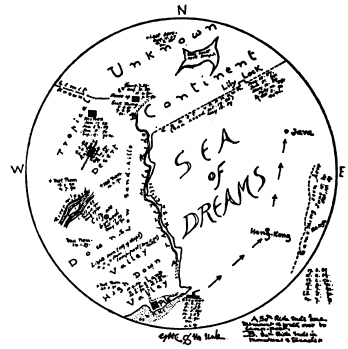
He and she explored the dark-purple downs as far inland from the brushwood-pile as they dared, but that was always a dangerous matter.  The interior was filled with “Them,” and “They” went about singing in the hollows, and Georgie and she felt safer on or near the seaboard.  So thoroughly had he come to know the place of his dreams that even waking he accepted it as a real country, and made a rough sketch of it.

And Kipling makes a sketch, too.  Maybe I should have quoted a weirder bit, like when Georgie drowns and a duck laughs.  “The Brushwood Boy” is like a Lovecraftian weird tale of the Dream Cycle variety that ends not with the revelation of forbidden knowledge but rather the discovery of, to use the contemporary word, a soulmate and, as the romance readers call it, a HEA.  Weird, weird, weird.

Friday, October 9, 2015

Hearing men talk of their own work - even if the men are horses and the work is polo

She delighted in hearing men talk of their own work, and that is the most fatal way of bringing a man to your feet.  (“William the Conqueror”)

There are not many women in The Day’s Work, but William makes up for a lot.  She is the strongest of strong Female Characters.

Twice she had been nearly drowned while fording a river; once she had been run away with on a camel; had witnessed a midnight attack of thieves on her brother’s camp; had seen justice administered, with long sticks, in the open under trees; could speak Urdu and even rough Punjabi with a fluency that was envied by her seniors; had entirely fallen out of the habit of writing to her aunts in England, or cutting the pages of the English magazines; had been through a very bad cholera year, seeing sights unfit to be told; and had wound up her experiences by six weeks of typhoid fever, during which her head had been shaved and hoped to keep her twenty-third birthday that September.

Despite her masculinity, she is a man-killer, only partly because she is a rarity, a young, single English woman living with an army.  She could “look men slowly and deliberately between the eyes — even after they had proposed to her and been rejected.”

The story is about the man, Scott, who finally conquers her, and vice versa.  He does it by doing his duty under extraordinary circumstances, a South Indian famine (William of course does her duty as well).  In its description of meaningful work, the story is quite similar to “The Devil and the Deep Sea.”  Scott is not trying to straighten a bent rod but keep children alive when he is shipped wheat rather than rice.

What was the use of these strange hard grains that choked their throat?  They would die.

I do not remember reading any such thing, but I assume that there is a contemporary fiction of famine, stories of aid workers delivering powdered milk and Plumpy’Nut.  I doubt there was such a thing before “William the Conqueror.”  Kipling, like his hero and heroine, has to come up with solutions on his own.

Amidst the famine, and despite the characters barely meeting, a love story moves along, its apotheosis the moment that William is given a vision of Scott as a god, a moment that she is only granted because she herself is a goddess.  But this is mythic-Kipling, not Kipling-at-work, which here is “feeding babies and milking goats.”

As odd as it seems, “The Maltese Cat,” a detailed description of a polo match, is also structured much like the rebuilding of the engine or the administration of famine relief.  For the players, it is a series of difficult problems to be solved with great effort and at great risk.  The players in this case are the horses – the story is mostly from the perspective of the title character, the captain of the horses.  For the length of the story, the game is their work.

I am having trouble finding a quotation that does not make the story seem ludicrous.  It’s a polo match; the characters are horses (one name here belongs to a human):

Corks was watching the ball where it lay in the dust close to his near fore with Macnamara’s shortened stick tap-tapping it from time to time.  Kittiwynk was edging her way out of the scrimmage, whisking her stump of a tail with nervous excitement.

As with any story about sports, at least when it is not your sport, and mostly even when it is, the question that is hard to answer is “Who cares?”  I mean, it does not really matter who wins any polo match, much less a fictional one.  But here I found myself chasing the ball around the field, caring mostly about what Kipling was doing with his prose.  “It was as neat an exhibition as fancy figureskating.”

Thursday, October 8, 2015

Kipling repairs an engine - Next morning the work of reconstruction began

The shell that arrived by way of the Chief Engineer’s cabin was some five inches in diameter, with a practice, not a bursting, charge.  It had been intended to cross her bows, and that was why it had knocked the framed portrait of the Chief Engineer’s wife – and she was a very pretty girl – on to the floor, splintered his wash-hand stand, crossed the alleyway into the engine-room, and striking on a grating, dropped directly in front of the forward engine, where it burst, neatly fracturing both the bolts that held the connecting-rod to the forward crank.  (“The Devil and the Deep Sea”)

The engine powers a British vessel at this point manned by pearl poachers, petty criminals operating under the British flag in Dutch Malaysia.  The shell, fired from a Dutch gunboat, was meant as a warning shot, but it cripples the ship.  The poachers, after an interval of slave labor,* find themselves housed by a cheapskate official on their own ship.  They secretly repair the engine and escape, never, after one act of revenge, to be heard from again.

About a third of the story describes either the damage to or repair of the engine.  The protagonist, if not the engine itself, is the Chief Engineer.  The repair of the engine is taken as a great act of heroism.  It is a pirate story where I root for the pirates.  Great feats are worth the doing – that is the primary theme of The Day’s Work.  And great feats are made up of an accumulation of little feats – that is the secondary theme.

I ended the quotation with a rod and a crank.  The next paragraph describes the damaged mechanism in motion.  Pistons, columns, that rod flailing about.  How many readers even at the time could visualize the scene well?  How much does it matter?

There was a sound below of things happening – a rushing, clicking, purring, grunting, rattling noise that did not last for more than a minute.  It was the machinery adjusting itself, on the spur of the moment, to a hundred altered conditions…  [the ship] slid forward in a cloud of steam, shrieking like a wounded horse.

Metaphors help.  But there are still plenty of pistons and so on.  Perhaps a diagram would help.  Perhaps not.

I have not even gotten to the repair of the engine.  The climax – I will skip to that – is the straightening of that connecting-rod, a hallucinatory scene.  “It is curious that no man knows how the rods were straightened”:

At last – they do not remember whether this was by day or night – Mr. Wardrop began to dance clumsily, and wept the while; and they too danced and wept, and went to sleep twitching all over; and when they woke, men said that the rods were straightened, and no one did any work for two days, but lay on the decks and ate fruit.  Mr. Wardrop would go below from time to time, and pat the two rods where they lay. and they heard him singing hymns.

Kipling has moved into his mythic mode.  This is something beyond work as such.

“The Devil and the Deep Blue Sea” has a plot not so far from a heist movie, except for the part of the story that us told as obliquely as any Modernist would dare, and it has characters, maybe only two, but characters like normal stories.  Except this story is about the repair of an engine.  It is radically original but also a dead end, at least for any writer without an imagination as capacious as Kipling’s.  Maybe it is one of a kind.  Sometimes it seems that is the real theme of The Day’s Work – stories no one has written before and will never write again.

*  Kipling’s narratorial voice is one of the few that deserves the word “sardonic.”  The crew is sent into, essentially, slavery: “Deep peace continues to brood over Europe, Asia, Africa, America, Australasia, and Polynesia.”

Wednesday, October 7, 2015

Kipling's engineers and talking horses - The Day's Work

In a given book of short stories, how many of the stories should be from the point of view of a horse?  A narrow reader, my answer would be “None,” although really I do not grudge one.  The Day’s Work, Rudyard Kipling’s 1898 collection, has two, which is pushing it.  One of those is really from the perspective of the narrator-Kipling, who is listening to the horses debate.  They are debating American labor politics.  This story, “A Walking Delegate,” was a mistake.

These stories are contemporaries of The Jungle Book (1894) and The Second Jungle Book (1895), so Kipling has talking animals on the brain.  He had always been good with animals.  But The Day’s Work also has a story about chatty railroad engines (“.007” – “.007 quivered; his steam was getting up, but he held his tongue”) and another one that does not personify an Atlantic freighter on its maiden voyage but rather all of the individual components of the ship including its steam (“The Ship that Found Herself”).  More characters: rivets, “a huge web-frame, by the main cargo-hatch,” and the garboard-strake (“the lowest plate in the bottom of a ship”).  These stories are not mistakes but are self-limiting.

Three more stories continue the train theme; two are farces about Americans running into trouble with the English railroad system, while one is about the apocalyptic cosmological implications of building a bridge across the Ganges.  Thus it introduces both the “men in India” theme, which continues in three stories, and the engineering theme, ditto in two.  One of those is about the destruction and part-by-part reconstruction of a ship’s engine (“The Devil and the Deep Sea”).

That one and “The Bridge-Builders” ought to be part of the curriculum at every engineering school.

One of the “men in India” stories, “The Brushwood Boy,” turns out to be a dreamy weird tale superior to Lovecraft’s except that it turns out to be a love story, and I do not want to read any Lovecraft love stories for comparison.  “William the Conqueror” is a terrific love story, too – this is one of the “men in India” stories, although William is a woman in India.

I am sorting the stories in this manner because when I describe The Day’s Work to myself in this way it sounds like a disaster, or at best a collection of oddities.  But I count five masterpieces out of twelve stories, which is a smaller proportion than in either Jungle Book but still, pretty rare.

That is one problem I have had thinking about this book – why would anyone write a story about repairing an engine and how could it be any good?  The other is that the overall themes of the collection are work and duty, as unfashionable a pair as I can imagine.  Perhaps Kipling has been done in not just by his political opponents but by his emphasis on ideas that have lost their literary audience, much like what happened to Walter Scott.

But who cares.  Some of these stories are terrific.  I sometimes use the metaphor of criticism as the dismantling of a story’s mechanism.  Never before has the image been so appropriate.

Tuesday, May 5, 2015

"We don't mean that sort. We hate 'em too'" - some Rudyard Kipling fairy stories

To prepare for a big novel about fairies I thought I would read an earlier books about fairies, Rudyard Kipling’s Puck of Pook’s Hill (1906), in which Kipling plays a cruel trick on unsuspecting children by using a fantasy frame to disguise a book about that teaches  English history.  Why are writers so cruel?  Children are so much better off today, now that they are not expected to know any history at all.

A pair of children are performing  (for an audience of “Three Cows”) their abridged (“as much as they could remember”) version of Midsummer’s Night Dream – on Midsummer Eve – in a fairy circle – which is, obviously, something of a magic spell, one that summons the actual Puck.

‘We – we didn’t mean to,’ said Una.

‘Of course you didn’t!  That’s just why you did it.  Unluckily the Hills are empty now, and all the People of the Hills are gone.  I’m the only one left.  I’m Puck, the oldest Old Thing in England…’ (“Weland’s Sword”)

“People of the Hills,” not “fairies”:

‘And that’s how I feel about saying – that word that I don’t say.  Besides, what you call them are made-up things the People of the Hills have never heard of – little buzzflies with butterfly wings and gauze petticoats, and shiny stars in their hair, and a wand like a school-teacher’s cane for punishing bad boys and rewarding good ones.  I know ‘em!’

‘We don’t mean that sort,’ said Dan.  ‘We hate ‘em too.’

That last bit could be the secret epigraph to Crowley’s Little, Big.  Promising enough, but as I said, after Puck and the children share cookies (“Bath Oliver biscuits” – this is Kipling, no vagueness here), the Old Thing begins summoning other Old Things, not fairies but regional historical figures, knights and so on, in order to march the children through 1066 and all that.  Roman Britain, Vikings, the Magna Carta.  Each chapter ends with Puck casting a forgetting spell on the children, a good running joke for a pedagogical novel, the point of which is to make historical episodes so fictionally vivid that they cannot be forgotten.

The historical episodes are linked in a number of satisfying ways, by a magic sword and a gold hoard and the exodus of the fairies and their degeneration from gods – “’England is a bad country for Gods,’” says Puck – and by Kipling’s style, his intense imagination, the way he sees and hears:

When they reached Otter Pool the Golden Hind grounded comfortably on a shallow, and they lay beneath a roof of close green, watching the water trickle over the flood-gates down the mossy brick chute from the mill-stream to the brook.  A big trout – the children knew him well – rolled head and shoulders at some fly that sailed round the bend, while once in just so often the brook rose a fraction of an inch against all the wet pebbles, and they watched the slow draw and shiver of a breath of air through the tree-tops.  Then the little voices of the slipping water began again.  (“The Knights of the Joyous Venture”)

I last saw that trout in a Richard Jefferies piece, “A London Trout,” which ended with the trout’s fate unknown, so it is nice to see he is thriving; I will next see him in the first chapter of Little, Big.

Wednesday, September 24, 2014

as it is written in the book – as it is written in the book : ghost stories by Kipling, Wells, and M. R. James

I don’t know if A. S. Byatt’s Oxford Book of English Short Stories is truly eccentric or if I am imposing a pattern suggested by her clever misdirection.  But she says she developed a “dislike for the ‘well-made tale’” (xvi), and I see the evidence of it.  She likes stories that go screwy, that take a big swerve.  Hey, me too.  And she likes fantasy stories of many types.  I’ll glance at three of those, three ghost stories.

The M. R. James selection, “Two Doctors” (1919, maybe), is the most traditional ghost story, or else has no ghost at all but rather perhaps some other kind of hobgoblin.  Some readers might remember that two years ago I spent a week reading ghost stories, which was instructive even if I was “shaken a bit by the fact that 75% of the ghost stories I read this week were about haunted bedrooms and the mysterious movements of bedclothes.”  Hey, guess what’s in “Two Doctors”?  I can’t even.  This time it’s a pillow.

“Under the Knife” (1896) by H. G. Wells is a science fantasy on the theme of anesthesia.  The ghost is the narrator, who, certain that he will die during surgery, has what we now call a near-death experience, first watching his own surgery before dying – this is where the story swerves – and being flung into the cosmos:

At last a quarter of the heavens was black and blank, and the whole headlong rush of stellar universe closed in behind me like a veil of light that is gathered together.  It drove away from me like a monstrous jack-o'-lantern driven by the wind.  I had come out into the wilderness of space.  Ever the vacant blackness grew broader, until the hosts of the stars seemed only like a swarm of fiery specks hurrying away from me, inconceivably remote, and the darkness, the nothingness and emptiness, was about me on every side.  (136-7)

I have doubts about that jack-o’-lantern.  Maybe I should have saved this story for Halloween.  The cosmic journey climaxes with a vision of God, or perhaps Steve Ditko’s Eternity (see left).  Alan Moore pilfers the scene for Swamp Thing #50.  This is why people come to Wuthering Expectations.

In Rudyard Kipling’s “’Wireless’” (1902), the ghost is John Keats, or the electromagnetic spirit of radio, or some mix of both.  Whatever the source, which is never resolved, much of the latter half of the story is a description of a fellow in a trance composing Keats’s “Eve of St. Agnes,” as uncanny a performance as I have ever seen a fictional ghost pull off.

He repeated it once more, using ‘blander’ for ‘smoother’ in the second line; then wrote it down without erasure, but this time (my set eyes missed no stroke of any word) he submitted ‘soother’ for his atrocious second thought, so that it came away under his hand as it is written in the book – as it is written in the book.  (123)

This ought to be the dullest story ever written.  We watch one fellow write a poem while another tinkers with a radio. But that was not my experience.  The story is of course a parable about creativity as Kipling saw it – magic and science, good luck and hard thinking, what is right in front of me plus what no one has ever seen.

Wednesday, September 4, 2013

The silence and the sun remain - Just So Stories illustrations and editions

This is a bibliographic post about Just So Stories.  Useful and nicely illustrated.

On the one hand, there is no reason to fuss over getting an edition of Just So Stories that uses Kipling’s illustrations.  The stories have been published along with other people’s illustrations since they first appeared in English magazines.  A fine recent example is The Complete Just So Stories (1993) which features Isabelle Brent’s colorful pictures which suggest mixtures of Persian miniature painting with African and other patterns.  More at Brent’s website.

On the other hand, no one is likely to out-weird the amateur Kipling:

This is the picture of the Animal that came out of the sea and ate up all the food that Suleiman-bin-Daoud had made ready for all the animals in all the world.  He was really quite a nice Animal, and his Mummy was very fond of him and of his twenty-nine thousand nine hundred and ninety-nine other brothers that lived at the bottom of the sea.  You know that he was the smallest of them all, and so his name was Small Porgies…  I don't know the names of the ships.  That is all there is in that picture.  (“The Butterfly that Stamped”)

That is part of the picture’s caption, which reveals the number one reason to make sure you have selected an edition with Kipling illustrations – they are accompanied by Kipling text, good text, strange text.  I suppose much of the strangeness. which is mild, comes from the implicit responses to the infant auditor, the kind of person who asks the name of the sea monster, and whether the monster ate the ships (no), and the names of the ships (“I don’t know”), and on to the exhaustion of one party or the other.

Just once Kipling’s illustration is so good that he has trouble joking about it.

That is from the great “The Cat that Walked by Himself,” a fable that plausibly explains why cats are so bad and are likely to remain so.  My own cats, when I tried to discuss the underlying ideas of the story with them, ignored me, exactly as predicted by  the tale.  Incidentally, “The Cat that Walked by Himself” belongs on any list of Housekeeping Fiction.  I warned that this was a bibliographic post.

The Brent collection, or some similar supplement, is useful not just for the illustrations but because the 1902 edition of the book is missing two Just So stories, one because it was not written until a couple of decades later, and another because it was apparently too sad.  The daughter for whom Kipling conjured up the Just So fables died of pneumonia when she was only six.

Each story is accompanied by a poem.  One of them obliquely refers to the daughter’s death.  It comes after “How the Alphabet Was Made,” in which a father and daughter invent the alphabet from first principles, by which I mean analogy and whimsy.  Tegumai is the father, Taffy the daughter:

          But as the faithful years return
            And hearts unwounded sing again,
          Comes Taffy dancing through the fern
            To lead the Surrey spring again.

          Her brows are bound with bracken-fronds,
            And golden elf-locks fly above;
          Her eyes are bright as diamonds
            And bluer than the skies above.

          In moccasins and deer-skin cloak,
            Unfearing, free and fair she flits,
          And lights her little damp-wood smoke
            To show her Daddy where she flits.

          For far--oh, very far behind,
            So far she cannot call to him,
          Comes Tegumai alone to find
            The daughter that was all to him.

Perhaps it is best not to know any of this.

Tuesday, September 3, 2013

You could very seldom see them, and then only when you knew precisely where to look - cracking the code in the Just So Stories

At time the Jungle Books were clearly books for children, at times something else.  The animal and origin fables in Kipling’s  Just So Stories (1902) aim younger and are therefore more purely childish, not just stories for little children, three or four years old, but stories meant to be read to children.  That is not right either.  They are meant to be performed.

They scuttled for days and days and days till they came to a great forest, 'sclusively full of trees and bushes and stripy, speckly, patchy-blatchy shadows, and there they hid: and after another long time, what with standing half in the shade and half out of it, and what with the slippery-slidy shadows of the trees falling on them, the Giraffe grew blotchy, and the Zebra grew stripy, and the Eland and the Koodoo grew darker, with little wavy grey lines on their backs like bark on a tree trunk; and so, though you could hear them and smell them, you could very seldom see them, and then only when you knew precisely where to look.  (from “How the Leopard Got His Spots”)

That is a pretty long sentence for a book aimed at four year-olds.  But for a ham actor parent, perfect.

My understanding is that the stories mostly have oral origins, Kipling improvising and perfecting a tale for his infant daughter.  At some point the tale was firm enough to be transferred to paper, perhaps even sent to a magazine.  A poem was always added, and a couple of Kipling’s peculiar illustrations.  My favorite running joke is his lament that he is not allowed to use color, that the illos would be much better if he were allowed to use color.  “I think it would look better if you painted the banana-tree green and the Elephant’s Child red.”

I assume that the latter is meant to elicit a squeal from the child:  Daddy, elephants ain’t red!  Thus distracting the youngster from all of the pedagogy embedded in the stories: the vocabulary words(sagacity, comestible), science (neap-tide, equinox), anthropology, and moral lessons (“The rest of the time he picked up the melon rinds that he had dropped on his way to Limpopo – for he was a Tidy Pachyderm”).

Then there are the puzzles.  “The letters round the tusk are magic – Runic magic, - and if you can read them you will find out something rather new” – this from “How the First Letter Was Written.”  I tried I don’t know how many combinations of search terms to get the internet to solve the code for me.  No luck.  The internet is useless.

I had to solve the puzzle myself.  Email me if you want the answer.  It turns out to be kind of meta, a message about cracking the code.

How strange Kipling’s imagination must have been.  How many writers are capable of writing animal fables of any quality at all, or original heroic legends.  Kipling’s mythic imagination is perhaps a clue to his uncertain status.  Myth-makers are supposed to be anonymous, and long dead. 

Saturday, August 24, 2013

Mutton stewed with butter and cabbages - notes on Kim, for next time

I cannot escape the feeling that writing too much about Kim after reading it once, or making too strong of a claim about it, is a mistake.  The novel has escaped in me in some interesting ways.  This is not a complaint.  So some notes.

1.  How much difference does it makes that Kim is a boy’s book?  Or how much of a boy’s book is it?  I don’t know.  It was curious to see, in what essentially a Victorian novel – I guess it is Edwardian by a few months – Kim’s mentors openly worry about the boy’s adolescent sexual adventures.  Maybe there aren’t any.  Kipling is suggestive but ambiguous on this point.  The mentors only care not out of any feeling for Victorian morality but because they are afraid that too much entanglement with women will ruin Kim’s effectiveness as a secret agent.

2.  I am amazed that this book has become part of an indictment of Kipling’s imperialism.  The book ends with a debate over the sleeping Kim between another spy (although Muslim, not English) arguing for the things of the world and the Buddhist lama arguing for the spirit.  Which does Kim choose, or does he find a balance?  “’Who is Kim – Kim – Kim?’” (Ch. 11) asks the hero, in one way or another, several times.  No answer.  Another of the novel’s deep ambivalences.  Kipling ends the novel before answering the question.

The issue is unfortunately close to impossible for an amateur reader to pursue.  The post-colonial literary theorists who have accused Kim and Kipling of various sins generally write in a jargon that requires not just effort but training to penetrate.  Ever try anything by Homi Bhabba?  I am too ignorant to call it gibberish.  It is a specialized form of discourse from which conclusions emerge based on arguments that I have no way to evaluate.

3.  At one point, long ago, Kipling was likely the most popular English-language writer on earth, and Kim one of the most popular novels.  For how many readers did it become the novel about India, and Kipling the Indian writer?  I can see how this would drive Indian writers and other people with real knowledge of India crazy.  Some push-back was probably necessary.

One example, one that I have finally figured out, is that Kipling’s India is really northwest India: the Punjab, Delhi, and some nearby areas.  Large parts of Kipling’s India are now in Pakistan.  Saying Kipling writes about “India” is just a bad shorthand.

4.  The world is good, so Kim is in a minor way a food novel:

Kim yearned for the caress of soft mud squishing up between the toes, as his mouth watered for mutton stewed with butter and cabbages, for rice speckled with strong scented cardamoms, for the saffron-tinted rice, garlic and onions, and the forbidden greasy sweetmeats of the bazars.  They would feed him raw beef on a platter at the barrack-school, and he must smoke by stealth.  (Ch. 7)

I can hardly believe I did not spend a day on the food.  Next time.

Friday, August 23, 2013

I think it good - the variety of Kim

Kipling packs in the characters, the rush of life, all kinds of sensory detail, place names.  And languages, too.  He enjoys scenes where characters are speaking different languages, or flipping among languages.  Kipling is happy to specify who is speaking what, although he sometimes leaves it to me to figure out why, why that language in this situation.

He blundered out almost into the Englishman's arms, and was bad-worded in clumsy Urdu.

Tum mut?  You drunk?  You mustn't bang about as though Delhi station belonged to you, my friend.”

E.23, not moving a muscle of his countenance, answered with a stream of the filthiest abuse, at which Kim naturally rejoiced.  (Ch. 12)

If nothing else, Kim is plausibly a boy.  In this scene, the use of Urdu and even the cursing are actually meaningful to the plot, since they are a means to communicate secret information in a public place.  E.23 is so named, or code-named, because he is a spy.  He uses his Urdu curses to convey secret information to another spy.  Every character in the excerpt is a spy, Kim, E.23, the English policeman.

While I’m on here – “bad-worded.”  A writer can easily overdo this kind of thing, but in this case the neologism complements the meaning of the scene.

Kipling has one more linguistic way to rapidly expand his fictional world, by keeping as many non-English words as he thinks I can manage, whether he translates them immediately as above or lets me figure them out by use.

Note that if the dialogue is spoken in Urdu or Punjabi or what have you, then the narrator is presenting it in translation.  In a sense, most of Kim is a work of translation, even if the original existed only in Kipling’s imagination.  Or perhaps it is better to call it a simulation of translation.  The dialogue that is not in English is not meant to sound like British English.

There is religion, too.  Hindu, Islam, Buddhism, Queen Victorianism, all treated with respect, all taken as legitimate.  Kim and his accompanying narrator are not dogmatists.  Quite the opposite.

I have been describing Kim as a holy man’s assistant or beggar.  The word Kipling and the characters use is chela, disciple.  The Buddhist lama speaks first here, in what is close to a summary of the ethical stance of the novel:

Chela, this is a great and a terrible world.”

“I think it good,” Kim yawned.  “What is there to eat?  I have not eaten since yesterday even.”  (Ch. 11)

Kim and Kipling love their part of India, its food, landscapes, languages, and people.  It is easy to imagine an alternative critical history in which Kim is not held in suspicion but is openly celebrated as the great Victorian novel of what we now call multiculturalism.  The world is good.

Thursday, August 22, 2013

'What is your caste? Where is your house? Have you come far?' - sprawling Kim

The Grand Trunk Road scenes in Kim are spectacular.  They are so full of variety, of life, that they seem to sprawl outside the bounds of the page.  In my imagination, I mean, since the words do not go anywhere.  Kipling seems like a spendthrift with his words, but is in fact usually parsimonious.  A few words, as in the passage from Chapter IV I quoted yesterday, creates birds and policemen and oxen out of nothing, and then they wander around while the next paragraph generates more men, beasts, noises, and smells.

It is the list technique at a  high level of craft, but fundamentally still a list.  I have gone to look for details that I remembered as effusively described only to find policemen made of nothing but “important coughings and reiterated orders.”

Then there are the proper names.

'What is your caste?  Where is your house?  Have you come far?'  Kim asked.

'I came by Kulu – from beyond the Kailas – but what know you?  From the Hills where' – he sighed – 'the air and water are fresh and cool.'

'Aha!  Khitai (a Chinaman),' said Abdullah proudly.  Fook Shing had once chased him out of his shop for spitting at the joss above the boots.

'Pahari (a hillman),' said little Chota Lal.  (Ch. I)

This is early, page five or so, the important scene in which Kim meets the holy man who he will guide (and who will guide him) through the rest of the novel.  Kim is immersive.  Three places, one at least in English; two ethnicities (annotated); three people.  None of these names, not one, need to be remembered.  Fook Shing “the Chinese bootmaker” was introduced a page earlier, as part of a description of the lama.  They have similarly “yellow and wrinkled faces,” our first hint of the lama’s non-Indian origin.  So Fook Shing never appears in a scene yet is mentioned twice (and never again) as if he is commonly known to exist.  Kim’s world is full.

The edition I used has footnotes for much of this stuff.  I imagine the original readers, just tossed onto the streets of Lahore.  I remember that Kim is commonly considered a boy’s book (and rightly so in some ways, but who are these boys)?  War and Peace has a similarly thick world, as do novels set in Balzac’s Paris, or the London of Bleak House.  But I do not know a predecessor that puffs out such a big world in so few pages, and this in a novel with just a handful of major characters.  I can see why previous readers found the book so thrilling, even before discovering that it is also a spy novel.

Strangely, or cleverly, the two parts of that passage that should be not remembered but seized upon when re-reading are transparent.  The last major episode of the novel is a return to those fresh, cool hills.  And then there are those questions that Kim asks.  He is just a boy here.  They are the questions he asks himself several times in the novel, although he simplifies them to three words: “Who is Kim?”