Showing posts with label SEBALD W G. Show all posts

Tuesday, February 1, 2022

Benjamin Labatut's physics fantasy A Terrible Verdure - The mind cannot come to grips with its paradoxes and contradictions

 I.

Benjamin Labatut’s Bolaño-Sebaldian 2020 novel-like object, Un verdor terrible (A Terrible Verdure, although Adrian Nathan West’s English translation is titled When We Cease to Understand the World) has been getting a lot of attention.  It is a fantasy novel where major twentieth-century scientists and mathematicians are mystics who make their discoveries through glimpses of the reality behind the veil.  Several, but not all, of the figures Labatut writes about were, in fact, mystics, although the relation, in what I call the real world, between their work and their mysticism is not so clear. 

In fantasy fiction, metaphors are made literal.  In A Terrible Verdure, high-cognition scientists are not just like mystics, but are mystics.  What do we get from this particular physics fantasy?

One thing is that the “genius poet” problem is solved.  Nabokov somewhere says that the hardest character to make convincing is the poet of genius, because the author has to actually be a poet of genius to provide the evidence that the character is such a thing.  Just asserting genius does not work.  The same is true for physicists and mathematicians.  By using real figures – primarily Fritz Haber, Karl Schwarzchild, Alexander Grothendieck, Erwin Schrödinger, and Werner Heisenberg – Labatut can use, or at least name, their actual contributions, while inventing much of the story around them.  Schrödinger, for example, comes up with the wave equation at the base of quantum mechanics (non-fiction) while reenacting sexy scenes from the contemporary novel The Magic Mountain (fiction).
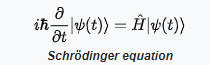

Labatut turns everything mathematical into metaphor, and what else is he supposed to do?  “I understand about as much physics as you can without understanding mathematics” he says in an interview in Physics Today.  At least the physics problems suggest something in the material world; the chapter on Alexander Grothendieck is especially abstract, since his specialty was pure mathematics, so abstract that even the names of the fields barely mean anything.  In my own study of mathematics, I tapped out at real analysis, already getting too abstract for me, so poking around in Grothendieck’s actual work was amusingly pointless.

The speaker here is a Chilean mathematician who, inspired by Grothendieck’s retreat, afraid that math is destroying the world, retired long ago to cultivate his garden:

We know how to use it [quantum mechanics], it works as if by some strange miracle, and yet there is not a human soul, alive or dead, who actually gets it.  The mind cannot come to grips with its paradoxes and contradictions.  It’s as if the theory had fallen to earth from another planet, and we simply scamper around it like apes, toying and playing with it, but with no true understanding.  (187)

Which words are doing all the work?  “[A]ctually,” “true”?  In another sense, lots of people understand quantum mechanics, thousands of people.  “You [physicists, but also anyone] need to let the book do what it’s trying to do, which is going to be harder if you’re a physicist,” Labatut says in the Physics Today interview, which I think is right, but the other side is that non-physicists should be clear about what the book is not doing.

II.

In the old days, a novel like this would have likely been about the dangers of nuclear power and nuclear war, but Labatut barely gestures in that direction.  His recurring catastrophe is environmental, not the familiar one of climate change, but rather a disaster of superabundance caused by artificial nitrogen fixing, the great discovery of chemist Fritz Haber, who was also the father of modern chemical warfare, an irony that has been explored many times.

Haber is the eventual subject of the first chapter, “Prussian Blue,” which is a direct imitation of W. G. Sebald’s The Rings of Saturn (1995).  The first paragraph covers German soldiers hopped up on Pervitin, which moves us to post-war suicides, and thus to cyanide, discovered as a by product of the invention of the chemical pigment Prussian Blue, which brings us to silkworm cultivation, and so on to Haber and his life and work.  Just like a Saturn chapter, except shorter and simpler.  The silkworms are taken directly from Sebald, and I mean directly:

The Reich Association of Silkworm Breeders in Berlin, a constituent group within the Reich Federation of German Breeders of Small Animals, which in turn was affiliated to the Reich Agricultural Commission, saw its task as increasing production in every existing workshop, advertising silk cultivation in the press, in the cinema and on radio, establishing model rearing units for educational purposes, organizing advisory bodies at local, district and regional level to support all silk-growers, providing mulberry trees, and planting them by the millions on unutilized land, in residential areas and cemeteries, by roadsides, on railway embankments and along the Reich’s autobahns. (293, Sebald, tr. Michael Hulse)

Labatut compresses the first seventy-three words into two:

The Nazis planted millions of such trees in abandoned fields and residential quarters, in schoolyards and cemeteries, in the grounds of hospitals and sanatoria, and on both sides of the highways that criss-crossed the new Germany. (16, Labatut)

This is the only time I noticed the literal rewriting of a Sebald sentence (“sanatoria” is added to foreshadow the Schrödinger chapter), but now I wonder if there are more, and plenty of other bits are dropped in, like the herring on the last page.  I don’t exactly want to say that Sebald’s sentences and maze of connections are better than Labatut’s, but they are clearly more complex.

Someone with a copy of Roberto Bolaño’s Nazi Literature in the Americas (1996) could, I suspect, enjoy a similar, or perhaps quite different, exercise.  See that Physics Today interview.

I enjoyed When We Cease to Understand the World quite a lot. But part of that pleasure was recognition, part was flattery, and part was because it was all kind of easy.

Saturday, November 19, 2016

Plainly this was the moment immediately before a disaster - a glance at the Italian journeys of W. G. Sebald and Yves Bonnefoy - I was thus flattered in my Gnostic tendencies

W. G. Sebald’s first novel, for some reason called Vertigo in English (1990, tr. Michael Hulse), describes a number of Italian journeys – those of Stendhal, Kafka, and a version of himself – that cross paths with Goethe in a number of ways.  Sebald deflects the comparison, declaring that in Venice he is reading not Goethe but

Grillparzer’s Italian Diary, written in 1819.  I had bought it in Vienna, because when I am travelling, I often feel as Grillparzer did on his journeys.  Nothing pleases me, any more than it did him; the sights I find infinitely disappointing, one and all; and I sometimes think that I would have done far better to stay at home with my maps and timetables.  (53-4)

The fantasy of Italy has a power that the actual place, full of murders and bad pizza and impending disaster, lacks or even violates.  See pp. 77-80 for details on all of that, one of my favorite passages in Sebald, where he includes a photograph of a receipt from the Pizzeria Verona, “which even from the outside made a disreputable impression,” as if to prove he were there, not to me, who thinks of Vertigo as fiction, but to himself “Plainly this was the moment immediately before a disaster” – that is some bad pizza – perhaps the disaster he foresaw a dozen pages earlier in Venice.  “For some time now I have been convinced that it is out of this din that the life is being born which will come after us and will spell our gradual destruction, just as we have been gradually destroying what was there long before us” (63).

Sebald is inverting Goethe, yet he finds himself “occupied more or less exclusively with my study of Pisanello, on whose account I had in fact decided to travel to Verona” (72).  There is no end to Bildung.  He describes a Pisanello fresco in detail.  “A landscape of a more northerly character rises (the word is suggested by the nature of the depiction) into a blue sky” (74).  Please see a recent post at Tony’s Reading List for more.

It is exactly that kind of landscape that Yves Bonnefoy uses in The Arrière-pays (1972, tr. Stephen Romer) to explain the title of his book, the “hinterland,” the “back country,” the strong sense, with him from his childhood, of the place that exists beyond wherever he is and whatever he knows.  In art, this place revealed itself first through the skies of Poussin, but eventually, once he travelled to Tuscany, through the detailed landscapes of 15th century Italian art. Or even before his Italian journey, described in Chapter III of The Arrière-pays, when he becomes lost in the paintings of Giorgio de Chirico and Paolo Uccello.

His first surprise in Italy is that the surrealism of Chirico is real,

that what I’d taken in Chirico for an imaginary, even an impossible, world existed, in fact, on this earth, except that here it was renewed, re-centred, made real and habitable by an act of spirit as novel for me as my own being, memory, and destiny became at a stroke… (67, ellipses in original)

Perspective itself, as in Uccello’s paintings, is imbued with meaning – “I was thus flattered in my Gnostic tendencies” (67) – by its implication of a world beyond the flat canvas.  The real Italy replaces the imaginary, works in person replace reproductions, yet the result is only the removal of the imagined world to some other place.  Visiting Italy awakens a lifelong, intense interest in art yet is destructive, and simultaneously creative.  “All sophistry, of course, because I was considering art, which is an order with its own laws, as merely an epiphenomenon which would provide a clue” (76).

Everything works out in the end – the Seagull Books edition includes several later, related essays attesting to the fact – due to the passage of time and Bonnefoy’s eventual recognition of the limits of his Gnosticism, perhaps in large part due to the writing of this book.  How I would love to know if Sebald knew it.  They are kindred books.

Sunday, January 31, 2016

Swinburne via Beerbohm and Sebald - he cooingly and flutingly sang

Max Beerbohm wrote a pleasing account of his visits to Algernon Swinburne.  “No. 2, the Pines,” is the essay, and Swinburne’s suburban address; it can be found in the 1920 And Even Now collection, or the recent The Prince of Minor Writers (2015, NYRB Classics).

Beerbohm was at this point the hot, or I guess cool, new thing in essay writing.  In the amusing “Diminuendo” (1895), Beerbohm discusses his declining influence and eclipse by the next cohort of writers.  He wonders if he should gracefully pack it in.  He is twenty-three years old.

So young Beerbohm frequently dines with the famous poet at the invitation of Swinburne’s friend, roommate, and caretaker Theodore Watts-Dunton.  Swinburne is quite deaf and his nervous complaint had worsened.  “His hands were tiny, even for his size, and they fluttered helplessly, touchingly, unceasingly” (35, page numbers from the NYRB book).  He did not speak – Watts-Dunton did not invite him to speak – until he had eaten a sufficient quantity of his “huge… joint of roast mutton,” and then:

So soon as the mutton had been replaced by the apple pie, Watts-Dunton leaned forward and “Well, Algernon,” he roared, “how was it on the Heath to-day?”  Swinburne, who had meekly inclined his ear to the question, now threw back his head, uttering a sound that was like the cooing of a dove, and forthwith, rapidly, ever so musically, he spoke to us of his walk; spoke not in the strain of a man who had been taking his daily exercise on Putney Heath, but rather in that of a Peri who had at long last been suffered to pass through Paradise,  And rather than that he spoke would I say that he cooingly and flutingly sang of his experience.  (36-7)

There we have a good dose of Swinburne and Beerbohm both.

In one strange passage, Swinburne tells a story of his aunt telling him a story about coming across the burial of a suicide at the crossroads, “a Hogarthian night scene,” but more vivid to Beerbohm is the scene of the story-telling:

a great panelled room, a grim old woman in a high-backed chair, and, restless on a stool at her feet an extraordinary little nephew with masses of auburn hair and with tiny hands clasped in supplication – “Tell me more, Aunt Ashburnham, tell me more!”  (40)

Part of the strangeness of the passage is that I had read it before, but where?  At the end of Chapter VI of W. G. Sebald’s The Rings of Saturn (1995), when the description of the sunken city of Dunwich turns to the last years of its greatest fan, Swinburne, and a great story of Swinburne’s vision of Coleridge’s Xanadu – “every last detail of the fabled palace.”  Someday I should track down which biography Sebald pilfered for this story, or perhaps convince myself that he made it up.

The chapter ends with a visit to Watts-Dunton and Swinburne, Beerbohm’s account mixed with someone else’s, or an invention – the visitor who thinks of Swinburne as an “ashy grey silkworm” (165, tr. Michael Hulse) is not Beerbohm.  Also, Sebald substitutes beef for Beerbohm’s mutton for some reason.  But he ends the chapter with this:

After the ball they drove many miles homeward on a crisp, cold, snow-bright winter night, when suddenly the carriage stopped by a group of dark figures who, it transpired, were burying a suicide at a crossroads.  In writing down this memory that goes back a century and a half into the past, noted the visitor, himself long since deceased [Max!], he beheld perfectly clearly the dreadful Hogarthian nocturne as Swinburne painted it, and the little boy too, with his big head and fiery hair standing on end, wringing his hands and beseeching: Tell me more, Aunt Ashburnham, please tell me more.  (165-6)

So, one more source for the “Demystifying Sebald” file.

Saturday, May 30, 2015

Swinburne's songs to the sea

Swinburne is giving his publisher instructions for publicizing his new book, Tristram of Lyonesse (1882):

If you print among the advertisements of Tristram any passage from the ‘Saturday’ review, I wish it to be this and no other: ‘We have some difficulty in taking this kind of thing seriously.  Any man who abandoned his mind to it “could reel it off for hours together.”’  (letter 1167, Aug. 6, 1882)

I am  about halfway through Swinburne’s enormous verse retelling of the Tristram and Isolde story, and I disagree with the anonymous critic on one point: it is not “any man” that could pound this out, no, but for Algernon Swinburne, this is poetry supplied by the yard.  Every line is purple.  Impressive in some ways, but more commonly I am with the poet Henry Taylor who wrote to Swinburne that the poem “sweeps me along through one or more pages with a consciousness that I am only half understanding what I read” (note to 1179, October 1, 1882).  Swinburne insists that he “hold[s] obscurity to be so great a fault that I should think no pains too great to take in the endeavour to avoid it” but concedes that “one must see a fault before it can be avoided, and this one is so difficult to see.”

I mention these letters because in 1880, Swinburne published a pair of masterpieces, long poems of 400 or 500 lines titled “On the Cliffs” and “By the North Sea,” both of which are complex and the former of which is maddeningly obscure, the most difficult thing I have ever seen by Swinburne.  It is addressed simultaneously to Sappho and to a (or the) nightingale, figures who merge not just into not just a muse of poetry but a new trinity, “woman and god and bird,” while the poem is also about a particular favorite seaside spot from Swinburne’s childhood.

O wind, O wingless wind that walk’st the sea,
Weak wind, wing-broken, wearier wind than we,
Who are yet not spirit-broken, maimed like thee,
Who wail not on our inward night as thou
In the outer darkness now,
What word has the old sea given thee for mine ear
From thy faint lips to hear?
For some word would she send me, knowing not how.  (ll.28-35)

All of those “w”s!  The “she” at the end is Sappho; the poet is on a cliff above the English Channel listening for inspiration from his goddess.

“By the North Sea” – more cliffs, more waves, more wind – is thankfully much clearer.  W. G. Sebald calls the poem Swinburne’s “tribute to the gradual dissolution of life” (Rings of Saturn, Ch. VI).  It describes “A land that is lonelier than ruin; / A sea that is stranger than death,” the ruins of Dunwich, the once-important medieval city that has been falling over the cliffs into the sea for the last seven hundred years.  There goes the cemetery:

Tombs, with bare white piteous bones protruded,
    Shroudless, down the loose collapsing banks,
Crumble, from their constant place detruded,
    That the seas devours and gives not thanks.
Graves where hope and prayer and sorrow brooded
    Gape and slide and perish, ranks on ranks.  (ll. 457-62)

Both writers end their visits to Dunwich with moments of “utter rapture,” Sebald by showing Swinburne, “like a startled moth,” telling a story from his childhood, a story about stories: “Tell me more, Aunt Ashburnham, please tell me more.”  Swinburne ends his poem with a prayer of gratitude to the destructive, creative sea:

Time gives what he gains for the giving
    Or takes his tribute of me;
My dreams to the wind everliving,
    My song to the sea.  (ll.  521-4)

Tuesday, December 23, 2014

Some great scenes from 2014 - Will you look at this! - that is all I am trying to say

Although respecting ancient tradition I made a list of best books, the fact is that I only read books incidentally.  I actually read words and lines and so on, arranged in ways that suggest scenes or characters or ideas.  I wish I were better at remembering lines and words.  What I remember are scenes.

Here are some good ones from books I read this year.  From books not mentioned yesterday, to add an arbitrary rule.

1.  Émile Zola worked in a way I understand: write big scenes and minimally fill in the connective matter.  Chapter 3 of L’Assommoir (1877) is one long working class wedding scene.  The guests gather at a bar, because of the rain they mill around, drinking, finally they wander off to the wedding dinner, where they spend many pages eating, and drinking, and eating some more.  In the middle of the chapter the guests spend four pages lost in the Louvre, baffled by the art, or laughing at it.  Not a kind scene – not a kind novel – but a good one.  “’Will you look at this!’ Boche kept saying.”  Exactly.

2.  Another party, Midsummer’s Eve, from Chapter 18 of Martin Andersen Nexø’s Pelle the Conqueror (1906).  Pure joy in a grim novel. “It had been an incomparable day for Lasse and for Pelle – making up for many years of neglect.  Too bad that it was over instead of just beginning.”

3.  Mary Delany for the first time looks at a flower and realizes that she could make an image of it out of colored paper.  She is 72.  In the next decade, she follows that one with 984 more flower portraits.  Molly Peacock, describing the scene in The Paper Garden (2010), can place Delany’s tools around her – ink, glue, scissors, paper – and can describe the flower, but not the mystery of inspiration.  

When the Duchess came in to check on her friend, shocked that she had taken apart her new scarlet geranium, then delighted that what Mary had composed were the petals in paper replication, the first of the great work had begun.

“I have invented a new way of imitating flowers.”

Right then Mary Delany’s friend of more that forty years supplied exactly what was necessary: applause.  (p. 309)

4.  Goethe’s Roman girlfriend, a waitress, “accidentally” spills wine on the table.  From Roman Elegies (1795).

5.  Moomintroll glimpses the spirit of winter, the Lady of the Cold, one of the strangest of many strange scenes in Trollvinter by Tove Jansson (1957).  A horse made of snow comes to life.  One of Jansson’s rare gifts was a mythic imagination.

6.  Not all memorable scenes are even scenes.  A paragraph in Johann Peter Hebel’s “Unexpected Reunion” that shows the passage of time by listing historical events has an uncanny, sublime effect that is hard to describe.

7.  Similarly: the part where Sebald visits Rousseau’s Swiss house.  Or where Eduard Mörike can’t stop writing, or where Gottfried Keller can’t stop writing, or where Robert Walser can’t stop writing.  This is all from W. G. Sebald’s A Place in the Country (1998).  The chapter on Walser ends with the writer floating away in a balloon (pp. 162-4).  Literary criticism conducted by means of scenes.

I could keep going.  I guess that is what I mostly do here.  But now it’s vacation time.  I’ll return in January to goof around with Italian literature.

Have a good holiday!

Saturday, April 12, 2014

What the earth has given back once it will not withhold again at the final call - the most wonderful story in the world

One of Hebel’s stories stands out because of the extravagant, almost unbelievable praise it has received from Franz Kafka, Elias Canetti, and friendly commenter humblehappiness.  “The most wonderful story in the world,” for example.  The two page (plus woodcut) story is titled ‘Unexpected Reunion” in my translation, although I think of it as “The Mines of Falun,” the title of E. T. A. Hoffmann’s much expanded 1819 version.  Hugo von Hofmannsthal tried to turn it into a very strange play, but he never finished it.  Richard Wagner apparently wrote a one page treatment for an opera based on the story.  W. G. Sebald more or less stole it for the last sentence of the first chapter of The Emigrants (1992).  These are just the descendants I know of.

At Falun in Sweden, a good fifty years ago, a young miner kissed his pretty young bride-to-be and said, “On the feast of Saint Lucia the parson will bless our love and we shall be man and wife and start a home of our own.”  (25)

But the miner dies in the mine.  Fifty years later, miners find his perfectly preserved corpse.  The bride-to-be, now an old woman, claims the body and has him buried, promising to join him soon.

“What the earth has given back once it will not withhold again at the final call,” she said as she went away and looked back over her shoulder once more.” (28)

The Sebald, where a man emerges not from a mine but a glacier, is:

And so they are ever returning to us, the dead.  At times they come back from the ice more than seven decades later and are found at the edge of the moraine, a few polished bones and a pair of hobnailed boots.  (The Emigrants, 23, tr. Michael Hulse)

The story is obviously built for all kinds of symbolic meaning, religious and visionary, or could this be another parable of war somehow?  It could; I have skipped the most interesting of the story’s five paragraphs.  The miner vanishes and the woman mourns, all in the first paragraph.  Here is the second:

In the meantime the city if Lisbon in Portugal was destroyed by an earthquake, the Seven Years War came and went, the Emperor Francis I died, the Jesuits were dissolved, Poland was partitioned, the Empress Maria Theresa died, and Struensee was executed, and America became independent, and the combined French and Spanish forces failed to take Gibraltar.  [Another event-filled sentence takes us into the Napoleonic Wars.]  The millers ground the corn, the blacksmiths wielded their hammers, and the miners dug for seams of metal in their workplace under the ground.  (26)

The power – in context, the uncanniness – of this passage of plain summarized history is hard to understand.  I guess the reader can be pretty sure the miner will somehow return just by looking at the title, but the long gap expressed in this particular way seems to give the unchanging dead man something like cosmic significance.  He stays the same while kings and nations change, when war and nature destroy whatever they can.  But as the last sentence shows, it is not just the dead man who stays the same.  So do many live men.

It all seems so obvious when taken apart, but that is not how it seems in the story, much less mixed in with the other gentle and less gentle stories in The Treasure Chest.  Hoffmann is so scared of it that he adds a lot of weird fairy tale stuff.  Well, his version is good, too, just not the most wonderful story in the world.

Friday, April 11, 2014

things were pretty violent and bloody during the last war - Johann Peter Hebel's war stories

The other 19th century war fiction I recently read was Johann Peter Hebel’s Treasure Chest (1811, more or less), which I read, of course, because of the chapter in Sebald’s A Place in the Country.  Almost none of the Hebel used by Sebald is present in the English Treasure Chest (tr. John Hibberd, 1994), or in English anywhere outside of the translated Sebald essay, which is an irritation.  I read this book as a substitute for a book that does not exist.

Hebel’s main literary form was the almanac, which he wrote under the guise of Der Rheinländische Hausfreund, the Rhineland Family Friend, beginning in 1808 and continuing, off and on, through 1819.  I am surprised it is not a form still in use by some literary eccentric.  I am not sure how “real” the almanacs were – what the weather prediction and holiday calendar was – but the form was flexible, allowing for stories, jokes, real news, fakes news, crime, moral tales, songs, poems, and riddles.

The almanacs were popular, thus the 1811 “greatest hits” collection of The Treasure Chest, which leans towards the fully formed stories and away from the more topical writing.  The result is less personal, by which I mean there is less digressive fun – Hebel knows his Sterne – with the narrator, the Hausfreund as Sebald calls him.  And the translated book is itself just a selection of a selection.

I sound like I am complaining, but I am not.  I would just like to read more Hebel, that is all.  The strange thing about the English Treasure Chest is that something like a story begins to appear, even from the fragments.  The story is a war story.  What else, after all, made up the news of 1808 and on for several more years?

In the Tyrol things were pretty violent and bloody during the last war.  They had just murdered a Bavarian staff officer, and their swords and dung forks were wet with blood as they pushed into the room where his wife was, weeping with her child in her lap, telling God of her grief, and they were going to murder her too.  (120)

The story, just a page and a half long, is titled “An Officer’s Wife Is Saved,” so we know it turns out all right for her, if not the poor officer.  Horrors of war show up in more and more stories as the book goes along, and if not the war than something as bad, like “Terrible Disasters in Switzerland,” three and a half pages (plus a woodcut!) of anecdotes of those killed by or miraculously saved:

… in that one night, and almost within the space of the same hour, whole families were smothered by avalanches, whole herds and their byres were crushed, pastures, gardens and orchards were swept away, scooped out down to the bare rock, and whole forests were destroyed, flung down into the valley below or the trees tangled, crushed, bent and broken like blades of corn in the fields after a hailstorm.  (106)

I compare this to passages of Hebel quoted by Sebald, for example when Hebel “calculates matter-of-factly” some of the material costs of war, for example the materials used in one ship, “1,000 mighty oak trees, as one might say a whole forest; further 200,000 pounds of iron” (A Place in the Country, 29), plus the rope and canvas and tar and, incidentally, men, most of this soon to be destroyed.

The avalanches somehow become an aspect of war; war takes on a cosmic character; the author emerges from behind his gentle moral tales and riddles as a visionary writer.

Wednesday, March 19, 2014

Some few of the most beautiful lines ever written - a Sebald bibliography

A couple of days of vacation are on their way, so this will be the last post until Monday.

I have been ignoring the issue of just who Gottfried Keller and Johann Peter Hebel and so on actually are, or what they wrote – everyone knows Jean-Jacques Rousseau, right, but not Eduard Mörike – just taking it for granted that they are worth reading not only because Sebald found them valuable but because I have read them myself, not that I have written much about them.

Keller is a good example.  You would think that Keller’s massive Green Henry (1854) would have given me two weeks of material, but I barely mentioned it, likely because I never really got hold of it, or I was writing about something else.  Keller’s novel is a portrait of a young artist much like himself who runs through a series of troubles with school, girls, and his attempts to become a painter.   Sebald is writing about a description of Henry walking at night:

What is remarkable about this passage is the way in which Keller’s prose, so unreservedly committed to earthly life, attains is most astonishing heights at precisely those moments where it reaches out to touch the edge of eternity.  (109)

Like, Sebald says, “the work of a baroque poet of mortality and vanitas.”  And this really is just a passage about a man out walking in the dark.  Sebald is talking about the mysteries that slip in, like the “invisible swarms of migratory birds [that] passed high overhead with an audible rustling of wings.”

Green Henry is a strange book that violates almost every idea I have about good writing, much like Adalbert Stifter’s Indian Summer, the other long German-language masterpiece from the 1850s.  One strange thing about it is that it is constructed out of a series of novella-length and novella-like episodes, an unusual structure.  Why I did not write about Keller’s actual novellas, like the heartbreaking A Village Romeo and Juliet or the fine folk tale-like comedies Clothes Make the Man and The Three Righteous Combmakers is more of a puzzle, although I see that I did write a bit about not writing about them.  How very helpful.  Those stories are all easy to like.

Eduard Mörike is a different issue, since I have not read his long Kunstlerroman titled Nolten the Painter (1832) – Sebald makes it sound like a mess – but rather some poems, which I wrote about many years ago, and his effervescent novella Mozart on the Way to Prague (1855).  The poems are so sweet and charming, except for the one where the poet kicks a critic down the stairs, and the Mozart story is also a delight, and frankly a corrective to the “kooky Mozart” stereotype.

I feel that Sebald cheats a bit with Mörike, since he never mentions Mozart on the Way to Prague or the more amusing poems.  Not melancholy enough, I guess, although they, too are part of the artistic “mystery” Sebald describes, the result of craft and “a very long memory” and

possibly, a certain unluckiness in love, which appears to have been precisely the lot of those who, like  Mörike and Schubert, Keller and Walser, have bequeathed to us some few of the most beautiful lines ever written.  (87)

If I have turned this post into a bibliography, it is because the translator of A Place in the Country, Jo Catling, has created such a fine bibliography herself, with German and English sources, primary and secondary.  It would make a good course of study, or a good guide to take with on a search for those beautiful lines.  It is full of temptations.  I predict I will soon succumb.

Tuesday, March 18, 2014

The teeming black scrawl - Sebald makes connections

Sebald is discussing the Robert Walser story “Kleist in Thun.”  He describes his discovery, “in a three-volume biography of Gottfried Keller which had almost certainly belonged to a German Jewish refugee,” of an old photograph of a house where Heinrich von Kleist lived and wrote.   Kleist, Keller, Walser, Sebald.  “Since then I have slowly learned to grasp how everything is connected across space and time” (158-9) Sebald writes, and if anything tells us that I am not reading one of his prose fictions, it is the directness of this statement, which would have been cloaked in some way in the novels.

Eduard Mörike and his friends, as young German radicals, wear “open-necked shirts with wide flowing sleeves, Renaissance berets and suchlike extravagant headgear, sideburns and unkempt locks and those strange small steel-rimmed spectacles which have clearly been the hallmark of the conspiratorial intelligentsia since time immemorial” (76).  That is a joke there at the end.

All of this is visible in a drawing of the young writer and his friends on p. 75 of the essay on Mörike, but also in a drawing of young Gottfried Keller and his radical pals, no less than three of whom, including the author, who is leading the charge with a drum and top hat, wear the little glasses.  “It is difficult to imagine that these five heroes are off to storm the barricades” (96).  The theme is pinged again in the Walser essay, in a passage about his youthful dandyism, his cane and “loud checked suit,” but now “[a] fondness for conspicuous costume and the dangers of indigence often go hand in hand” (137).

Just as an example.  Everything is connected when made to be so by an artist of Sebald’s caliber.

Sebald does hide himself in A Place in the Country, or I think he does, and in one of the most common ways, by writing about visual art.  For example, when describing a painting of a bowl of grapes on a white tablecloth (reproduced in the book), Sebald writes:

The more I look at the paintings of Jan Peter Tripp, the more I realize that beneath the surface illusionism there lurks a terrifying abyss…  The dark background, the white linen cloth with the embroidered monogram – already we have begun to sense that it is spread out not for a wedding breakfast, but on a bier or catafalque.  And what is the business of painting in any case but a kind of pathological investigation in the face of the blackness of death and the white light of eternity? (177)

The question is absurd if taken literally, but I note that writing, and for that matter the act of reading, are generally a matter of a contrast between blackness and whiteness.

The word “pathological” is also questionable, but the previous five essays have been about people for whom writing is in fact pathological or close to it with Walser the most extreme case.  “No one… recognized the pathological aspect of thought as acutely as Rousseau, who himself wished for nothing more than to be able to halt the wheels ceaselessly turning within his head,” (58) – not even writing, but thought

So Walser, at the end of his essay, drifts off in a balloon provided by Nabokov; Keller writes to “contain the teeming black scrawl which everywhere threatens to get the upper hand, in the interest of maintaining a halfway functional personality” (122-3), and Mörike is last seen with his family, “not very content in his role as a poet from which – unlike his clerical calling – he can no longer retire.”  A painter friend

relates how on several occasions he observed Mörike noting things down which came into his head on special scraps and pieces of paper, only soon afterward to take these notes and “tear them up again into little pieces and bury them in the pockets of his dressing gown.”  (91)

Today’s Mörike would perhaps instead do what I am about to do.

Monday, March 17, 2014

Unwavering affection - Sebald's A Place in the Country

The only certain thing is that he writes incessantly, with an ever increasing degree of effort; even when the demand for his pieces slows down, he writes on, day after day, right up to the pain threshold and often, so I imagine, a fair way beyond it.  (129)

W. G. Sebald is describing Robert Walser in a chapter of A Place in the Country, his 1998 book of essays on all of my favorite writers:  not just Walser but Johann Peter Hebel, Jean-Jacques Rousseau, Eduard Mörike, and Gottfried Keller, as well as the artist Jan Peter Tripp.  If not my favorites, exactly, I can at least say that I have read something by all of them, which must be rare among English readers although not among serious readers of Sebald.

I can still remember quite clearly how, when I set out from Switzerland for Manchester in the early autumn of 1966, I placed Gottfried Keller’s Der grüne Heinrich, Johann Peter Hebel’s Schatzkästlein des Rheinischen Hausfreunds, and a disintegrating copy of Robert Walser’s Jakob von Gunten in my suitcase.  The countless pages I have read since then have done nothing to diminish my appreciation of these books and their authors, and if today I were obliged to move again to another island, I am sure they would once again find a place in my luggage.  This unwavering affection for Hebel, Keller, and Walser was what gave me the idea that I should pay my respects to them before, perhaps, it may be too late.  (3)

That last phrase is a little too sad.  The pieces on Rousseau, Mörike and Tripp have different origins but share thematic material with the others.  To point out an obvious one, Rousseau, Keller and Walser are Swiss, while Mörike, Hebel, and Tripp (and Sebald) are from nearby parts of Germany.

A Place in the Country is not a work of fiction, but it is written in the hybrid style Sebald had developed in his novels.  It is easy enough to imagine Sebald making it fiction.  It is no surprise to see, for example, Nabokov (another Swiss writer) make an appearance in the Walser essay, although this time as a writer, as a source of quotations, rather than as the ghost who floats through The Emigrants.  If Sebald’s fictional prose works are not exactly novels, this late work of criticism gestures towards fiction, more so than, I think, his next book, also criticism, On the Natural History of Destruction (1999).  This book is rather a history of destruction through writing.  Please revisit the description of Robert Walser up above.

Sebald’s colleague Jo Catling translated the text and added thoughtful notes.  She is, I am amazed to see, now translating Sebald’s earlier critical essays on Austrian writers, thornier stuff than in this book.  I never thought any of this would be translated – Hebel! Stifter! You gotta be kidding me! – but I could not be happier to be wrong.  I will wander in it for a couple more days.  Terry Pitts at Vertigo has, as one might guess, already written a piece on each chapter, beginning with Hebel.

Tuesday, February 25, 2014

Mere virtue and rancid matter - Swinburne's letters - The original probably verges on coarseness.

In A Place in the Country (1998), the new (in the U.S., and more importantly in my hands) W. G. Sebald book, Sebald calls what appear to the naked eye to be long, detailed literary essays “extended marginal notes and glosses” (p. 5), and if that’s what those are, then I hate to think what these are here at Wuthering Expectations.

So today, some genuine marginal glossing, on Volume 2 of The Swinburne Letters, Yale University Press, 1959, covering 1869-1875.  When we last saw Swinburne, he had just achieved early fame and notoriety with Atalanta and Calydon (1865) and Poems and Ballads (1866).  Now he is in his thirties and is settling into a career as a poet and essayist, if he does not drink himself to death first.

He also goes hiking in the French Massif with Richard Burton, corresponds with Victor Hugo, and hangs out with Robert Browning and James McNeill Whistler.  None of this is why I enjoy Swinburne’s letters.  Rather I am on the lookout for this sort of thing:

A foul mouth is so ill matched with a white beard that I would gladly believe the newspaper scribes alone responsible for the bestial utterances which they declare to have dropped from a teacher whom such disciples as these exhibit to our disgust and compassion as performing on their obscene platform the last tricks of tongue now possible to a gap-toothed and hoary-headed ape, carried at first into notice on the shoulder of Carlyle, and who now in his dotage spits and chatters from a dirtier perch of his own finding and fouling; Coryphaeus or choragus of his Bulgarian tribe of autocoprophagous baboons who make the filth they feed on.  (Jan. 30, 1874, p. 274)

Take a breath, Algernon!  Two guesses who the “teacher” is.

Here Swinburne needs to title a book of poems, but his favorite is too close to someone else’s.

Damn the minor poets, what right have they to call their titles (or their souls) their own, if we condescend to find any use for them?  (Jan. 20, 1875, 374-5)

Swinburne is some kind of comic demon.  An old woman possesses artifacts of Percy Shelley: “I need not say that I suggested strychnine, duly reduplicated, with earnestness worthy of Carlyle, but seemingly in vain” (Feb. 23, 1869, 6).  He wants to review Flaubert’s Sentimental Education “foreseeing that as before in his case the British press will generally exude mere virtue and rancid matter” (Nov. 25, 1869, 56).  After delivering a scatological burst borrowed from Rabelais (“turdilousifartishittical etc.”), Swinburne suggests that

the translation is no doubt – and very properly – softened down to the standard of English delicacy.  The original probably verges on coarseness.  (Feb. 12, 1870, 89)

Lest it seems that Swinburne is all rancid matter, I suggest a glance at any of Swinburne’s letters to Dante Gabriel Rossetti  (sorry, not Mar. 1, 1870 which is full of obscene parodies of Elizabeth Barrett Browning poems) in which Swinburne works his way through Rossetti’s upcoming collection of poems, including the sonnet sequence “The House of Life.”  It is a high level poetry workshop in which Swinburne the craftsman weighs the sound, sense, and beauty of every detail.  It is a treat to see how much this gleeful weirdo loves poetry, to see him wallow in it.

A couple of years later, D. G. Rossetti cut off his friendship with Swinburne (“and no one knows why,” including Swinburne, says the editor, p. 178).  Swinburne talks poetry with others – it is the only thing he really cares about – but no one else, in this book, who is really his peer.  It is sad, really.  Damn the minor poets.

Friday, January 24, 2014

The sepia saga business - De Waal borrows Sebald's voice

What Sebald did for me was to say that a particular voice was allowed.  That voice was very internal, very quiet and credible across a whole piece of writing.  I think I learnt that entirely from reading Sebald.

Edmund de Waal did a little interview with a “pick five books” theme.  W. G. Sebald’s Austerlitz was one of them; see above for why.

It is possible that I could write another post about de Waal and Walter Benjamin, another of his five picks, if only I had read Benjamin.

From the quotations I used yesterday, I would not guess that de Waal was especially Sebaldian, but he has more than one rhetorical mode, and at least one of them is the one he describes in the interview, Sebald played on a less complex instrument.  This is aside from common interests in modern European history, or the meaning of objects, or the meaning of loss.  De Waal has separated himself from Sebald enough to put captions on the images he uses, although he is writing non-fiction, which has different standards.

Some odd coincidences pop out.  De Waal’s great uncle, the one from whom he inherits the netsuke, was homosexual (a word never used by de Waal).  He finds a home, a career, and a companion, a husband, in Japan after World War II.  Part Four of The Hare with Amber Eyes is a portrait of the marriage of Iggie and Jiro, “my Japanese uncle.”

They explored Japan together, travelling to an inn that specialized in river trout one weekend; to a town on the coast for an autumn matsuri, a jostling parade of red-and-gold floats…  But music was closest to the heart of their life together…

And this is the fourth resting-place of the netsuke.  It is a vitrine in a sitting-room in post-war Tokyo looking out across a bed of clipped camellias, where the netsuke are washed late at night by waves of Gounod’s Faust, played loud.  (310-11)

This text is above a photo of the two smiling men, the young Jiro’s hand on the balding Iggie’s shoulder.  You can see it at de Waal’s website, along with a shot of Iggie and his vitrine.

Readers familiar with The Emigrants will likely find it hard to escape an overlay of the section of that books about Sebald’s great uncle, Ambros Adelwarth, and its narrative about his gay marriage before the fact, including this weird intersection:

Once, at Mamaroneck, said Aunt Fini, Uncle Adelwarth spent all of one afternoon telling me about his time in Japan.  But I no longer remember what he told me.  Something about paper walls, I think, about archery, and a good deal about evergreen laurel, myrtle and wild camellia.  (79)

The next page has a photo of a pagoda built over a lake, perhaps that “floating and well-nigh empty house” where Adelwarth lived for a time with his Japanese lover.

Why does de Waal need Sebald’s help?  Because he is not a writer. 

I know that my family were Jewish, of course, and I know they were staggeringly rich, but I really don’t want to get into the sepia saga business, writing up some elegiac Mitteleuropa narrative of loss.  And I certainly don’t want to turn Iggie into an old great-uncle in his study, a figure like Bruce Chatwin’s Utz, handing over the family story, telling me: Go, be careful.

It could write itself, I think, this kind of story.  A few stitched-together wistful anecdotes, more about the Orient Express, of course, a bit of wandering round Prague or somewhere equally photogenic, some clippings from Google on ballrooms in the Belle Epoque. It would come out as nostalgic. And thin.  (15)

This is early.  De Waal has not even started researching the book.  He is expressing his fear about how to tell the story he wants to tell, how to avoid all of the clichés and received ideas of the genre.  He needs to do a lot more work – the book is in part a chronicle of his work – and he needs a model for the voice.  He finds it in Sebald.

Perhaps a new set of clichés will form around Sebald as his style hardens and dims in the hands of his imitators.  Not yet, though, not in The Hare with Amber Eyes.  Of course de Waal does write a narrative of loss.  But it is not nostalgic, not thin.

Friday, September 13, 2013

Introducing Algernon Charles Swinburne

Introducing him to myself, I mean.  I believe that he was, until a couple of months ago, the only major Victorian poet I did not read in college, even in scraps, just a few famous poems, which was all I read of John Clare and Matthew Arnold and Christina Rossetti and many others, and is still all I have read of Gerard Manley Hopkins, who I think is now the last big name I have not worked on.  Unless Robert Bridges and Ernest Dowson count as major poets and big names.

Perhaps Swinburne is no longer a major poet.  Regardless, he does not offer easy entry.  Many of his best-known poems are long, allusive, a real challenge to concentration.  The editors of the 2004 Algernon Charles Swinburne: Major Poems and Selected Prose (Yale UP) say:

Negotiating a poem by Swinburne requires a state of attention that can scarcely be maintained and that is, in any case, never sufficient.  (xxiv)

Which is hilarious, and, at least as far as maintaining my attention goes, less true for me know than it was twenty-five years ago.  If I do not understand Swinburne, I can at least read him.

The funny thing is that  without reading him I picked up a lot of facts and fun about Swinburne, whether through literary history or magazine book reviews or W. G. Sebald’s The Rings of Saturn:

He was small of stature, and at every point in his development he had remained far behind a normal size; he was quite startlingly fine-limbed; yet even as a boy he had an extraordinarily large, indeed outsize, head on his shoulders, which sloped weakly away from his neck.  (162)

This is directly below the a tiny black and white reproduction of the portrait of Swinburne by his friend William Bell Scott.  Perhaps I thought I knew Swinburne just because of this amazing image.  His head really was that big; he really did love the seashore more than any poet I know aside from Whitman.

The portrait is easily that of the man Henry Adams describes meeting in The Education of Henry Adams, the effervescent, endlessly learned talker.  “The idea that one has actually met a real genius dawns slowly on a Boston mind, but it made entry at last.”

My trusty, worn Fifth Edition Norton Anthology of English Literature  gives Swinburne nineteen pages of poems.  Seventeen pages come from 1865 to 1868, age 28 to 31, mostly from the 1866 Poems and Ballads, the book that made Swinburne’s name for the usual mix of good and bad reasons – high-quality writing, charges of obscenity.

This is also the period in which Swinburne was developing his alcoholism, along with his poetry, to a point of perfection.  Friends eventually dried him out and tamed him.

I have been reading Swinburne’s letters along with the early poems, the first of the six volume edition Cecil Lang put together in the 1960s.  The publication of the letters inspired an outstanding “life and works” piece by Edmund Wilson for the New Yorker (also available in The Novels of A. C. Swinburne (1962), where I read it).  Swinburne, as compressed by Wilson:

Here is a life lived entirely for literature, in which nothing else is really important – and since literature is inexhaustible, a life that is immensely enjoyed.

Reason enough to read Swinburne to the extent my attention can handle him, and even to spend a few days writing about his poems.

Tuesday, January 29, 2013

The lion appeared completely oblivious - Atxaga, Baudelaire, Sebald - looking for patterns

What is Bernardo Atxaga up to in his Belgian Congo novel Seven Houses in France?  What patterns should an attentive reader see?

Friendly, thoughtful readers supplied some good ideas which I will ignore in favor of Atxaga’s Baudelaire theme.

Lalande Biran, the commanding officer, is a published poet.  Specifically, he is a disciple of Charles Baudelaire, who he occasionally quotes and even met:

Sleep overwhelmed him as he was searching for the next line of the poem, and the word that had been in his mind shortly before – syphilis – stirred in his head, presenting him with the image of the Master as he had seen him in Paris once when he was very young and the Master was ill and ugly and contorted with pain.  (46)

Biran’s section of the novel climaxes with two triumphs, an enormous killing in the corrupt mahogany and ivory trade, and the composition of a poem.  The novel is typically written in a realistic mode, so this passage is unusual:

The two numbers [“the price of mahogany and ivory: 330 and 370”] began to change shape in his mind…  First, he saw them floating in the air and then, immediately, they were transformed into birds flying over a vast green meadow…  Except they weren’t birds now, but two bats.  ‘Yes, bats,’ said the voice.  (101, ellipses mine)

The numbers and the dream-bats together form the poem, “those two numbers – 330, 370 – as the title, but without telling anyone why” and the bats in the text:  “But, friends, Sisyphus cannot stop.  If he does, he will be assailed by ravenous bats” (103).

Bats, you don’t say:

When earth becomes a trickling dungeon where
Trust like a bat keeps lunging through the air,
Beating tentative wings along the walls
And bumping it head against the rotten beams  (from “Spleen (IV)” tr. Richard Howard)

And take a look at “Spleen (III)”:  “I’m like the king of a rainy country, rich \ but helpless…”  Even before this point in the novel I began to wonder if there could be a series of encoded Baudelaire references that I was missing because I do not know his poems well enough.

Maybe this is nothing more than a simple reminder that culture is no defense against barbarism, that the elegant poet can be a monster, too.  Baudelaire himself merely played at monstrousness.  Or maybe Biran is just a derivative poet.

Two more ironies come with Baudelaire.  One is that Biran is old-fashioned.  It’s 1903!  Get up to speed, ya dinosaur.  The other is that Baudelaire, as we all know, loathed Belgium.  “Don't ever believe what people say about the good nature of the Belgians” and on and on in that vein.  Baudelaire’s letters are something else.

W. G. Sebald writes in the same spirit in The Rings of Saturn:

And indeed, to this day one sees in Belgium a distinctive ugliness, dating from the time when the Congo colony was exploited without restraint and manifested in the macabre atmosphere of certain salons and the strikingly stunted growth of the population, such as one rarely comes across elsewhere.  At all events, I well recall that on my first visit to Brussels in December 1964 I encountered more hunchbacks and lunatics than normally in a whole year.  (122-3)

But “the very definition of Belgian ugliness, in my eyes, has been the Lion Monument and the so-called historical memorial site of the Battle of Waterloo.”  The lion takes me back to Atxaga, to the final lines of the novel:

The lion did not move a muscle.  It remained lying down, watching the men unload the cargo.

Near the beach, a monkey screamed.  The lion appeared completely oblivious.  It seemed to be deaf.  (250)

Symbolism has intruded.  Forget Baudelaire – work backwards from the end.

The translation of Seven Houses in France is by my hero Margaret Jull Costa from Atxaga’s Spanish, which was itself translated from Atxaga’s original Basque.

Monday, January 28, 2013

The climate of the Congo triggered a kind of dementia - I am puzzled by Bernardo Atxaga's novel about the Belgian Congo

Maybe someone can help me out with this novel.  I had the idea that Basque writer Bernardo Atxaga was a tricky post-modernist, and I thought I knew how to read tricky post-modernists.  So what am I missing in this book?

Seven Houses In France is Atxaga’s 2009 novel about the nightmare world that was the Belgian Congo.  A new officer arrives at a distant outpost.  He is openly religious, a superb shot, and avoids native women from an entirely justified fear of syphilis.  The jealousy and resentment – other officers are lustful, irreligious, and mediocre shots, and also thoroughly corrupt, and at least one is a sociopath, although they are all violent racists – causes a series of plotty and unlikely events that eventually lead to, from a certain point of view, disaster.

From the perspective of the Congolese, every disruption of the Force Publique is a life-saver.  Literally millions of lives would have been saved if the Belgian officers had concentrated on murdering each other rather than the Congolese.

The novel begins in 1903, when the vast territory of the Congo was a military work camp owned by King Leopold II of Belgium, operated by his army, devoted to harvesting rubber by means of slave labor enforced by violence:  beating, torture, murder, and mass killings.  The characteristic act of brutality was the severing and smoking of the right hand:

He proudly showed Sheppard some of the bodies the hands had come from.  The smoking preserved the hands in the hot, moist climate, for it might be days or weeks before the chief could display them to the proper official and receive credit for his kills.  (165)

That is not Atxaga but Adam Hochschild, from Chapter 10 of his history King Leopold’s Ghost (1998).  The kind of institutionalized violence described by Hochschild is present throughout the novel, but always in the background, as an ordinary part of life and work.

Perhaps that is a clue to the purpose of Atxaga’s novel, this casual acceptance of violence and its destructive effects on the perpetrators.  I wonder who Atxaga is trying to convince?  King Leopold blamed the climate, not violence:

Leopold explained that he considered the work done by the blacks as a perfectly legitimate alternative to the payment of taxes, and if the white supervisory personnel at times went too far, as he did not deny, it was due to the fact that the climate of the Congo triggered a kind of dementia in the brains of some whites, which unfortunately it was not always possible to prevent in time, a fact which was regrettable but could hardly be changed.  (128)

Or perhaps he did not, since I am now quoting Chapter V of The Rings of Saturn by W. G. Sebald (1995), which is a novel, and therefore full of untruths, of which this may well be one.

I have some doubts about the ethics of Seven Houses of France.  The foreground of Atxaga’s novel, the story he tells, is trivial compared to actual events.  It is like a tale of adultery and revenge among Auschwitz guards.  However well written and engaging, I would hope most readers spend their time watching the calendar, waiting for the Soviet Army to arrive.  When Joseph Conrad visited the same territory, he wrote about how ego and ideology can cause horrific crimes.  Atxaga appears to be writing about how horrific crimes incidentally cause much less horrific crimes. 

Michael Orthofer, in his review of the novel, says the novel “does all feel a bit tame and simple -- there's an odd sort of nonchalance to the whole narrative.”  That is just how I felt.  But Atxaga is a tricky post-modernist, so Orthofer and I must be wrong.  There must be something more to the book.  Tomorrow I will look for clues.

I do not have a solution.  If you know the answer, you can save me the trouble of speculating.

Friday, May 4, 2012

A passage that I can no longer find - Borgesian Brownian Sebaldian Sebald

The photographs in Sebald’s novels undermine the facts of his fiction by seeming to guarantee them.  A man in a dark coat stands on an empty winter beach.  The text says “this picture” was taken by Uncle Casimir and is of the narrator of The Emigrants, who is also more or less the author.  Sebald possesses the picture because his uncle sent him a copy “two years later, probably when he had finally shot the whole film, together with his gold pocket watch” (89).

I mention this photo not because it is particularly interesting – in fact it is particularly dull – but because I was amused to find a second reference to it in the new book of poems – confirmation! – although  of what I cannot say.  But this is one of Sebald’s recurring jokes, the inclusion of fragments of evidence of some vague something that actually prove nothing.  The reproduction of a pizza lunch receipt in Vertigo is a highlight of the technique.  The story must be true – here is the receipt!  I am always tricked for a moment, too.

I wonder what the ratio of fact to fiction is in Sebald’s books.  High, I assume.  In The Rings of Saturn Sebald spends a couple of pages summarizing the Borges story “Tlön, Uqbar, Orbis Tertius,” which begins with the discovery of an encyclopedia  “which contains four pages that are not in any other copy of the edition in question,” pages that are fictional in the sense that Borges made the whole thing up, but have an indeterminate status within the story itself.  Four fictional pages are enough to reshape the world, at least within a text.  The chapter ends with the Borges story colonizing the Sebald novel. 

And then see how the novel ends (the chapter has been about silk and silkworms):

And Sir Thomas Browne, who was the son of a silk merchant and may well have had an eye for these things, remarks in a passage of the Pseudodoxia Epidemica that I can no longer find that in the Holland of his time it was customary, in a home where there had been a death, to drape black mourning ribbons all over mirrors and all canvasses depicting landscapes or people or the fruits of the field, so that the soul, as it left the body, would not be distracted on its final journey, either by a reflection of itself or by a last glimpse of the land now being lost for ever.

In the Borges story, Uqbar is in some sense discovered in a mirror, and the story (and Sebald’s chapter that employs it), both end with a mention of Browne, so Sebald deliberately linked these endings.  But the key of course is the lost remarks.  I assume that enterprising Sebaldians have either identified the passage or proven that it does not exist.  I am not sure which outcome I prefer. 

Someday all of this work will have been done, indexed and catalogued, the relevant parts of every book Sebald identified in footnote, or, who knows, linked directly to the text.  I must admit that part of the fun of reading Sebald is that my own little discoveries still feel fresh.

Thursday, May 3, 2012

A volume of fish twenty times the size of the earth - Sebald's fictional facts

Boy did I not plan to spend so much time with Sebald.  Some of what I have been writing is as closely related to other books I have been reading as to Sebald.  José Saramago’s Baltasar and Blimunda (1982), for instance, which in its own way depends as heavily on knowledge as Sebald does.  Both authors follow a common postmodern path, fiction buttressed by massive quantities of facts, or fiction as an interrogation of fact.

The third chapter of The Rings of Saturn is mostly about herring (the part not about herring is mostly about Borges):

I have read elsewhere, in a volume on the natural history of the North Sea published in Vienna in 1857, that untold millions of herring rise from the lightless depths in the spring and summer months, to spawn in coastal waters and shallows, where they lie one on top of another in layers.  And a statement ending with an exclamation mark informs us that each female herring lays seventy thousand eggs, which, according to Buffon’s calculation, would shortly produce a volume of fish twenty times the size of the earth, if they were all to develop unhindered. (55)

So much in this seemingly prosaic passage.  The exclamation mark, noted, but of course not employed by Sebald, even in quotation.  This is what I was getting at yesterday – everything is paraphrased, even down to the punctuation.  The antique Viennese natural history is the best joke, though.  Why on earth was Sebald reading that?  To help write an eight page history of herring, presumably.  What the nets are made of, how long the herring lives without water, or without its fins – “This process, inspired by our thirst for knowledge, might be described as the most extreme sufferings undergone by a species always threatened by disaster” (57).

Claude Lanzmann, the director of Shoah and other documentary films, mostly about the Holocaust, asks:

What is knowledge?  What can information about a horror, a literally unheard-of one, mean to the human brain, which is unprepared to receive it because it concerns a crime that is without precedent in the history of humanity?*

The Emigrants is a kind of Holocaust novel, but The Rings of Saturn broadens the range of horrors.  The natural history of the destruction of the herring is also without precedent:  “It was not without reason that the herring was always a popular didactic model in primary school, the principal emblem, as it were, of the indestructibility of Nature” (53).  The Holocaust may well be uniquely unimaginable, so Lanzmann responds with an attempt to eliminate fiction.  Sebald suggests that human fallibility is deeper, though, more pervasive.  The novel’s title is a reference to the destruction of a planet.  Sebald responds with fiction.

The East Anglian train that was once destined for service in China that I mentioned yesterday is likely a fiction – Rise pointed me to a Guardian article that says so.  I will not guess which of the “facts” about herring are from Sebald’s imagination.  Says the Guardian writer “perhaps it doesn't matter that he made the train thing up.”  Perhaps it matters a lot – perhaps that is exactly what matters.

*  Claude Lanzmann interviewed in Kultura (tr. Richard Brody), quoted by Adam Thirlwell in a review of Lanzmann’s memoir The Patagonian Hare: “Genocide and the Fine Arts,” The New Republic, May 10, 2012, pp. 28-9.

Wednesday, May 2, 2012

The most palpable proof of his failure - reading along with Sebald

Although I once looked up every person, place, and painting mentioned in The Emigrants (1992), I can hardly imagine doing the same thing with The Rings of Saturn (1995).  It is too full of stuff, of facts, of knowledge.  In the guise of documenting a walking tour along the East Anglia coast, Sebald wanders wherever he wants.

A bridge over the river Blyth, real enough, leads him to the fact, from “local historians,” that its tracks used to carry a train “built for the Emperor of China.”  Chinese dragons make a cameo – as Nabokov is the presiding spirit of The Emigrants, Borges inhabits The Rings of Saturn – and then we are plunged into nineteenth century Chinese history, particularly into the life of the Dowager Empress Cixi.  Then we are pulled back onto the seashore, to visit the sunken city of Dunwich, followed by six pages on the life of poet Algernon Swinburne.  How this is a novel - eh, you have to see it for yourself.

I was once in a book group that stumbled upon - crashed against - Pearl Buck’s Imperial Woman (1956), a historical novel about the Empress Dowager, a fascinating subject embedded in tedious prose.  Searching for a better book on the subject, I tried Marina Warner’s biography The Dragon Empress: Life and Times of Tz'u-hsi 1835-1908 Empress Dowager of China (1972), yes, much better, but with odd moments, passages I had read before, and not in Buck.  Passages like:

On the morning of the 15th of November, still in reasonably good health, she presided over the grand council’s deliberations upon the new situation, but after her midday meal, which in defiance of her personal doctors’ warnings she had concluded with a double helping of her favourite pudding – crab apples with clotted cream – she was stricken with an attack resembling dysentery, from which she did not recover.  (153)

To be clear, I am quoting Sebald, not Warner.  Sebald is paraphrasing Warner, pilfering all of the good bits.  I do not have Warner’s book here, so I cannot compare passages (I need the last few pages of the biography), but the apples in cream, which Sebald moved directly from one book to the other, are memorable enough.  Sebald certainly read more on the subject than this one book, but based on the evidence he did not necessarily read a lot more.

Another “Sebald book” I found more deliberately.  Max Ferber, the painter in the last chapter of The Emigrants, is a composite character but is based in part on Frank Auerbach.  I must have read that somewhere.  So I read Robert Hughes’s monograph Frank Auerbach (1990) and was amused to discover that Sebald had obviously read this very book.  Ferber’s studio is Auerbach’s:

Since he applied the paint thickly, and then repeatedly scratched it off the canvas as his work proceeded, the floor was covered with a largely hardened and encrusted deposit of droppings, mixed with coal dust, several centimetres thick at the centre and thinning out towards the outer edges, in places resembling the flow of lava.  This, said Ferber, was the true product of his continuing endeavours and the most palpable proof of his failure.  (161)

But Sebald is writing fiction, so he can have his painter insist that nothing in the studio ever changes, nothing but the paint and dust, while the real Auerbach can remodel:

‘I changed the lino three times,’ Auerbach says.  ‘The last time quite recently, less than ten years ago.  If I didn’t, the paint would be up to here.’  He gestures at thigh-height.  (Frank Auerbach, 13)

Sebald borrows Auerbach’s studio, biography, and techniques, but turns him into a Sebald character.  The line about failure above, that’s Sebald, as is:

And indeed, when I watched Ferber working on one of his portrait studies over a number of weeks, I often though that his prime concern was to increase the dust.

I had experienced an obvious but still useful demystification with these non-fiction books.  How did Sebald do what he did?  One important step:  he read widely.  That part I can do!  There are also other parts, yes.

See here for a painting of Auerbach's studio and other samples of his work.  It would take an imagination more powerful than mine, now that I know Auerbach’s work, to separate the fictional painter from the real paintings.  Terry, at Vertigo, has a fascinating article on another part of the connection between the real and imagined painters.

Tuesday, May 1, 2012

Trying to see further and further - Sebald and knowledge

If my little conversation with W. G. Sebald went well, and I flatter myself that it did, it could not have hurt that I flattered the author by recognizing one of the cleverest parts of The Emigrants, his use of Vladimir Nabokov.  A different fan might have singled out a particularly beautiful scene, but that does not sound like me.  Praised for his cleverness, Sebald was willing to expand on it.

In the passage I used yesterday, Nabokov is never mentioned.  The speaker does not know, no one in the chapter knows, who the man with the butterfly net is, and Sebald never actually says.  Nabokov had been mentioned twice in earlier chapters about different characters, though, and a photograph of Nabokov with his net is on page 16, so Sebald had put me on notice, but I knew the butterfly man in that passage was also Nabokov because I knew his biography and knew that Nabokov was living in Ithaca, New York at the time Sebald's character was in Ithaca.  Sebald’s fiction rewards, and perhaps demands, knowledge.

At one point – several years after I met him – I read The Emigrants with the goal of looking up every reference I did not know, and finding every location on a map.  Please, no quizzes, but I did it.  I had already made my great discovery, if I can call it that, the first or second time I read the novel:

Afterwards we were in the great hall of the palace, and I stood beside Uncle, craning up at Tiepolo’s glorious ceiling fresco above the stairwell, which at that time meant nothing to me; beneath the loftiest skies, the creatures and people of the four realms of the world are assembled on it in fantastic array.  (185)

The internet was a bit primitive in those days, so I had to resort to a library book about the Residenz in Würzburg, a baroque masterpiece for which Tiepolo’s giant allegorical fresco is only a highlight.  Actually, Würzburg itself was so charming, at least at Christmas-time, that I can say the Residenz is only a highlight.  Yes, I was so interested I went to see it:

Strangely enough, said Ferber, I only thought of that afternoon in  Würzburg with Uncle Leo a few months ago, when I was looking through a new book on Tiepolo.  For a long time I couldn’t tear myself away from the reproduction of the great  Würzburg fresco, its light-skinned and dark-skinned beauties, the kneeling Moor with the sunshade and the magnificent Amazon with the feathered headdress.  For a whole evening, said Ferber, I sat looking at those pictures with a magnifying glass, trying to see further and further into them.  (185)

The speaker here is not Sebald, but of course the author is also describing his own encounter with Tiepolo and the Residenz, and likely his way of looking at the world.  Whether he is rewriting Stendhal’s autobiography (in Vertigo) or working through the natural history of the herring (The Rings of Saturn) or inventorying the contents of a shop window (Austerlitz), he is trying to see further, to know more, and inviting his readers to do the same.

Monday, April 30, 2012

He replied been good to meet you Max - I remember W. G. Sebald

That first sentence in the title is broken into the last three lines of a W. G. Sebald poem, one written in English, titled “I remember” (Across the Land and the Water, 139-41).  “He” is a “lorry driver \ from Wolverhampton.”  Sebald’s friends knew him as Max, not as W. G.  I see more and more people calling him Max, actually.  I always call him Sebald, even though I met him once.

This is not much of a story, but it is better than the story of my encounter with Saul Bellow.

It must have been in the spring of 1997.  Sebald’s only book in English was The Emigrants;  I owned the paperback, which must have just been published.  The Emigrants was Sebald’s second novel of, at the time, three.  It was clear enough that Sebald was up to something exciting, clear enough just from the first twenty pages of The Emigrants.

Sebald had been invited to the University of Chicago to do a reading.  Probably, more, too – visiting classes or something – I don’t know.  This was a reading not at a bookstore, but at the university itself, in a stuffy little neo-Gothic room.  Sebald read, in a quiet, careful voice, with a heavy Bavarian accent, a passage from early in the “Paul Bereyter” chapter and then a long piece of “Ambros Adelwarth,” from when the character is in the Ithaca mental hospital:

The air was coming in from outside and we were looking over the almost motionless trees towards a meadow that reminded me of the Altach marsh when a middle-aged man appeared, holding a white net on a pole in front of him and occasionally taking curious jumps.  Uncle Adelwarth stared straight ahead, but he registered my bewilderment all the same, and said:  It’s the butterfly man, you know.  He comes round here quite often.

I wonder if Sebald actually read this passage.  It is what I remember him reading, what else can I say?

Over at the faculty club, at the reception, I harvested my crackers and cubes of cheese – a lush life we led there at the U. of C. – and studied for a moment the author, who was standing by himself in the middle of the room with his drink.  I had not really planned to say anything to Sebald, but here we had a breach in hospitality.  My theory is that Sebald’s host had been trapped in a corner by a crank.  We had more than our share of cranks.  So I went over and said hello.

The odd thing is that Sebald and I chatted for about twenty minutes by ourselves, right in the middle of the room, before anyone else joined us.  That crank must have had some powerful Theories.  My role was intellectual straight man, meaning I suggested a topic and Sebald spoke about it.  The three topics were:

1. The Emigrants.  In particular, we talked for a while about Sebald’s use of Vladimir Nabokov in the novel, his five appearances in the book.  There he is up above with his butterfly net.  The Nabokov intrusions are absolutely central to my understanding of the novel, but at this point I have no idea what I came up with on my own and what Sebald told me.

2. Campus novels.  How did we move to this subject?  I do not remember.  What I do remember was Sebald laughing that he wished he had written a campus novel, because one of his friends had just published a bestseller in the genre.  Der Campus by Dietrich Schwanitz, that’s the book, still available at Amazon.de.  We (he) must have talked about David Lodge, too, but I have forgotten.  I just remember Sebald laughing about his friend’s book, or  perhaps just at the concept of having a bestseller.

3. German cinema.  Shaky terrain for me.  I was doing all right as long as we stuck with Expressionist films, but Sebald suddenly hopped to post-War East German cinema and I was about to be reduced to the role of vigorous nodder.  But the subject – this seems strange, but it was not Sebald himself but the subject of German film – attracted a couple of grad students who were able to enthusiastically take up the conversation, so soon enough I thanked Sebald and slipped away.  Where in the devil was his host?  Who was supposed to take him to Giordano’s for pizza casserole stuffed pizza?  Maybe I should have stuck around a little longer.

Well, that’s the story of my half hour talking to Max Sebald, a treasured if imperfect memory.  I do not have any more stories like it.