Monday, May 30, 2022

Colette's last hit, Tanizaki's puppets, McBain's police work - the wash of blue and white which was the sky


Some of these books have to got back to the library.  Let’s write ‘em up.

***

Some Prefer Nettles (1929) by Tanziaki Junichiro.  A married couple has fallen out of loe with each other, and the wife in love with someone else.  They should divorce, probably, but then what’s the hurry.  Every literature has, at some point, its divorce novels, and here is a Japanese example.  It is mostly from the point of view of the shallow Westernized husband, whose Westernization is described in two fine scenes, one where he buys a multi-volume Richard Burton Arabian Nights in order to read the dirty parts (which he never finds), and another where he visits his Western “mistress,” who is a Russian-Korean prostitute working in a brothel.  Some readers may wish the story had a different point of view character, but I had a good laugh at him.

My puzzle was how this tight but flatly-written domestic novel is a candidate for “greatest novel by greatest Japanese writer.”  Let’s see what Donald Keene says in the “Fiction” volume of Dawn to the West (1984):

Some critics consider this to be Tanizaki’s finest work, not only because of its intrinsic literary excellence  but because it presents both subtly and effectively the great transformation in Tanizaki’s life from a worshiper of the West to a believer in the Japanese heritage.  (759)

The intrinsic excellence is unspecified, and the last part is not remotely an aesthetic quality.  So I am still puzzled.  The Japanese cultural detail, including several substantial sections about the puppet theater, is of high interest, the ironies of the marriage are well-observed, etc. etc.  But “finest” and so on, I don’t see it.

***

Cop Hater, Ed McBain (1956).  I am continuing my education in the history of crime fiction with a key police procedural, the first of a long line of 87th Precinct novels that abandon any hint of a puzzle mystery for the grind of ordinary, tedious police work.  Or at least make steps in that direction.  My sense of the realism of Cop Hater is based entirely on subsequent cop shows deeply influenced by these novels, so what do I know.

Salvatore Lombino was a classic hack writing science fiction under these pseudonyms and crime fiction under those, more or less settling for the McBain name when these books became his biggest hits.  In classic hack fashion, his prose can get kinda purple, when I would expect nothing but plainness:

The clear silhouettes of the buildings slashed at the sky, devouring the blue; flat planes and long planes, rough rectangles and needle sharp spires, minarets and peaks, pattern upon pattern laid in geometric unity against the wash of blue and white which was the sky.  (1)

A little purple is all right with me.  I enjoyed this book, and if I were a real fan of mysteries I would seek out more, but really I would rather know what else was out there.

***

Gigi (1945) by Colette.  Age 71, writing in occupied Paris, Colette writes the biggest hit of her life, a novella about a fifteen year-old girl being groomed to be a courtesan by her grandmother and great-aunt, both courtesans themselves.  The story is not as creepy as it sounds only because it is not clear what is going on for quite a while.  Maybe the grandmother is just unusually obsessed with etiquette, or something.  And the real story of the story is Gigi’s subtle resistance, ultimately successful, to her groomers.  The character in the 1958 Vincente Minelli musical is surely aged quite a bit?

The book titled Gigi includes the novella and three other pieces.  “The Sick Child” is the saddest thing, a lovely piece about the imaginative life of a boy bedridden with polio.  “The Photographer’s Wife” oddly has more detail about the lost profession of pearl stringing – “Because I had, in the old days, a pearl necklace like everyone else” (2nd paragraph) – but the title character takes over by the end.  “Flora and Pomona” is not a story but an extended wander through Colette’s love of flowers, plants, and even, why not, fruit.  Colette mostly writes at my reading level, but with that last one she kicked me around pretty hard.  The flowers, the parts of flowers, just to begin.  Good for my French, I tell myself.

“Gigi” is easy to find in English.  The next two stories are in the big Collected Stories, although all translation above is mine.  “Flora and Pomona” is in a 1986 collection of Colette’s essays titled Flowers and Fruit.  All a pleasure to read, setting aside the difficulty of the French.


Friday, May 27, 2022

The Suppliants by Euripides - O grief, O grief!

The Suppliants, or The Suppliant Women, by Euripides, c. 423 BCE, or perhaps a few years later depending on how certain passages link to specific incidents in the Peloponnesian War.  A curious play, hardly one of Euripides’s best.


The story is familiar.  It is Seven Against Thebes and Antigone on the other side of the wall, with the grieving mothers of the soldiers lost fighting Thebes petitioning Athens to help them recover and bury the bodies of their sons.  The victorious Thebans, forbidding burial, are committing what we would call war crimes.  Virtuous Athens, led by Theseus, is willing to go to war in the name of human rights.

THESEUS:  By my many noble deeds

I have made myself a byword to the Greeks:

They count on me to punish wickedness.  (71)

You can hardly say The Suppliants is not relevant.  My impression, which is why I prefer the earlier date, making a Trilogy of Grief with Andromache and Hecuba, is that Euripides is working on dramatizing the costs of war but has not yet rejected, in disgust, the Athenian experiment.  Or whatever happened.  The Trojan Women is eight year or so in the future.  I should save some of these thoughts for The Trojan Women.

ADRASTUS:  Cities!  You might use

Reason to end your troubles; but with blood,

Not words, you ruin your affairs. – Enough!  (84)

What strikes me about both of the passages I have quoted is that they do not seem, in the context of the play, ironic.  Up above I placed a stereoscopic photograph of the Temple of Theseus,, taken circa 1870, owned by the Getty Museum.  One strange aspect of The Suppliants is that it is, for Euripides, a pious play, telling a religious story.  Why does Athens have a Temple of Theseus?  Why, down that road, is there a shrine to Capaneus, who is not even Athenian?  Well, there is a story about that – and here is the story.  We have stepped back to the Greek drama as origin story.

I have wondered about the role of the producer, to use our word, the money man, in the plays we have been reading.  Different wealthy citizens acted a producer of the Dionysian plays in different years.  Some apparently sent over the minimum funds while others spent lavishly; some were hands off while others were more involved.  Really just like Hollywood producers.  I wonder if the Suppliants was something like a commissioned play.  The producer sacrificed at the Shrine of Capaneus, got what he wanted, and now owes Capaneus a favor.  Euripides is then juggling his own concerns with those of his money guy.  I don’t know any of this, but I wonder.

Regardless, the emotional core of the play, the thing that makes it some kind of tragedy, is the mourning of the mothers and children for the fallen soldiers.  “O grief, O grief!” (87) as Adrastus says.  A god drops in at the end to wrap things up, but until then the action, and the sorrow, has been utterly human.

I’m reading the Frank William Jones translation.

The play next week is The Clouds by Aristophanes (423 BCE).  This one is unmissable.  Aristophanes sets aside his feud against Cleon for a year to instead go after a very special guest star.  Do not miss The Clouds!

Monday, May 23, 2022

Dorothy Richardson's Interim, book 5 in Pilgrimage - It went on and on. It seemed to be going toward something.

My piece about Dorothy Richardson’s The Tunnel (1919) was a bit late, and now I’ll write up Interim (1920), the fifth novel in the Pilgrimage series, a bit late.  All this relative to the novel-a-month readalong mostly taking place on Twitter, useful for many reasons but mostly for Neglected Books posting startling archival finds like the actual article the protagonist Miriam is reading in the highbrow dental trade journal The Dental Cosmos.  And that’s the second literary dental trade journal encountered so far in Richardson’s books.  When Katherine Mansfield reviewed The Tunnel, she seemed to be a bit frightened by Richardson’s capacity to remember details like this.

Last time I worried about the metaphysics; now I’ll just wallow in the prose.  Look at this – Miriam is reading:

She plunged back into Norway, reading on and on.  Each line was wonderful; but all in a darkness.  Presently on some turned page something would shine out and make a meaning.  It went on and on.  It seemed to be going toward something.  But there was nothing that any one could imagine, nothing in life or in the world that could make it clear from the beginning, or bring it to an end.  (382)

Now Richardson is writing about the metaphysics of fiction.  Is Miriam reading Pilgrimage?  Aside form the word “Norway” the passage is a good self-description.

She read a scene at random and another and began again and read the first scene through and then the last.  It was all the same.  You might as well begin at the end.  (383)

What on earth is she reading?

Ibsen’s Brand [1867] is about all those worrying things, in magnificent scenery.  You are in Norway while you read.  That is why people read books by geniuses and look far-away when they talk about them.  (383)

Two or three fine pages of young intellectual discovery. 

People go about saying ‘Ibsen’s Brand’ as if it were the answer to something, and Ibsen knows no more than any one else. . . . (384, ellipses in original)

The aggressive italics are a normal feature of Richardson’s style.

Interim is mostly a boarding house novel, in which Miriam meets many curious neighbors, many of them medical students, one even, exotically, Canadian.  But the novel begins with a marvelous long chapter where Miriam spends Christmas with the family of some former students from her brief time as a teacher in Backwater (1916), three novels ago.  In a kind of climax, Miriam begins remembering earlier Christmases.  Curiously, as interior as Miriam is, she does not do much remembering.  Everything is now and forward.  So this scene was a surprise:

‘Didn’t you love it?’ broke in Miriam presently.  ‘Do you remember—’ and she recalled the Noah’s ark as it had looked on the nursery floor, the offended stiffness of hthe rescued family, the look of the elephants and giraffes and the green and yellow grasshoppers and the red lady-bird, all standing about alive amongst the stiff bright green trees.  (298)

And on and on, like Ibsen, for a couple of paragraphs.  A paper theatre, a kaleidoscope, various dolls.  On and on to the point that she puts her hosts to sleep.  A lovely couple of pages in a lovely chapter.  Richardson, a real innovator, gets in line with a long English tradition of charming fictional Christmases.

Friday, May 20, 2022

The Knights by Aristophanes - Here, put on this wreath and pour a libation to Stupidity


The Knights
(424 BCE), the second surviving Aristophanes play.  The target is the demagogue, a familiar figure today, and thank goodness because otherwise much of The Knights, without scholarly help, and sometimes with, is cryptic.  But anyone will understand this method of succeeding in democratic politics:

CHORUS: We’ve found a villain even deeper,

A crook, a wheedler and a creeper,

Full of every crafty wile,

A man of truly perfect guile!  (62)

The villain, Aristophanes’s arch-enemy Cleon, is defeated by means of creating an even worse demagogue (that's him above, the sausage-seller).  One cheer for democracy.

When the play was first performed Cleon was, apparently, sitting in the front row.  In the original Greek, there is a comment that the Cleon character’s mask should not be too recognizable, to avoid a slander suit.  As Alan H. Sommerstein (Penguin edition) adapts the bit:

Oh, and by the way, you needn’t be afraid to look at his face.  It won’t look like the real one.  You see, our sponsor was a bit worried in case you-know-who might – you-know-what.  Ah, but he’ll be recognised all right; as I say, we’ve a brainy audience!  (44)

It is clear enough that the translation of Aristophanes requires more adaptation than the tragedies.  Too many puns, parodic quotes from Euripides, local references, and comic songs.  Sommerstein identifies appropriate Gilbert and Sullivan tunes for his songs.  I can imagine Tom Stoppard or Richard Bean salvaging The Knights, which in Sommerstein’s more compromising version – this idea more for performance, that annotation more for students – is sometimes rough going.

Not that there are not some classic gags in Sommerstein:

DEMOSTHENES: You don’t even believe in the gods.

NICIAS: I didn’t use to, but I do now.

DEMOSTHENES: Why?

NICIAS: Because if there weren’t any gods, I wouldn’t be so bloody god-forsaken.  (37)

Then there is the nose-blowing gag, a precursor of gross-out comedy, which begins:

PAPHLAGONIAN: Blow your nose, Thepeople [Demos], and use my head to wipe your hands! [He kneels in from of THEPEOPLE, who begins to blow his nose.]  (70)

And the joke keeps going, acted out in disgusting detail in front of the citizens of Athens, who were likely howling.

Another line I liked, a motto for Aristophelian comedy:

Here, put on this wreath and pour a libation to Stupidity.  (44)

I remind myself that we have here a five-year run of Aristophanes plays; I find The Knights  more interesting as a chapter in that run than on its own.

If you were at the International Festival of Ancient Greek Drama in Cyprus last summer you could have seen a performance of The Knights.  I have borrowed a photo of their sausage-seller.

Next week is the last of our informal Euripides trilogy of grief and suffering, The Suppliants (c. 423).  The story should look familiar.  After that, also from 423, is an Aristophanes masterpiece, The Clouds.

Wednesday, May 18, 2022

Zola and Gissing in Dorothy Richardson - ‘You understand about books, don’t you,’ she said wistfully.

The Tunnel is by far the longest book in the Pilgrimage series – almost 300 pages! not actually long – and it contains the longest chapter in the series, Chapter 3, 43 pages long, a day at the dentist office.  Per the usual Richardson method, there has been no previous hint that Miriam is working in a dentist office, and it will likely take a reader a page or two to figure it out her employer is a dentist, not a doctor.  “’Morning, pater, got a gas case?’” (32).

Chapter 4, 25 pages long, sees Miriam walk home and visit some friends after work.  It is a day in the new London life of Miriam.  The two chapters together are a quarter of the novel.

I associate this “typical day at work” device with Zola, who used it frequently, repeatedly in the department store novel The Ladies’ Paradise but also in L’Assommoir, The Belly of Paris, and Germinal.  The “typical” day establishes an underlying rhythm to which Zola can add counter-rhythms and disruptions.  That is essentially what Richardson is doing.

Perhaps, though, you remember the piece I wrote a month ago about the curious preface Richardson wrote for the 1938 edition of the (almost) complete Pilgrimage, in which she makes the curious claim that Proust is the first successor to Balzac in French “realism,” skipping Flaubert, a blatant influence on Richardson, and also Zola.  So I am reading this chapter thinking “Ah, the Zola device,” when I get to the part where Miriam begins discussing novels with the wife of one of the dentists, in particular hoping Miriam will help her pick some books from Mudie’s Lending Library, and particularly in particular:

‘We’ve been reading such an awful one – awful.’

Miriam began fingering her gold-foil [dentistry detail]. Mrs Orly was going to expect her to be shocked. . .

‘By that awful man Zola. . . . ‘

‘Oh, yes,’ said Miriam, dryly.

‘Have you read any of his?’

‘Yes,’ said Miriam carefully.  (62-3)

Which is the first I’ve heard of that.  Miriam, our writer in formation, is reading Zola, in French.

‘You understand about books, don’t you,’ she said wistfully.

‘Oh, no,’ said Miriam.  ‘I’ve hardly read anything.’

‘I wish you’d put those two down [on the lending library list].’

‘I don’t know the names of the translations,’ announced Miriam conceitedly.  (Ch. 2, 63)

Richardson likes to put adverbs after the word “said,” but these are unusual intrusions by the narrator.  The particular novels Miriam recommends are Lourdes and La Rêve (The Dream).  She is being conceited.

But my point is that this is obviously Richardson’s nod to her predecessor, this appearance of Zola amid the bookkeeping and appointment tracking and anesthesia that makes up the typical day.

I could only think of one example of a British novel that used the same device: Mr. Bailey, Grocer (c. 1891) by Harold Biffen, an example no less important because it is imaginary.  It is a novel “so dedicated to the principles of mimetic realism that nothing happens in it at all” as Adam Roberts describes it in his perceptive piece on George Gissing’s New Grub Street (1891), in which Mr. Bailey, Grocer appears.  The imagined novel is so conceptually perfect that there is no reason to read Gissing’s novel, and certainly not the novel itself, to understand it.  Mr. Bailey, Grocer has become a touchstone for me, or maybe more like a boundary stone for the limits of fiction.  Richardson often seems to be getting close to Mr. Bailey, Grocer, the novel of the most perfectly described ordinariness.

I don't know that Richardson read Gissing, but it did surprise me when the second proper name in The Tunnel, after "Miriam," was "Mrs Bailey," her landlady, not, at least at this point, married to a grocer.

New Grub Street is well worth reading for other reasons, the main ones described by Roberts.  Another Gissing novel, The Odd Women (1893), is even more relevant for The Tunnel.  Set at almost exactly the same time as Richardson’s novel, it is about young women who learn stenography and typing in order to have an independent life without marrying or being a governess.  Or a life acceptable by their class­ – the novel is deeply classist.  Half of the novel is about a woman who marries badly to avoid the terrible alternatives, and the other half about the odd woman who trains the odd women but finds herself tempted, against her convictions, by marriage. 

I see why the status of The Odd Women has grown over the last thirty years, even if it is not exactly a great novel (Gissing, as a prose writer, is good but kind of heavy).  I recommend it to any reader of Pilgrimage.  I recommend New Grub Street to everyone who can stand Victorian novels.

Tuesday, May 17, 2022

If writing meant that, it was not worth doing - The Tunnel, fourth book of Dorothy Richardson's Pilgrimage

The Tunnel (1919) by Dorothy Richardson, the fourth book in the Pilgrimage series, is what I will write about here.  There are always interesting things in these books.

1. Our autobiographical heroine is now in London, working in a dentist office and living in a little room in St. Pancras.  The genre of the novel is “young woman in the city.”  The previous novels, where Miriam was a teacher in Germany, a teacher in North London, and a governess, were all false starts, but Richardson, and thus presumably Miriam, will work as a secretary – office manager, maybe – for the dentists for ten years, so maybe this roman is finally going to start fleuving.

Three false starts in the first three novels is just one more reason why Richardson is neglected.  Patience testing.

2.  Richardson’s method continues to be relentlessly interiorized, inside Miriam’s head all the time, and fragmented, with lots of the usual writing that connects scene to scene missing.  The reader is tossed into the pool headfirst, over and over again.  A mass of material results – lots of extraordinary social detail, like all of the stuff where Miriam learns to ride a bicycle, and lots of questionable but at least provocative thinking from young Miriam.  I have been wondering, though, how it is all being shaped by Richardson.  Really, if it is shaped.  My prejudice is that all else equal, shaped is more artful than unshaped.

Both Katherine Mansfield and Virginia Woolf reviewed The Tunnel in 1919.  Both were, at that point, the authors of one book each, so this is early, before their major works.  But I assume they were both better readers than I am, and both vote that Richardson’s novels are unshaped.

Mansfield: “Only we feel that until these things are judged and given each its appointed place in the whole scheme, they have no meaning in the world of art.”

Woolf: “We want to be rid of realism, to penetrate beneath it, and further require that Miss Richardson shall fashion this new material into something which has the shapeliness of the old accepted forms.”

These are both positive, if skeptical, reviews.  Many thanks to Neglected Books for collecting these reviews among so much other useful material.

3.  In real life, Richardson reconnected with a high school friend around this time (1894 if I am dating the time of the novel correctly).  The friend was recently married to a young writer who turned out to be H. G. Wells.  I mean, he always was, but in 1894 he had not yet published a novel, just a mass of short stories and newspaper writing, so he was not yet, you know, H. G. Wells.  Anyway, this sounds so unlikely to me, but it happened, and if it happened it went into Pilgrimage, so there is some fascinating stuff about Miriam hanging around with the Wells circle.

One way Pilgrimage is perhaps shaped is as a portrait of the artist as a young woman, and much of that theme is developed in the “Wells” chapter.  For example:

[T]he business of the writer was imagination, not romantic imagination, but realism, fine realism, the truth about ‘the savage,’ about all the past and present, the avoidance of cliché . . . what was cliché? . . . (Ch. 6, 122 ellipses in original)

Rows and rows of ‘fine’ books; nothing but men sitting in studies doing something cleverly, being very important, ‘men of letters’; and looking out for approbation.  If writing meant that, it was not worth doing. (Ch. 6, 130)

To write books, knowing all about style, would be to become like a man.  Women who wrote books and learned these things would be absurd and would make men absurd.  (Ch. 6, 131)

Many great lines in Chapter 6.

I’ll save #4 for tomorrow.  Zola and Gissing tomorrow.

Friday, May 13, 2022

Hecuba by Euripides - Good words should get their goodness from our lives

So what is Hecuba to him, exactly?  Shakespeare would have meant the Hecuba from Seneca’s gruesome Troades (1st century CE), not the Hecuba of Euripides (c. 424 BCE), and from Ovid.  Maybe I should revisit Seneca and Ovid soon.  The image below, borrowed from the Met, is a 1606 Italian illustration of Ovid showing Hecuba and her servants murdering Polymestor.  The Romans preferred the murders to be onstage, so to speak.


Hecuba, famous for having fifty children, or more, if she had fifty sons, lost all but three of them in the Trojan War.  In this play, she loses two more. Only Cassandra outlives her mother, and not for long.  Euripides tells a story of suffering, of grief piled on grief until the poor mother loses her humanity.

A lot of Hecuba should look familiar by now: the two-part structure, one part for the cruelly sacrificed daughter and another for the crassly murdered son; the pointless religious sacrifice of a young woman, like she is just a kind of sheep; the double-talking, self-interested heroes who are cowardly politicians, not heroic in any way.  The gods are replaced by ghosts this time.  “There is none but goddess Suffering herelf” Hecuba laments, plausibly (43, Arrowsmith).

At least one thing is close to new.  Euripides begins what will be an extended argument, over many plays, linking the corruption of the leaders, the heroes, to the decline of civilization.  I have no doubt the argument is political, a response that is still perhaps mere disquiet at this point to the suffering of the Peloponnesian War.  The Athenians know they are the good guys, fighting for the right reasons, yet they end up sounding like “that crowdpleasing, honeytalking, wordchopping” (106, Carson) Odysseus:

ODYSSEUS: You barbarians don’t know how to treat your friends as friends,

how to venerate men who die beautiful deaths.

The result is: Greece on top!

And your fate matches your policy.  (114, Carson)

This speech is the justification of a human sacrifice.  Athens on top!

Hecuba, in a couple of curious places, makes an argument about the source of good and evil, and connects the concepts to the playw0right’s, and politician’s, great instrument, words:

Good words should get their goodness from our lives

and nowhere else; the evil we do should show,

a rottenness that festers in our speech

and what we say, incapable of being glozed

with a film of pretty words.

                                                    There are men, I know,

sophists who make a science of persuasion,

glozing evil with a slick of loveliness;

but in the end a speciousness will show.

The impostors are punished; not one escapes

his death.  (62, Arrowsmith)

Some of this may be true, some false.  These ideas will return.  Agamemnon, with whom she is arguing here, certainly gets his punishment soon enough.  Like the Greek audience, we can enjoy the sinister irony when Agamemon just doubts that women are capable of revenge.

                                            But women?

Women overpower men?  (47, Arrowsmith)

I read, and am using, both the William Arrowsmith and the Anne Carson translations.  I liked them both.

Next week’s play is The Knights (425 BCE) by Aristophanes, which I remember as being much like The Acharnians but with new jokes.

Friday, May 6, 2022

The Acharnians by Aristophanes - what I’m going to say may be unpalatable, but it’s the truth

The Acharnians (425 BCE) by Aristophanes, his third play and our first.  It is a chaotic joke machine, so no wonder I did not remember it at all, but it is a good introduction to Aristophanes, who, along with his lost competitors in the comedy festivals, is literally inventing stage comedy, playing with many of the rhetorical devices comics use today: satire, ridicule, nonsense, obscenity, silly wigs, topical jokes, ethnic humor, goofy costumes, and cheap personal attacks.  Anything for a laugh.

It is curious to remember that the named targets of the personal attacks were likely in the audience, pretending to laugh along with everyone else, while of course thinking about how to get revenge on Aristophanes later.  The feud with Cleon, leader of the radical anti-Spartan faction in Athens, began with the previous, lost play, and will continue through at least three of the next four plays.

Another way, then, that The Acharnians introduces Aristophanes well: will I always need so much annotation, so many notes about people and events and parodies of other plays?  Yes, pretty much.

In The Acharnians a citizen farmer makes an independent peace with Sparta, allowing him to live as he did before the Peloponnesian War, which mostly means eating and drinking, a lot more fun than wartime deprivation.  He has to dodge angry generals and the Acharnian chorus, whose village still suffers form Spartan attacks, but it all works out, for him at least:

I’ve got the skin; there’s time at least

To give ourselves another feast.

Let’s have the toast with three times three –

‘Hail to the champion’ – that’s me.  (104)

We are at the very end of the play here, so the farmer is not just celebrating but asking for victory in the dramatic competition, which The Acharnians in fact won.  Aristophanes plays are almost by definition self-conscious, full of parody and references to his own and other plays, even sending a character meant to be identified as himself onto the stage, if I understand the relevant scene correctly.  The peak of the pastiche postmodernism is the long scene where the farmer begs scraps of costumes and speeches from a pompous Euripides, culminating in a Defense of Comedy:

Don’t hold it against me, gentlemen, if, though a beggar – and a comic poet at that – I make bold to speak to the great Athenian people about matters of state.  Not even a comedian can be completely unconcerned with truth and justice; and what I’m going to say may be unpalatable, but it’s the truth.  (71)

And this is what we’ll get from Aristophanes for the next twenty-five years.  A number of his plays – at least five as I count them – are better than this one.  But this is the idea.

Page numbers and translations are from Alan H. Sommerstein’s Penguin Classics translation.


Sadly I could not find an image of the pig children emerging from the sack – I did not think to look for the eel – so a depiction of pigs by The Pig Painter will have to do.  Visit the Fitzwilliam Museum in Cambridge to see this masterpiece for yourself.

Next week’s play is Hecuba by Euripides, generally thought to be one of his best.  I remember it as tightly written compared to Andromache.  I also remember it being full of truly horrible events.  I plan to brace myself and read it twice, in William Arrowsmith’s and Anne Carson’s translations.

Friday, April 29, 2022

Andromache by Euripides - murder clears the way in family squabbles. Anything goes.

Andromache by Euripides, performed sometime around 425 BCE.  Another example of the Euripidean mess, in my opinion – the title character vanishes halfway through, and the tragically murdered character never appears on stage – but compared to The Children of Herakles a brilliant mess, full of interesting things, in the end looking rather more like a soap opera than a tragedy.


I read the John Frederick Nims translation in the University of Chicago edition.  Nims has a nice introduction that surveys critical attempts to clean up the mess, as well as scholars who just dismiss the play:

(Professor Lucas comes up with a deadpan diagnosis worthy of Euripides himself: the poet, in these difficult days of plague and Spartan invasions, was temporarily out of his head.)  (70)

It is possible that the play was some kind of special commission, not performed at the Dionysian festival but created as anti-Spartan propaganda.  Thus the blustering Menelaus, full of threats but a coward when pushed.

More convincing to me is that Euripides likes the mess.  He can be a Dostoevsky-like writer, allowing many points of view, contradictory and even ludicrous, without putting his full weight on any one of them.  He often seems like a true skeptic.  I am not much of an “interpreter” myself, enjoying the way complex works of art have multiple meanings, which is perhaps why I get along well with Euripides.

ORESTES: A piece of wise advice (whoever gave it):

In disputations, listen to both sides.  (108)

Setting aside that Orestes, in this play, is a Machiavellian villain.

Andromache has some superb fights.  The early one, the murderous Hermione versus the relatively helpless Andromache, that’s a good one:

HERMIONE: Father and daughter intimate, mother and son,

Sister and brother – murder clears the way

In family squabbles. Anything goes. No law.

Now that’s a point of view, however insane.

Old, brave Peleus versus craven Menelaus is good, too, although my favorite part is the little detail where Peleus has trouble untying the rope that binds Andromache – “What did you think you were oping? Bulls? Or lions?” – thus insulting simultaneously Menelaus and praising Andromache.

Hey, there’s the deus ex machina again at the end, for all the good it does most of the characters.  Euripides is not lazy, or not merely lazy.  He loves the god descending from the machine, often, given the staging, literally descending from some kind of machine.  These endings are part of his metaphysics.

Greek art, and later art, is full of depictions of Andromache, but as you might guess not from this story but from the Trojan War: Andromache parting from Hector or with her earlier threatened child, her poor murdered son.  In the above curious piece of late 18th century Derby porcelain, owned by the British Museum, she is standing with the urn containing Hector’s ashes.  The events of the Euripides play are in her future.

Next week’s play is The Acharnians by Aristophanes.  How exciting to add comedies to the readalong; how irritating that even after reading about it I do not remember anything about this play.  Euripides is a character in it!   That should be fun.

Tuesday, April 26, 2022

Ellen Glasgow's Barren Ground - American Hardy - The pathos of life is worse than the tragedy

Laird Hunt’s Zorrie reminded me strongly of an interesting bestseller from a century earlier, Ellen Glasgow’s Barren Ground (1925).  Glasgow takes 500 pages to cover thirty years of Dorinda Oakley’s life, while Hunt only needs 150 to cover fifty of Zorrie’s, but both women, after early struggles, become successful farmers, with much of each novel describing their lives as farmers.  Maybe “successful, independent female farmer” is a more common genre than I know.  Here are two examples, at least.

Dorinda, the protagonist of Barren Ground, is from a hardscrabble farm family, each year scratching out smaller crops from worse soil in the hill country of western Virginia.  She falls for the vivacious doctor’s son, but once he impregnates her he dumps her for the richest girl in the county.  Dorinda jumps a train for New York City, where she has a miscarriage and almost starts a new life – a different novel – but instead returns to the farm which she takes over by force of will, converting it, step by step, for two hundred pages, into a modern dairy supplying premium butter to Washington, D. C. hotels.  She marries a sensible man; she swallows the entire property of that rich girl and that dog of a boyfriend, now an alcoholic.  She is a great success.

Yet Barren Ground, from the title onwards, is among the most pessimistic American novels I have ever read, a genuine descendant of Thomas Hardy’s novels.  It is the closest thing to an American Hardy that I have ever seen, not just in its metaphysics but in its attention to landscape, and the metaphors of landscape.

But mostly the metaphysics:

For an instant, the permanence of material things, the inexorable triumph of fact over emotion, appeared to be the only reality. These things had been ageless when her mother was young; they would be still ageless when she herself had become an old woman. Over the immutable landscape human lives drifted and vanished like shadows.  (Pt. 2, Ch. 13, 345)

Dorinda is at this point looking over her own property, her own farm.  I believe that Barren Ground points to an interesting cultural idea.  American pessimism is rarely the subject of a novel.  Dorinda’s success does not make her happy; the failure of her former lover does not make her happy.  Her early scarring has somehow permanently removed the possibility of happiness, yet she works hard and succeeds regardless.  Glasgow is not preaching a simple “money can’t bring happiness” message – nothing can bring happiness:

His face was the face of someone who had come to the edge of the world and looked over.  It expressed not pain, nor despair even, but nothingness…  Again she thought: “Why am I here?  What is the meaning of it all?”  Again she felt as she had felt at her father’s death: “The pathos of life is worse than the tragedy.”  (Pt. 3, Ch. 9, 504-5)

The doctor’s son, the alcoholic, is at this moment dying, and Dorinda is caring for him not because she loves him anymore but as some kind of tribute to the moment when she did.  Here she is thirty years earlier, just after her betrayal:

If only one could get outside of it and stand a little way off, how ridiculous almost any situation in life would appear! Even those moments when she had waited in anguish at the fork of the road were tinged with irony when they revived now in her memory. "All the same I wouldn't go through them again for anything that life could offer," she thought.  (Pt. 2, Ch.3, 229)

Dorinda is an existentialist before existentialism.

Glasgow is quite good with landscape description, but the sad fact is that it was only about halfway through the novel that I began to realize how interesting it was, so my notes are inadequate for the descriptive side.  I did jot down a sentence I thought was hilarious, in a book that, like Zorrie, is humorless:

A stray sheep was bleating somewhere in the meadow, and it seemed to her that the sound filled the universe.  (Pt. 3, Ch. 11, 516)

The alcoholic has just died; the bathos is worse than the tragedy.

Ellen Glasgow was, once, America’s premier Southern writer, her South being Virginia.  She coined the term “Southern Gothic” as an attack on the upstarts like Faulkner who have now displace her, but she seems like she would be worth more attention.


Monday, April 25, 2022

Laird Hunt's quiet Zorrie - and soft green passages and blurry lemon highlights

Nancy Pearl, America’s librarian, asked Twitter to recommend favorite “quiet” novels, and what surprised me is that people responded as if they knew what she meant, which I did not, only in part because the recommendations were almost all books I have not read.  So I asked what “quiet” meant – “domestic fiction, but not too melodramatic” seems to be what “quiet” means.  Along the way Pearl ordered me to read a book:

I do think that [Laird Hunt]'s Zorrie [2021] is the gold standard of the kind of novel I'm thinking of, and if you haven't read it, you should.

And who am I to say no to America’s librarian?  Plus the novel is only 150 pages, really.

Zorrie covers the life, from childhood to just before (if I read the book right) death, of a rural Indiana orphan whose experiences are what ordinary people might well experience: school, the Depression, the loss of a husband in World War II, that kind of thing.  There is some melodrama, but it is all within plausible bounds.  Early on, Zorrie takes a job in an Illinois watch factory, applying radium paint to the dials, and I thought, ah, this is what the novel is about, but she soon leaves the job and it instead becomes one of many sources of imagery and themes that are carried through the novel.

The first words of Zorrie are a quotation from Gustave Flaubert’s A Simple Heart (1877), another story of a life compressed into a few pages, simpler in language and conception than Flaubert’s longer novels but a good place to see his methods.  Hunt follows those methods, moving through episodes that are not always so exciting  – “quiet” – but provide motifs that recur as plot or memory or imagery, until a final chapter pulls the threads together in a way I found quite artful.  There is nothing half as audacious as the end of A Simple Heart, the transfiguration of the stuffed parrot; I am not saying that.  But the last chapter changed my idea of what the book was doing, and it does include a thoughtful, tasteful use of The Diary of Anne Frank, something not every author pulls off.

I guess I did not ever find the prose too exciting, and the novel has almost no humor, but it is written, with metaphors and adjectives and surprising verbs and rhetorical devices and all of that, not the exaggerated plain style that for some reason is so common now:

Later it seemed like a mist had fallen in front of Zorrie’s eyes, and when it cleared, whole herds of years had again gone galloping by.  This troubled her more than it had in the past, this coming wide awake to the evidence of time’s ruthless determination: this figure thrown back to her from the mirror, with its splotches and thick ankles and twisted fingers and thin gray hair.  For the first time she registered that she had started to move gingerly, was creeping almost, that her balance had gone somewhat haywire, that she sometimes even dreaded the morning and the tasks that lay ahead.  (145)

The chapter epigraphs, read together, form a poem.  I took the post’s title from one of its lines.

Thanks again to Nancy Pearl.  I still have some doubts about “quiet” as a genre.  Zorrie often reminded me of another novel covering the life of a woman farmer that I have meant to write up for years, Ellen Glasgow’s 1925 Barren Ground, so I should do that tomorrow.

Friday, April 22, 2022

Oedipus the King by Sophocles - Aren't you the great solver of riddles? Aren't you Oedipus?

Sophocles, Oedipus the King, performed c. 426.  A perfect work of art, although hardly the perfect play.  We have read enough to see that form of Greek tragedy had room for many things.  It is hard to separate Oedipus the King from its reception, from Aristotle and Freud, except by reading it, or presumably seeing it, and enjoying the amazing thing itself.

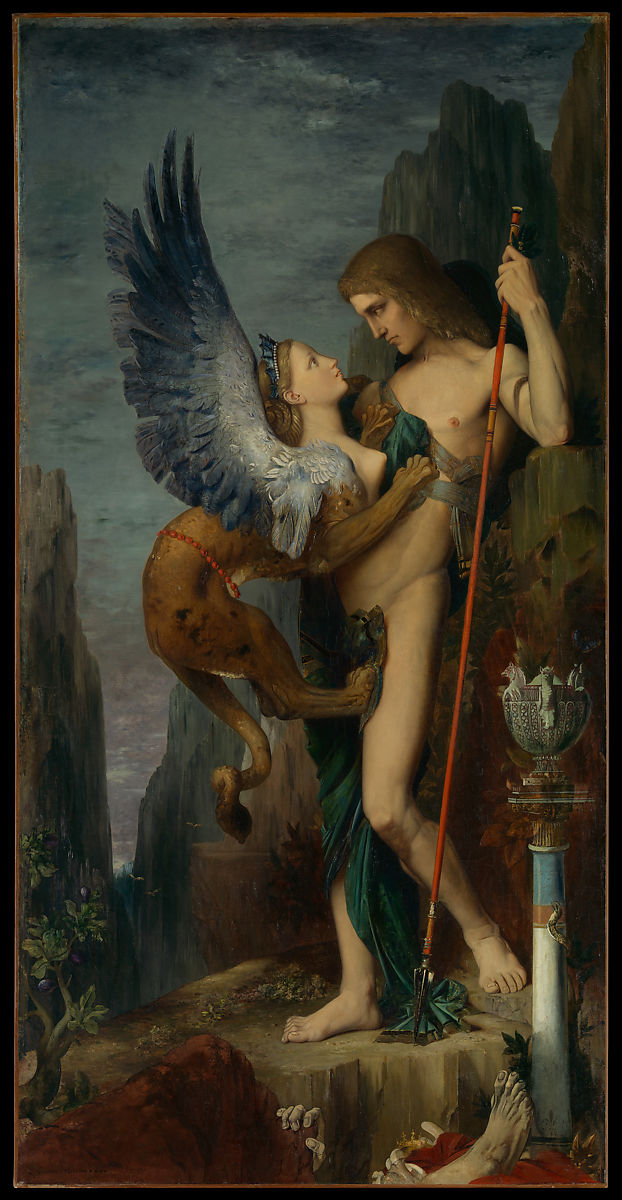
All of my quotations will be form the Stephen Berg and Diskin Clay translation, another of those Oxford editions matching a classicist and a poet.  Off to the side I put another famous response to the Oedipus story, Gustave Moreau’s 1864 Oedipus and the Sphinx (hanging at the Met), backstory for the Sophocles play.  Happier times, when sexy Oedipus was making out with the sexy Sphinx.  Or whatever is going on there.  Dig that creepy ravine full of corpses.

Oedipus was the great Greek monster-killing hero who won not through feats of strength or the seduction of helpful women – we’ve seen all of that lately – but through his intelligence, so he is a good choice for the invention of the detective novel by Sophocles.  The Delphi oracle tells King Oedipus that the plague tormenting Thebes will only subside when the murder of the previous king, Laios, is solved.  And Oedipus is just the man to solve a cold case:

Now I am here.

I will begin the search again, I

will reveal the truth, expose everything, let it all be seen.  (29)

And although Oedipus turns out not to be such a good detective, he does solve the case.

The perfection of the play, what makes it an exemplar, is its use – its embodiment – of dramatic irony, brilliant at every level from the plot, well known to every Greek, down to the individual lines, often written as if to make the audience wince, or howl.  Just a few lines below the detective manifesto above:

The man who killed Laios might take revenge on me

just as violently.

And Oedipus is right, the killer of Laios takes a terrible revenge on Oedipus.  One theme is about knowledge and truth.  In the first few lines, before he knows about the oracle, Oedipus says:

I am king, I had to come.  As king,

I had to know.  Know for myself, know for me.  (23)

The knowledge theme is linked to another complex system of imagery full of light and sun and sight:

KREON: Once everything is clear, exposed to the light,

we will see our suffering is blessing.  All we need is luck.  (27)

But as the clues appear (DETECTIVE OEDIPUS: “One small clue might lead to other,” 28), characters begin to doubt the light, to doubt the oracles of Apollo the sun god.  The chorus begins to get freaked out:

nobody prays to the god of light no one believes

nothing of the gods stays (63)

A theme of darkness intrudes, as when Jocasta, wife and mother of Oedipus, reassures Oedipus:

Why should men be afraid of anything?  Fortune rules our lives.

Luck is everything.  Things happen.  The future is darkness.  (66)

Another line where the audience softly, or for all I know loudly, moans in horror.  The blinding is still ten pages away in my edition.  The fact that both Kreon and Jocasta invoke luck, which Oedipus, convinced of his autonomy, rejects, suggests one line towards interpreting his terrible fate.  Jocasta turns against knowledge, too, by the end of the play.  What good did it do her?

The last time I read Oedipus the King, it was Oedipe roi, translated by Didier Lamaison, the text included as a supplement to his ingenious 1994 conversion of the play into an actual detective novel (also titled Oedipe roi), published in a line of detective novels, shelved with the mysteries in the bookstore where I bought it.  Sadly this novel is not yet in English.  It’s good.

The title quotation is from the great fight between Oedipus and Teiresias early in the play, p. 43.

The next play is Andromache by Euripides.  We have enough Euripides plays that we can observe, or invent, artistic phases, and I remember Andromache, Hecuba, and The Suppliants, all performed within three years, feeling like they belonged together.  We will see.

Friday, April 15, 2022

Hippolytos by Euripides - I wish we men could curse gods

Now here’s a Greek tragedy – Hippolytos, performed 428 BCE, winning Euripides the first prize.  Or maybe one of the other lost Euripides plays performed with Hippolytos was even better.  Another kind of tragedy.

Hippolytos is like Medea, an objectively important artwork, art that generated more art, culminating in Jean Racine’s Phèdre (1677).  Below we see Sarah Bernhardt as Phèdre in an 1893 lithograph by Henri de Toulouse-Lautrec which I have borrowed from the Art Institute of Chicago.


Phaedra has fallen in love with her step-son, who is a member of an anti-sex purity cult and reacts badly when her nurse clumsily reveals Phaedra’s passion to him.  A series of almost logical disasters follow.  In a sense the tragedy is driven by a conflict between gods, with Aphrodite wrecking lives to punish Hippolytos for rejecting sex, but in what I think of as a typical Euripidean touch the psychology of the characters could as well be driving everything.  Racine will be able to toss out Aphrodite and Artemis without much effort.

Where The Heracleidae seemed both overstuffed and overwritten, Hippolytos is balanced, well-paced, and full of complex and subtle imagery.  It is obviously much more carefully written.

By subtle and careful, I mean things like the bee image that Carson mentions in her introduction, which I will not describe here.  Hunting, horses, running water.  I’ll look at the “house” theme.  Here Phaedra, suffering and literally fasting to death to control her lust and shame (she is also a purist), is imagining other adulterous women.

What keep them from shaking in honest terror

at the darkness, their accomplice?

What keeps them poised in the embrace

of the wooden skeletons of their homes

which might any second break their disgusted silence?  (37, tr. Bagg)

That is pretty original, and weird, on its own, and Euripides develops the image.  A couple of pages later the “earthbound” life-loving nurse, having overcome her very brief shock at the possibility of her queen’s adultery, decides that sex is the answer (the nurse occupies the anti-purity position):

To spend your life in a neurotic drive

for perfection is simply not worth it.

Look at the roof of your own house.

Is there a single timber not slightly askew?

As a roof it’s a great success.  (39, tr. Bagg)

The nurse gets a lot of the most outrageous lines.  Euripides is a master of the outrageous, and the nurse is his mouthpiece.  The house returns once more, now invoked by Hippolytos, who wishes he had a witness against a false accusation of rape:

If only this calm inanimate house

could speak for me, and say faintly

if there’s anything so vile in my blood.  (68, tr. Bagg)

As much as I enjoyed Anne Carson’s Hippolytos, line by line I preferred Robert Bagg’s 1973 Oxford version, so I am using it more.  Do not miss, though, Carson’s strange essay written in the voice and under the name of Euripides justifying his (and I presume her) obsession with the Phaedra myth. 

Like many later writers, like Racine, Carson is more interested in Phaedra than Hippolytos.  But poor Hippolytos, what a death scene he gets.  I really had to slow down, which was hard to do at that point in the play, but what pathos, and what great lines:

Why me?  I have not done

one wrong act in my whole life.  (81)

Or even better:

I wish we men could curse gods –

curse and destroy those killers from our graves.  (83)

Is that ever Euripidean.  The deus ex machina appearance of Artemis at the end of the play is a cheap device in most hands, but Euripides, a kind of postmodernist, is actually interested in the device, and as skeptical as his readers.  Artemis is as outrageous as the nurse.  She can’t cry for him, sorry, gods can’t cry.  She can’t see him die, that would be “pollution.”  And don’t worry about justice, since Artemis will just murder one of Aphrodite’s favorites to balance things.  So no problem, right, you know, cosmically?  We’ll see this again, several times.

Nex week is the play of plays, Oedipus Tyrannus, Oedipus Rex, Oedipus the King, the first detective story, among other things.  I am not a fan of “should read,” but if there is one Greek play you should read, it is probably this one.

Friday, April 8, 2022

The Children of Heracles by Euripides - I don't mind telling you, these oracles have got me worried

The Heracleidae, or The Children of Heracles – I know I am being inconsistent about the spelling of Herak/cles – by Euripides, typically dated to c. 429 BCE based almost entirely on the way the end of the play mimics a recent event from the Athenian headlines, which is plausible.  Read all about it in Thucydides, as I mentioned last week, but not here.

The children of Heracles, who simply hang around on stage, are being chased from city to city by King Euystheus, his persecution of Heracles continuing even after the death of the hero.  But now the city is Athens, and (after some violence), the children find a home.  Euripides is flattering Athens again, although the flattery is perhaps already turning sour.  The commitment of Athens to its ideals may not be as pure as its rhetoric would suggest.

DEMOPHON (king of Athens): If you’ve another plan, let’s hear it, since

I don’t mind telling you, these oracles

Have got me worried and at my wit’s end.  (133, tr. Ralph Gladstone)

I did not remember this as good Euripides, and I have not changed my mind.  It appears to me to be overstuffed with ideas, and perhaps written in haste, so the connections between scenes are often jagged.  The imagistic language is undeveloped.  The chorus often seems to be off in its own world.  The text is, almost certainly, in bad shape, with major pieces missing.  So although I wonder why Macaria, the daughter of Heracles, vanishes after offering herself for blood sacrifice, the answer is likely that the speech about what happened to her is lost. 

Euripides was obviously fascinated by all of the myths about young people sacrificing themselves for some stupid oracle – many examples await us – so he likely would have done something with the trope here.  We’ll never know.

When Eurystheus is captured in battle, Alcmene, the mother of Heracles, insists on murdering him, a gross violation of the rules of war.  The chorus, representing Athens, protests.  Eurystheus, in two speeches, defends himself while Alcmene becomes a monster.  The swing in sympathy here is wild, and likely the most interesting part of the play.

ALCMENE: Take him away, and when you’ve killed him, throw

Him to the dogs, to scotch his last hope that

He can come back and exile me again.

CHORUS OF ATHENIANS:  That’s the solution.  Take away this man.

I want to make sure that our kings are cleared

Of all responsibility in this.  (155)

And that’s the end, of the text we have, at least.  Like I said, sour.


I had no luck finding an interesting depiction of a scene from The Heracleidae, so I settled for one of the favorites of the Greek vase painters, Heracles terrifying Eurystheus – that’s him cowering in the pot – with the Erymanthean boar, captured as his fourth labor.  So some back story about why Eurystheus is tormenting the children of Heracles, and Eurystheus is a character in this play. This particular amphora is at the Louvre.

The next play is another Euripides, a good one, I am happy to say, a major work, like Medea, art that has generated more art.  It is Hippolytus (428 BCE), the ancestor of Jean Racine’s Phèdre (1677) among many other works.  Proust fans should read this one. 

Monday, April 4, 2022

Nikos Kazantzakis's The Odyssey: A Modern Sequel - what a monster - mankind's murderess soul seemed deep

What a monster, but it’s done now.  I just finished Nikos Kazantzakis’s massive 1938 epic The Odyssey: A Modern Sequel in its staggering 1958 translation by Kimon Friar, in collaboration with Kazantzakis. 

In the Greek, it is “33,333 lines of an extremely unfamiliar seventeen-syllable unrhymed iambic measure of eight beats” (ix), using “simplified spelling” and “a special lexicon of almost 2,000 words… in familiar and daily use by shepherds and fishermen” (x), all of which has disintegrated in the English, which makes do with regular old alexandrines. 

What are you gonna do?  Maybe someone who reads Greek will come by and tell me what I am missing.  I doubt that will happen.

Kazantzakis is writing in the tradition of Dante, Tennyson, and Cavafy, sending a restless Odysseus off on new voyages, but aside from writing a massive epic rather than a lyric poem he also cuts the last two cantos off of Homer, beginning his story just after the death of the suitors and thus creating a branching, alternate epic.  His Odysseus has been changed, perhaps traumatized, by his adventures, and is now a danger to his home and family:

The stooped house-wrecker in his brine-black heart drank in

the uncivil poisoned welcome of his shameless people

and in his wrathful heart a lightning longing seized him

to fall on his isle ruthlessly and put to the sword

men, women, and gods, and on the flaming shores of dawn

scatter to the wide winds the ashes of his own homeland.  (Bk. 1, 6)

So what a relief when he recruits a crew of misfits and heads south, for good, his patron god no longer the civilized Athena but Death.  The Odyssey of Kazantzakis is, really, a philosophical poem, beginning with Nietzsche and ending with Epicureanism, with Odysseus becoming reconciled with the world and disintegrating into the oversoul, let’s say.  The book often made me think of Hermann Hesse.  Somewhere in the middle I wondered if Odysseus would meet Buddha, or become Buddha.  Yes and perhaps yes.  He meets Don Quixote, too, a camel-riding, slave-freeing East African Don Quixote.  I would read that novel, if anyone would write it.

I thought the last four cantos, the increasingly abstract death of Odysseus, were the best part of the book.  I assume Kazantzakis had a good sense of where he was going but was more inconsistent filling in the episodes in between.

The ethos of the book is masculinist.  Lots of phalli and breasts; lots of seed and milk.  All of this is fair game for the imagery of an anthropologically sophisticated maximalist syncretic mid-century work of literature, but I found Kazantzakis’s language sometimes turning into kitsch.  The book contains its own critique – the eventual Epicurean position demands a balance – but at times it was rough going.  The second major episode of the book is set in a grotesquely masculine Cretan bull-god society, where some of the kitsch is likely intentional.  The bull-god is overthrown by Odysseus and his friends, with a happily pregnant Helen (yes, that Helen) installed as the ruler of the newly feminized culture.  The masculine principle, pushed too far, is decadent, corrupt, and destructive.  Clearly a critique.  “The fate of woman suddenly seemed to him most cruel” (Bk 6, 187, before the revolution).

Still, The Odyssey is not exactly due for revival.  This is not its moment.  Perhaps it will never have another moment.

The bit in the title is from Book 6, p. 186:

Odysseus watched, and mankind's murderous soul seemed deep,

bottomless, sunless, pummeled like earth's bloody crust.

But Odysseus, and the patient reader, has a long ways to go from here.

Friday, April 1, 2022

Medea by Euripides - No other soul can hold so many thoughts of blood

With Euripides’s Medea (431 BCE) we’ve reached the point that inspired me to read the Greek plays in some kind of chronological order.  From Medea on for more than twenty-five years, there is a surviving play, sometimes two or three, in almost every year, a mix of Euripides, Aristophanes, and Sophocles.  And meanwhile, the Peloponnesian War begins, just a few months after the performance of Medea, ending in 404 BCE with the conquest and destruction of democratic Athens.  I have, perhaps incorrectly, placed the final surviving tragedy, Oedipus in Colonus in that year, rounding off not the great tradition of Greek tragedy just as the culture that supported it is violently transformed into something else.


Euripides and Aristophanes, in the plays we have, directly respond to the events of the war in their plays.  They perhaps invent the protest play.  Sophocles may well have been above it all.  The reader interested in putting the plays alongside the History of Thucydides will find many interesting things.  I am not so interested in that right now, but rather the literary interactions among the playwrights, the way they respond to each other.  But of course the entire tradition was always deeply intertextual, telling the old stories again and again.

As with Medea.  I wondered, as I read it, what a reader unfamiliar with the story might be thinking.  The audience knew it in detail, so from the first lines, as soon as we learn where we are in Medea’s story (meaning, this is not about the Golden Fleece, and not about the gruesome trick murder of King Pelias) we anticipate a series of horrible deaths, even if, give the variety of stories, we are not sure exactly how everyone will die.  Was the audience prepared for the detailed gore of the Messenger’s description of the death of Jason’s bride, eaten away by Medea’s poisoned dress?  Or was the gore an innovation?

The prizes were likely awarded as much on the costumes, music, and dancing as for the plays themselves, and we know nothing of the competition, or of the other three Euripides plays presented with Medea, but still, Euripides came in last place that year. It was later writers – Ovid, Seneca – who identified Medea as one of the best plays.

Let’s see.  What do I think about this one.  Medea is an archetype of the Strong Female Character, getting stronger as the plays progresses, transcending humanity by the end, if she were ever such a thing:

Let no one think me a weak one, feeble-spirited,

A stay-at-home, but rather just the opposite,

One who can hurt my enemies and help my friends;

For the lives of such persons are most remembered. (p. 86, tr. Warner)

Medea cannot give up the murder of her own children because it might make her look weak.  To whom, I wonder, but as is often the case in Euripides the psychology is pretty individual.  The gods and fate are distant.  Himadri, the Argumentative Old Git, has been writing about the curious split structure of so many of the plays, but Medea is pure – one single rising, or falling, action, from Medea’s feminist manifesto in her first speech (”We women are the most unfortunate creatures,” 67 - the bit in the title is also from this speech) to, mounted on her dragon chariot, her triumphant humiliation of her no-good ex-husband at the end.

The clueless chorus is amusing.  The open flattery of Athens is odd, except see above.  As the Peloponnesian War progresses, the flattery will dry up.

Quotations have been from the Rex Warner version.  I also read Jean Anouilh’s 1946 Médée, an adaptation, not a translation, and I found it thin, humanizing Medea a little too much, making her into a “crazy ex-girlfriend” without any mythic weight.  Not as interesting as his Antigone or Eurydice.  The French was easy, at least, a sign of progress.

I put a 1606 Italian print, an illustration from Ovid’s Metamorphoses, atop the post.  It is at the Met.

Next week’s play is The Heracleidae or The Children of Heracles, dated to 429 BCE entirely because of a link to a contemporary event.  So who knows, really.  It is, in a number of ways, a strange play.  I believe we are all used to that by now.