Showing posts with label AESCHYLUS. Show all posts

Thursday, December 1, 2022

Thanks and praise to celebrate the happiness of this great event – the end of the Greek play readalong

I am quoting the end of Alcestis by Euripides, his early whatever it is, not a tragedy, not a satyr play, not a comedy.  Admetos has won back his wife and the play is at its end, so he declares “a feast of thanks and praise” (tr. Arrowsmith), which is what I want to do.  If we had done all this in a real-life book group I would take you all out for gyros.  But Admetos ends the play with this:

From this day forth we must remake our lives,

And make them better than they were before.

We can only try.

So, first, many thanks to anyone who participated in any way, on your own, in the comments section, or otherwise.  Anyone who wanders around in the comments of my posts will find some superb responses and insights; anyone who follows the links to posts people wrote will find the same.  Intellectually, this exercise was very good for me.  I hope for you, too.  Endless thanks to everyone.

I had read all of the plays, except Menander’s Dyskolos, about 25 years ago, and had reread a few since then.  Antigone I knew from much earlier, from Western Civ in college.  The core stories and myths and characters I knew from childhood, and they are as familiar to me as another set of stories and characters I was absorbing at the same time, “Bible stories.”

What did I learn this time?

First, there was my epistemological crisis, visible in my earlier posts before I got over it.  The evidentiary base for what we know about classical Greek plays was much weaker than I had previously understood.  For example, we all know that each playwright directed three tragic plays and a satyr play, like the Cyclops of Euripides, full of booze and nonsense.  But Alcestis was presented in the “satyr” spot, and thus the evidence is actually half satyr and half not-satyr.  What was the real ratio?  How often did writers use the satyr spot for something more unusual and innovative?  Alcestis is unique among the surviving plays, but what does that tell us.

So, second, this time I understood how we were reading these extraordinary plays in a massive void of lost plays. Nine tragedies a year, plus three satyr plays, and an indeterminate number of comedies (four to six?) every year, and we have almost none of them, even by the most famous playwrights.  For the first twenty-eight years of Sophocles’s extraordinarily long career, we have Ajax.  He did not necessarily submit plays every year, but we could easily be missing eighty or ninety early Sophocles plays, pre-Antigone.  How I would like to get to know young Sophocles.

The remarkable thing, and I think everyone saw this, was how easy it was, after a couple of plays, to get a sense of the personality and sensibility of the author: rough, mythic Aeschylus; methodical, pious Sophocles, the perfect candidate to invent the detective story; turbulent, to use William Arrowsmith’s favorite word, Euripides.  With Euripides, we are lucky to have enough plays to even see his progression, to watch him become angrier with Athenian wartime politics until he becomes disgusted with the entire Athenian, or possibly human, experiment, culminating in his astounding late works of pessimism like Orestes and Bacchae.

But this is all a construction, the reader inferring the author from the available evidence, when most of the evidence is missing.  Who knows what Aeschylus or Sophocles would look like if we had seven more plays.  It is hard to believe that there are too many more masterpieces at the level of Agamemnon or Oedipus the King among the lost plays.

Given how much we have lost, the twenty-seven year or so stretch between the Medea of Euripides (431 BCE) and Oedipus at Colonus by Sophocles (say 404 BCE) where we have a play, sometimes two, almost every year, takes on enormous meaning, especially when these plays are contemporary with the Athenian history described in detail by Thucydides.  The narrative is very strong.  Honestly, this is why I got so excited by reading the plays in chronological order, which I had not done before.  Just watching the hilarious one-sided duel between Aristophanes and Euripides.

Then, in a coda, Menander and the New Comedy come along, thinner but less alien, leading to Roman comedy, Shakespearean comedy, and television comedy.

Prmoetheus chained to the rock, Cassandra declaiming her own death, Oedipus learning the truth, Antigone arguing ethics with her uncle, the entrance of the chorus of the birds, Dionysus outsinging the chorus of the frogs, Medea murdering her children, Orestes burning it all to the ground, Dionysus dressing up Pentheus.  What things we saw.  The chorus in Agamemnon claims that Zeus “las it down as law / that we must suffer, suffer into truth” (tr. Fagles), but I feel we found a great deal of truth without much suffering, which is how great literature usually works.

I am thinking of writing a longer essay on our experience this year, and sending it – who knows – somewhere – so if you have any ideas you do not mind me stealing, please let me know.  Another debt.  My deepest thanks, as it is.

Friday, October 21, 2022

The Frogs by Aristophanes - Brilliant! Brilliant! Wish I knew what you were talking about!

The Frogs by Aristophanes is this week’s play.  It was performed in what now look like the waning days of Athens, just before their conquest by Sparta, and in particular the last days of Athenian tragedy, with Euripides and Sophocles both recently dead.  In what may be the most outrageous conceit of Aristophanes, Dionysus, understandably worried about the quality of the plays at his festivals, travels to Hades to retrieve Euripides to save his festival, and to save Athens.  “I need a poet who can write,” Dionysus says (tr. David Barrett, p. 159).  But once he gets to Hades, it turns out there are options.

The first half of the play is the journey to Hades by Dionysus and his servant.  Here we find the famous chorus of the frogs:

FROGS:  Brekeke-kex, ko-ax, ko-ax,

      Ko-ax, ko-ax, ko-ax!

Oh we are the musical Frogs!

We live in the marshes and bogs!

Sweet, sweet is the hymn

That we sing as we swim,

And our voices are known

For their beautiful tone…  (164)

I cannot guess how often I have seen writers, modern writers, quote those frogs.


The second half of the play contains a duel between Euripides and Aeschylus over who is the better poet.  Sophocles if of course above all this nonsense.  The debate, whatever ridiculous turns it takes, is genuine, a real contrast of the aesthetic ideas of the two poets.  It is the invention of Western literary criticism, perhaps a hundred years before Aristotle’s Poetics, which, by the way, I invite you to read along with me next week.  Some of the terms of the debate are obscure for us, and not just us:

DIONYSUS: Brilliant!  Brilliant!  Wish I knew what you were talking about!  (198)

But many are clear enough from the plays we have.  A surprising number of the plays mentioned are ones we have, which may say something, although I do not know what, about which plays survived;

AESCHYLUS:  Then I put on The Persians: an effective sermon on the will to win.  Best thing I ever wrote.

DIONYSUS:  I loved that bit where they sang about the days of the great Darius, and the Chorus went like this with their hands and cried ‘Wah! Wah!’  (194)

Dionysus is perhaps not the most sophisticated theater-goer.


If The Frogs were some poor reader’s first Greek play it would likely be gibberish.  Too inside.  I mean,  the first line of the play is literally a joke about jokes:

XANTHIAS: [surveying the audience unenthusiastically]: What about one of the old gags, sir?  I can always get a laugh with those.  (156)

But for those of us who have made it to this point in the readalong, The Frogs is like a reward.

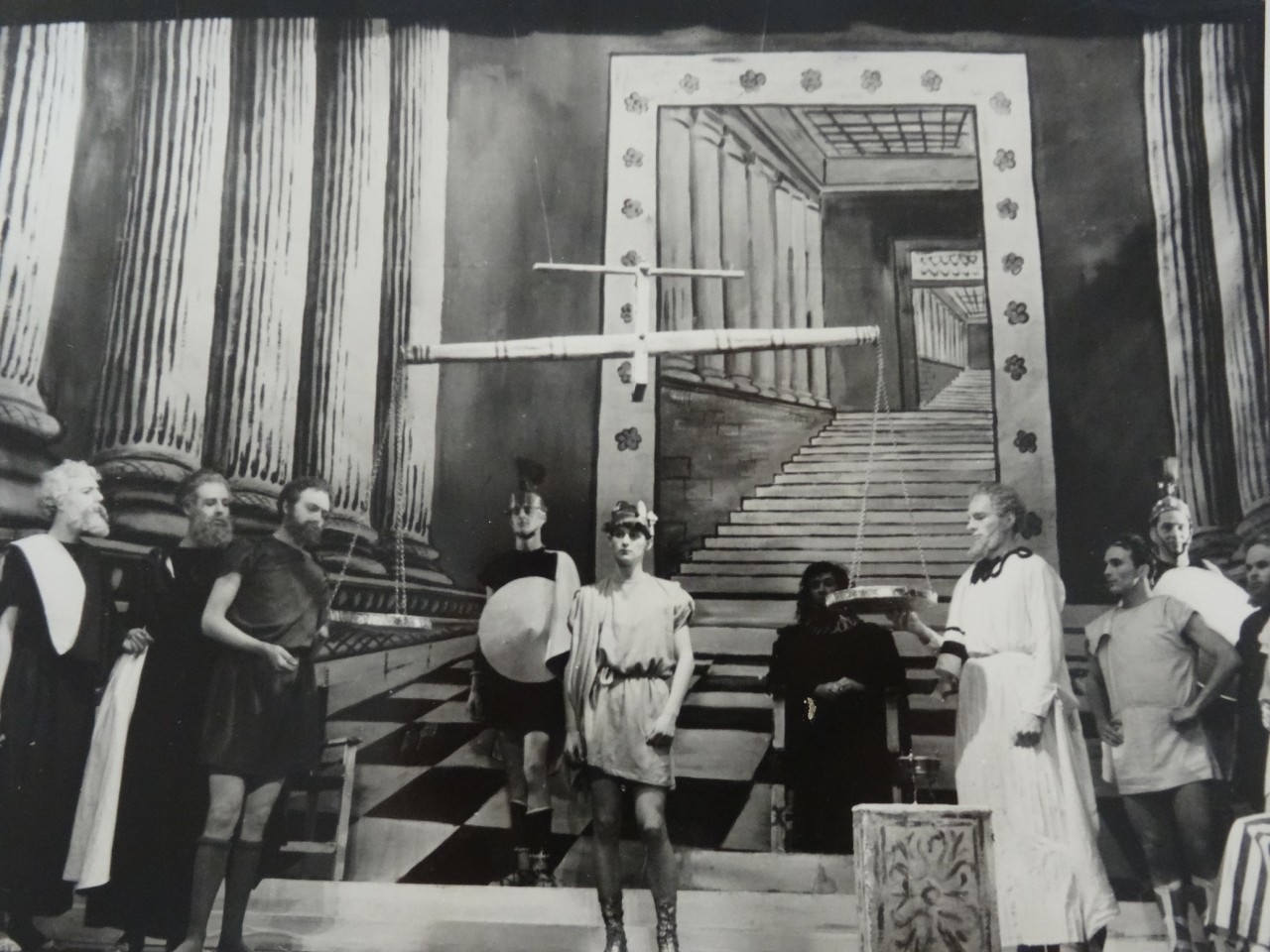
I illustrated this post with two performance stills of the weighing of the poetry of Euripides and Aeschylus, one from 1947 and one from 2013, both from the Cambridge Greek Play site.

Next week is the last surviving tragedy, Oedipus at Colonus by Sophocles, performed posthumously in 404 BCE, or perhaps 401 BCE, or perhaps some other time.  It makes a fine ending to this great tradition.

Friday, March 4, 2022

Terrible kindly ones, come to your rest - The Eumenides by Aeschylus – Come, Furies, dance!

Here we see, in a representation likely dated fairly close to The Eumenides (458 BCE), Apollo protecting Orestes from a Fury, from the British Museum:


I know, I know, the wings:

PRIESTESS: Black, like the rags of soot that hang in a chimney,

Like bats, yet wingless.

Each of their faces a mess of weeping ulcers –

The eyes, the mouth, ulcers.  (Hughes, 152-3)

Another great bit from a minor character.  Again, I will mostly use the Ted Hughes translation for quotations, and Robert Fagles for one exception.

Orestes is pursued by the Furies for the murder of his mother.  He is defended by Apollo, and judged by Athena and a juror of Athenian citizens, who successfully end the cycle of bloodshed means of a move to a new mythic stage of civilization.

There is the first extant courtroom drama, the beginning of a genre, with a remarkable number of the pros and cons of the genre present from the beginning, the big con being the opaqueness, the arbitrariness, of the jury’s decision, and in a fate-driven ethos like this, close to rigged.

I particularly enjoy the moment when the prosecuting and defense attorney begin screaming insults – “Filthy witches – rubbish of creation” (180) – at each other.  I suspect this is an example of Athenian realism.  Audience members were thinking “That’s like when I was on the jury.”  The defense attorney tries to bribe the jurors; the prosecutor threatens them.  The core of the genre is ready to go.

The big mythic story is the old gods versus the new, the earth gods versus the sky gods, big primal forces versus human civilization, with, implicitly, the humans absorbing both into a new humanistic third era.  The Furies are underground creatures, “Made of darkness, clothed in darkness” (168), and when they lose their case they lament that:

The earth is overthrown.

Our laws are obsolete.

You younger gods

Who argue us out of court,

And rob us of what is ours –

You violate creation!  (187)

But, in a compromise, they end up living in an Athenian cave, transformed into The Kindly Ones (“Terrible kindly ones, / Come to your rest,” 197), which for them is a happy ending.  They like caves.  Everyone, old, new, and newer, claims to be following the law; everyone is following some law.

I wonder, as usual, but more so this time, what the Athenian audience was thinking.  Aeschylus did not invent this story.  The cave, the cult site, in which the former Furies lived was real, on the opposite side of the Acropolis from the Dionysian Theater where the Athenians were watching the Furies howl, argue, and dance.  Seeing these protective but ancient powers out in the open, casting their spells, must have been pretty strange. I’m switching to Fagles:

FURIES:     Come, Furies, dance! –

link arms for the dancing hand-in-hand,

now we long to reveal our art,

our terror, now to declare our right

    to steer the lives of men,

we all conspire, we dance!  (Fagles, 245)

Ted Hughes, I am sad to say, omits this passage.  His Furies do not dance.

Next week’s play is Antigone by Sophocles, a great among the greats, and a good choice for the person who has never read a Greek play.  I’m going to see what Seamus Heaney’s adaptation is like.

Friday, February 25, 2022

The Libation Bearers by Aeschylus - How can we hope to do what has to be done?


ELECTRA:  Everything dies – the dust is forgotten.

How can we hope to do what has to be done?  (Hughes, 109)

Robert Fagles calls it The Libation Bearers; Ted Hughes prefers Choephori; in either case it’s the play where the bloodthirsty chorus of female slaves howls for avenging the murder of Agamemnon that we all enjoyed so much in the previous play.

CHORUS:  Let me scream

That holy scream of joy.

Why should I smother it?

If Justice shares my hope,

If God rides the savage storm

That shakes my heart for vengeance –

Vengeance, vengeance, vengeance.  (Hughes, 111)

Will we enjoy the murder of Clytemnestra as much?

I would have guessed that this chorus, captives taken by Agamemnon over the course of the Trojan War, would not be so firmly on his side, but he is dead and his murderers and their current enslavers, Clytemnestra and Aegisthus, are alive.  The chorus, as we have often seen in Aeschylus, gets a lot of good lines.


The Libation Bearers is tragedy mixed with fairy tale, with its cute brother and sister recognition scene, where Electra recognizes the presence of her brother by the shape of his footprint in the dust – remember this when we get to Euripides – and a parallel pair of curious anti-recognition scenes in the second half of the play, when first the Orestes’s mother and then his nurse fail to recognize him.  The nurse’s failure is admittedly a little more conceptual and thematic, part of the nursing theme that is itself part of the larger washing theme, corrupting blood countered by cleansing water and milk.  Agamemnon was all blood.

Not that The Libation Bearers does not have plenty of blood.

CHORUS:  But Orestes fought, he reached the summit

of bloodshed here…  (Fagles, 219)

This is more or less at the moment when Orestes kills his mother, egged on by the chorus and his best friend.  My understanding of the ethics of the play is that the killing of Aegisthus, the uncle of Orestes and an usurping tyrant, is at worst neutral, just power politics, while the killing of his mother is an abomination, one more in a long line for this family.  The most curious moment to me was just before the lines above, when Orestes hesitates and doubts:

ORESTES: Pylades, can a man kill his mother?

Can he perform anything more dreadful

Than the murder of his own mother?

What shall I do?

PYLADES:  Remember the words of Apollo.

Obey the command of the god of the oracle.

Embrace the enmity of mankind

Rather than be false to the word of heaven.  (Hughes, 134-5)

The strange thing is that these are the only lines of Pylades, who has otherwise been silently shadowing Orestes through the play.  If I think like a fantasy writer, then this creature is clearly some kind of double, Apollo, or an agent of Apollo (or of someone else?} who has taken the form of, or possessed, the friend of Orestes.  Just a few pages later, we see that “Pylades” is essentially lying: it is the Furies, not men, who begin to torment Orestes.

They are climbing out of the earth,

Out of their burrows in old blood.

Eyes like weeping ulcers,

Mouths like fetid wounds.

Their whips whistle and crack. (Hughes, 144)

In an earlier speech (Hughes, 106), Orestes says this is what Apollo told him would happen if he did not avenge his father.  Apollo is a liar.

CHORUS:  Where will it end? –

where will it sink to sleep and rest,

  this murderous hate, this Fury?  (226, tr. Fagles)

And curtain, although the Greeks did not have curtains. An intermission, a week long for us, and then we will get the answers to those question in The Eumenides, or The Kindly Ones, where we will say farewell to Aeschylus.

One more curious thing is that we will return to this story three more times, in Sophocles and Euripides.  So few of the plays survive, but we have four versions of this story.

The painting is Louis Jean Desprez’s “The Tomb of Agamemnon,” a study for an 18th century Swedish opera, a surprising item owned by the Metropolitan Museum of Art.  One more Aeschylus play with an altar in the center of the stage.

Friday, February 18, 2022

Agamemnon by Aeschylus - Find some other blood-glutted / Family tree of murder


Agamemnon
by Aeschylus.  What a quotable play.  Here’s a two-line summary:

CHORUS:  Where is the right and wrong

In this nightmare?  (77, tr. Ted Hughes)

War is over.  Queen Clytemnestra is thrilled that her husband Agamemnon is coming home after a decade of war, because it will finally give her the opportunity to murder him in revenge for his murder of their daughter Iphigenia, killed in a ghastly human sacrifice that, if we stick to my schedule, we will see with our own eyes sometime next fall.  How horrible; who would want to see that?  The chorus on the sacrifice of Iphigenia:

Some called it a monstrous act

But it seemed to work.

Anyway, that’s all in the past. (40)

Agamemnon’s family history is so cursed and blood-soaked that this is just usual business.  Here Clytemnestra welcomes Agamemnon home, laying out carpets dyed with “all the colours of blood”:

You have come like a spring day, opening the heart

After locked-up winter.

When Zeus treads the unripe grape

And lets the wine flood out

Then the whole house is blessed.

As it is now

When you step through your own doorway. (45)

In one of those masterpieces of Greek irony, she openly tells Agamemnon that she is about to murder him.

I had forgotten the unrelieved violence of Agamamnon.  We get not just the murder of Agamemnon, described in detail before it happens by the traumatized prophetess Cassandra, plus her murder, but also graphic descriptions of the cannibalistic murder of the sons of Thyestes, the sacrifice of Iphigenia, and the sack of Troy.  These descriptions take up most of the play.  Horror literature.

Or other kinds of literature.  The quality of the little parts is so impressive.  Agamemnon is arguably the worst part in the play, the most minor.  The watchman who begins the play has some superb lines – “And then – what follows, / Better not think about it” (6) – smart man; the arrogant tyrant Aegisthus is pure ham; and the Herald briefly turns Agamemnon into war literature:

Then on the beaches it was worse. Dug in

under the enemy ramparts – deadly going.

Out of the sky, out of the marshy flats

the dews soaked us, turned the ruts we fought from

into gullies, made our gear, our scalps,

crawl with lice…

But why weep now?

It’s over for us, over for them.

The dead can rest and never rise again;

no need to call their muster.  We’re alive,

do we have to go on raking up old wounds?

Good-bye to all that.  Glad I am to say it.  (124, Fagles)

I have mostly been using the 1999 Ted Hughes translation of Agamemon, which simplifies but also clarifies the language of Aeschylus, but I could not resist Robert Fagles in this passage, with his direct invocation of Robert Graves’s combat memoir, which I doubt is in the original Greek.

Hughes is good, too.  The Chorus of old men on how the war looked to them:

The men came back

As little clay jars

Full of sharp cinders.  (26)

But the big part is Clytemnestra’s, magnificent all the way through.  She is like Prometheus or Ajax, a rebel against the gods.  Much of this blood is supposedly demanded for unknown reasons by the cruel, perhaps insane gods.  Her own grievances irrevocably revenged, she addresses “You Powers, whoever you are”:

Find some other blood-glutted

Family tree of murder –

Go and perform your strange dance

Of justice in their branches.

Leave us.

I ask for nothing,

Now the killing is over –

Only to be left in peace.  (79-80)

Imagine if Agamemnon were the only play of the trilogy that had survived.  But no, so next week we’ll see if the next generation can lift the curse in The Libation Bearers.  Good luck, kids!

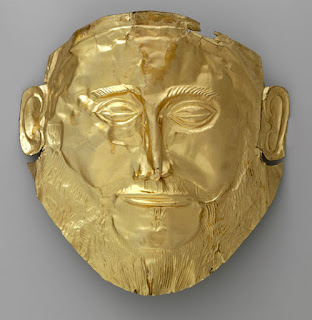
I’ve illustrated this post with a 1906 “galvanoplastic” reproduction of the famous, so-called Mask of Agamemnon, owned by the Metropolitan Museum of Art

Friday, February 4, 2022

Prometheus Bound by let's-call-him Aeschylus - This is what you get / for loving humankind.

This week’s play is Prometheus Bound, by Aeschylus, or maybe not – A Common Reader here reviews a book arguing the “not” case – and first written and performed nobody knows when.  The translator of the Penguin version, Philip Vellacott, wants the play to be late, even posthumously performed, in order for Aeschylus’s ideas about Zeus, to “develop” in a particular way, as if the ideas of writers have to move in a straight line.  No one knows.

But the play is in fact about Zeus, the specific mythical figure but also the concept of godhood.  We are way, way back in the mythological timeline, at the moment Zeus and his siblings have overthrown their parents, the Titans.  Prometheus has been sentenced by Zeus to imprisonment and torture on a Scythian mountaintop, where the play opens with embodiments of Power and Violence dragging Prometheus onto the stage.  Says Power:

He must submit

      To the tyranny of Zeus

And like it, too.

He’ll learn.  (29, tr. Scully and Herrington)

Or, in Vellacott, “Till he be taught to accept the sovereignty of Zeus” (20).  I read the Oxford translation by poet James Scully and classicist C. J. Herington as well as Vellacott’s version; this bit sure shows the difference.

Power?  Violence?  Which gods are these?  Violence does not even have any lines.  How do I even know she is there?  Hephaistos the blacksmith – there’s a god I know – addresses them by name.  Greek plays did not have stage directions, but in Prometheus Bound detailed directions often appear in the dialogue, as during Hephaistos’s violent binding of Prometheus to the rock, under the orders of Power:

POWER: Now, hard as you can, hammer the shackles INto him!

                Watch it now.  The Boss checks everything out.

HEPHAISTOS:  I can’t tell which is worse: your looks or your loud mouth.


The possibilities for staging Prometheus Bound are so interesting.  A 2013 outdoor production at the Getty used a five-ton wheel as the mountaintop.  Characters are constantly flying onto the stage, in winged chariots, or in one case on “a winged four-footed creature” (Vellacott, 29).  Were characters lowered on decorated cranes, or was it all left to the imagination of the audience?  This play seems visually richer than the others we have read, even keeping in mind, however poorly, the masks and costumes and dancing.


There’s another thing we know nothing about, the dancing, the music.  At least the masks and costumes are depicted in art.  At one point, another victim of Zeus appears on stage, Io who was turned into a cow (her mask clearly has horns) and raped by Zeus, then hunted and tortured by jealous Hera.  Aeschylus told Io’s story in The Suppliants, while that story is retold in Prometheus Bound.  Her scene ends with the return of her torments:

spirally wheeld

by madness, madness

stormblasted I’m

blown off course

my tongue my tiller

it’s unhinged, flappy

words words thrash

dashed O at doom

mud churning up

breaking in waves

                               (IO charges off)  (73, Scully & Herington)

I assume that is pretty free.  But if I imagine it as song, along with Io’s maddened, terrified cow dance, it could be shocking to see.

Or ridiculous.  I was surprised by all of the humor in Prometheus Bound, as in Hephaistos’s response to Power up above.  The scene with the blustering Ocean, the character who rides the winged beast, is essentially comic.  The argument between Prometheus and Hermes near the end of the play is comic.  Prometheus gives Io a long prophecy because “I’ve more spare time than I could wish for” (69, Scully).  The play begins with a torture scene and ends with another, possibly mental, that leads perfectly into Percy Shelley’s Romantic sequel, but in between there is quite a lot of comedy, audible in both versions I read.

This is what you get

for loving humankind.  (30, Scully and Herington)

Is that comic or tragic?

Next, for a change, is a Sophocles play, Ajax, thought to be an early one which just by probability puts it before the Oresteia.  With a subject from the Trojan War and a cast of famous heroes and themes of human folly and divine fate, Ajax may look more like my stereotype of a Greek play.  It’s another good one.

Friday, January 28, 2022

The Suppliants by Aeschylus - This is the prelude to suffering and slavery.

That is almost literally what The Suppliants or The Suppliant Women (463 BCE) is, the prelude to what is likely a more tragic, more interesting pair of plays that we have lost.

The fifty daughters of Danaus, rejecting a forced marriage with their fifty male cousins, have fled Egypt for refuge in Greece, in Argos, the home of their distant relative Io, who was turned into a cow and raped by Zeus in the form of a bull.  (I love how everyone in the play just takes all of that for granted).  The Argives have a dilemma – reject the Danaids and break taboos of hospitality and religious sanctuary, or protect them and risk war with the Egyptians.  “I have entered this dispute to my own ruin,” worries the Argive king (67).  The Greeks make the latter choice, pretty clearly the ethically correct one, and the suppliant women are saved.  Hooray!  Curtain.

I don’t know how long the intermission was between plays in the Athenian theater.  Presumably long enough for some fish cakes, some wine, some discussion of the play.

Last week, in Seven Against Thebes, we saw the women of Thebes deliver a long, powerful song about their terrible fate if an army sacks their city.  In The Egyptians, the play that follows The Suppliants, it is likely that the Argives lose their bet, the city is sacked, or almost sacked, and the Danaids are forced to marry their cousins.  The play would end just before, or just after, forty-nine of the fifty brides simultaneously murder their husbands in bed.  This is what I take as the more interesting part of the story.


Anybody’s guess what happens in the third play.  One tradition is that the Danaids spend eternity in Hell futilely carrying water in leaky vases, as depicted in René Jules Lalique’s 1926 glass vase, this particular one now in the Dallas Museum of Art.  But more likely there is a reconciliation of some kind, like we will later see in The Eumenides.

I wonder if – no, I am certain that – there has been a production of the play in Greece where the Danaids are portrayed as Syrian refugees.  It would not take much tinkering.  The Danaids constantly emphasize – or the Philip Vellacott translation emphasizes – that the women are rejecting male violence:

And grant that we, descendants of Io his holy bride,

May escape the embrace of man,

And keep our virginity unconquered.  (58, repeated in a kind of chorus)

They are being pursued not by lust or gain but, they sing, “the male pride of the violent sons of Aegyptus” (55), and when an Egyptian character threatens war he hopes that “the male cause gain the victory and rule” (82).  A director does not have to wander too far from this text.

What else is in here?  This is the third play in a row with an altar in the center of the stage.  We’ll break the streak with the next one. 

The massive irony of the great-great-etc. granddaughters of one of Zeus’s many rapes appealing to Zeus for protection from rape is never addressed in the text that I could see, unless the curious arguments of the women’s maids at the very end are obliquely bringing it up.

How many people are on stage, anyway?  How big is this chorus?  All fifty women, plus their fifty maids?  Or more likely only twelve (plus maids).  Who knows.

One song of the chorus is especially beautiful, although horrible, the one where the suppliants imagine the peace of a sublime death:

Could I but find a seat in the blue air

Where drifting rain-clouds turn to snow,

Some smooth summit where even goats cannot climb,

A place beyond sight, aloof,

A dizzy crag, vulture-haunted,

To witness my plunge into the abyss,

To escape a forced marriage my heart refuses! (78)

The Suppliants is my least favorite Aeschylus play, but there is still plenty in it for a good rummage.  I wonder why it was preserved?  But I wonder that with most of the plays.

Next week we read Prometheus Bound, another first in a trilogy, and another strange one.  The date is unknown, and even the authorship of Aeschylus is an open question.  Talk about interesting.

The title quotation is on p. 77 of the Vellacott Penguin.


Friday, January 21, 2022

Seven Against Thebes in three big scenes - I fear shipwreck, I fear unspeakable things

I fear shipwreck, I fear unspeakable things,

the city’s destruction, the foul death of two kings. (54)


That is the chorus of women in Seven Against Thebes, getting it right as usual.  Aeschylus wrote a Theban trilogy in 467 BCE, of which only this last play survived.  Perhaps the Sophocles play kicked the Aeschylus Oedipus out of the anthologies.  Now there’s a tragedy.

The two sons of Oedipus, enacting the long-running family curse, are at war, with Eteokles defending Thebes from the besieging army of his brother.  I will pick out three great scenes in the play, one of which is also simultaneously the most tedious surviving scene in Greek tragedy (that I remember, at least).

First, there is the chorus’s terrified pre-threnody, when they imagine the sack and looting of the city, especially, vividly, the rape, murder and enslavement of themselves.

Perhaps a dark deliverance may occur

                   in that foul bridal, the untamed

violence of the battle-grounded bed.

                   and there may come to her

                   a species of relief

an end to tidal groans, weeping, and grief. (36)

In other words, the women will be lucky if they die quickly.  This scene was first performed in front of an audience that, fifteen years earlier, had abandoned Athens to the Persian invaders.  The particular suffering of women during war is a major theme of Greek tragedy, so we’ll see this again.

A second great scene comes when Eteokles willfully chooses direct combat with his brother, violating religious taboos and ensuring his destruction.  The chorus tries to dissuade him, but in a long, nihilistic argument he justifies his fratricidal, suicidal decision by the meaninglessness of all things:

ETEOKLES:  Somehow, for a long time,

we have ceased to be a concern of the gods.

Our death is the only sacrifice they would value.

Why any longer lick

at the bone hand of man-harvesting Fate?  (51)

The result is that both brothers win Thebes, exactly “as much land / as the dead may need” (53). I can see how this caught the attention of twentieth century existentialists.  I often think of the essence of Greek tragedy as an exploration of fate and divine capriciousness, but here the anti-hero chooses his doom with open eyes.

Perhaps you have noticed the rhymes and strong metaphors in the above passages.  They are all from the Anthony Hecht and Helen H. Bacon translation (Oxford, 1973), part of a series which teamed a poet and a classicist to create new translations.  Hecht, a great poet, really lets it rip sometimes.  I read Philip Vellacott’s 1961 Penguin translation, too, which is readable and tamer.  An unusually wild bit of Vellacott:

And Tydeus, mad with lust for battle, like a snake

Shrieking at noon…  (99)

And Hecht and Bacon:

But Tydeus, raving and gluttonous for battle,

bellows like a chimera in noonday clangor. (37)

Translators do what they gotta do.  What relationship any of this has with the Greek text I do not know, although that is what the classicist side of the team is for.  Bacon, though, is a classicist with a theory.  The middle third of the play is a Homeric catalogue of champions, seven on each side (there is a spatial “seven” theme that interacts with a temporal “three” theme), with special emphasis on the meaning of the devices on the enemy champions’ shields.  Only one of the defending champions’ shield devices is specifically described, but Bacon’s idea is first, that of course Aeschylus does not need to describe the shields when the audience can simply see them, and second, that there are enough clues in the text that she can guess what the shield emblems are supposed to be.  The climax of the scene is not just when Eteokles embraces his doom by choosing himself as combatant against his own brother, but when he reveals his shield emblem.  The audience, which has been following along carefully, gasps in horror!  He has picked anger (Fury), rather than love (Aphrodite)!

What do I know about any of this, but the whole scene makes a lot more sense in the Hecht and Bacon version than in Vellacott.  Something is happening on stage that is part of the spectacle, not the text.

I hope anyone reading along has enjoyed Seven Against Thebes.  I guess I think it does require a little more forceful imaginative sympathy than most of the other Greek plays, a little more of an attempt to imagine the Greek perspective.

Next is The Suppliants or The Suppliant Women, four years later (463 BCE), just in time to confound all generalizations.  The protagonist is the chorus!  And the play is not a tragedy!

Friday, January 14, 2022

The Persians by Aeschylus - soon new disaster gushes forth

That little tag (l. 814, p. 145) about disaster could be from many Greek tragedies, but it is specifically from The Persians by Aeschylus (472 BCE), his first extant play, and therefore the first extant Greek play, and therefore the first extant play, which amazes me every time I think about it.

The Persians is likely not the first in many other ways, although as with any aspect of this subject, who knows, but it is pretty close.  The cult of Dionysus had only been in Athens for a hundred years or so, and the interactions between a chorus and a single actor performing some kind of dramatic story (meaning, a play) younger than that.  The Theater of Dionysus had only been in use for about twenty-five years, which is likely about how long Aeschylus had been writing and directing plays.  Greek tragedy was already a mature theatrical tradition when Aeschylus wrote The Persians, with a number of older playwrights, experiments, and so many lost plays.

Side note: my plan is to write about various aspects of Greek plays as I write about specific ones.  I won’t say anything you won’t read in the introductory material to whichever editions you are reading, but it is all part of how I organize my thoughts about the plays, and about literature generally.  Why did anyone write this kind of thing?  Who was the audience?  What did the performance of the play look like?  How did it sound?  Basic stuff.

How many Greek tragedies were directly* about recent events, for example?  The Persians is the only example we have.  It is the tragedy of Xerxes, king of Persia, specifically his decisive defeat by a much smaller force of Greeks, primarily Athenian, in the naval battle of Salamis just eight years before the performance of the play.  It’s the victory that kicked off the Athenian Golden Age and created the power vacuum in the Aegean that led to an empire run by a democratic government of a once-minor city-state.  Unlikely events.

My understanding of human nature suggests that a play or epic poem or song about a great victory would be celebratory, perhaps even boastful, but this play is about the suffering of the Persians in defeat, and not of ordinary people but of the Emperor:

XERXES: Weep and howl.

CHORUS:  We weep and howl. (ll. 1060-1, p. 151)

The great showpiece scene features a messenger giving a long description of the battle, the great defeat, and the subsequent disastrous retreat, while the mother of Xerxes and the Persian elders react in horror and grief.  “Yet I must now unfold the whole disastrous truth” (l. 53, 130), the messenger says:

Sirs, I was there; what I have told I saw myself;

I can recount each detail of the great defeat.  (ll. 63-4, 151)

And what gets me is that a large part of the audience, and the actors, and likely the playwright, the 15,000 free male citizens of Athens, were also there, at Salamis, or adjunct to it, and many others had fought in other battles against the Persians.  Even the youngest would remember the events, only eight years before, when a massive Persian force was on the edge of conquering Athens.  Obviously, the tragedy of the Persians is the negative image of the triumph of the Athenians, but The Persians appears more like a radical act of sympathy.  “Why is the groaning earth rutted and scarred” (l. 71, p. 141) asks the ghost of King Darius, a universal question, perhaps, or at least a good one for the rulers of a new empire to ask.

Or I am misreading the tone completely, and The Persians is about gloating and humiliating the justly punished enemies of God-favored Athens.

I read the Philip Vellacott translation in the old Penguin Classics edition, so line and page numbers come from there.

Next up is Seven Against Thebes (467 BCE), the third play in an otherwise lost trilogy about Oedipus and Thebes.  I’m going to switch to the Anthony Hecht and Helen H. Bacon translation because the edition has more notes, and boy does this play need them. While The Persians is a great place to kick off a trip through the Greek plays, Seven Against Thebes is a poor follow-up, in that it is likely the most arcane, alien play we will read.  Who was the audience; what did it look like – I will need these questions more than ever.

I hope everyone enjoyed The Persians.  It is awfully interesting.

The vase, roughly contemporary to The Persians, is at the Metropolitan Museum of Art.  It shows Athena holding the stern of a warship, and likely commemorates an Athenian naval victory.

* A number of later plays are indirectly about recent events, but we’ll get to that.

Wednesday, December 8, 2021

The ancient Greek plays, in chronological order - a readalong for next year - cry, cry in triumph, carry on the dancing on and on!

Let’s read the ancient Greek plays next year.  All of them.  There are not so many, and they are generally short.

I’ll read them all, one per week, and put up some kind of post on Friday, where anyone can join in.  Of course anyone can do whatever they want, on their own blog or on Twitter or in quiet communion with nature.  Below, we can see my schedule, but everyone is welcome to dip in as they like.

I have no Greek and no expertise, except that I read through the plays over twenty years ago, and have read several on occasion since.  They are, overall, fundamental texts in my understanding of literature, not just theater.  They are also full of great characters, exciting stories, extraordinary language (even in translation), and conceptual innovations of the greatest importance.

We are lucky to have seven surviving plays by Aeschylus, seven by Sophocles, nineteen by Euripides (one of which is perhaps by someone else), eleven by Aristophanes, and one by Menander, with one more close enough to complete that I am including it.  Forty-six plays in forty-six weeks.

I have made an educational and perhaps foolish attempt to put the plays in chronological order, relying mostly on the Penguin and University of Chicago editions.  My chronology is likely full of errors – please correct – and anyways should be often taken as guesswork.  But once we get into the 420s the mix gets pretty interesting.  405 is a landmark in literature.  All years are BCE.

A

Aeschylus (524-456)

S

Sophocles (496-405)

E

Euripides (480-406)

Ar

Aristophanes (446-386)

M

Menander (341-290)


472

A

The Persians


470


first Sophocles play

467

A

Seven Against Thebes


463

A

The Suppliants


???

A

Prometheus Bound


Early?

S

Ajax


458

A

Agamemnon


A

The Libation Bearers


A

Eumenides


441

S

Antigone


Before 440?

"E"

Rhesus


438

E

Alcestis

Death of Pindar

431

E

The Medea


430


Death of Herodotus

c. 429

E

The Heracleidae


428

E

Hippolytus


c. 426

S

Oedipus Rex


c. 425

E

Andromache


425

Ar

The Acharnians


c. 424

E

Hecuba


424

Ar

The Knights


c. 423

E

The Suppliants


423

Ar

The Clouds


c. 420s

S

The Women of Trachis


422

Ar

The Wasps


421

Ar

Peace


Late - 420-414

S

Elektra


c. 416

E

Herakles


c. 415

E

The Trojan Women


c. 414

E

Iphigenia in Tauris


414

Ar

The Birds


c. 413

E

Ion


c. 413

E

Electra


412

E

Helen


411

Ar

Lysistrata


411

Ar

The Poet and the Women


c. 410

E

The Phoenician Women


Late ?

E

The Cyclops


409

S

Philoctetes


408

E

Orestes


405

E

The Bacchae

 Death of Sophocles


E

Iphigenia in Aulis


Ar

The Frogs


404

S

Oedipus at Colonus


400


Death of Thucydides

399


Death of Socrates

392

Ar

The Assemblywomen


388

Ar

Wealth


347


Death of Plato

323


Death of Alexander

322


Death of Aristotle

316

M

Dyskolos


c. 315

M

The Girl from Samos


Just putting the list together got me excited to read the plays along with whoever is interested.  Perhaps half of them are among the greatest works in literature.  But we can chat about that later.


As for translations, I have no advice.  The University of Chicago series has been a standard for a long time.  The Oxford series with the black covers always seemed excellent, and have more notes.  Every Penguin Classics I have tired has been good.  Any of these will have adequate notes for most people.  I am curious about some of the “celebrity” versions – Seamus Heaney’s Antigone, or Wole Soyinka’s Antigone, for example.  H.D.’s Ion is a good one.  But all of that can wait, too.

I plan to start in January, with the first post on The Persians up on January 14.

The title of the post uses the last line of The Eumenides as per Robert Fagles.