Showing posts with label puppets. Show all posts

Thursday, March 29, 2018

Literary branding in Lisbon and Lyon

In Lisbon, where I vacationed recently, images of Fernando Pessoa were everywhere, in street art, on mugs and shirts and puzzles, even on books.  This lovely tile example is near the Pantheon, overseeing the Saturday flea market where I bought my own Pessoa souvenir, a €1 tile with the image of Pessoa used on the cover of one of the many Richard Zenith translations.  There were three different Pessoa tiles available.  That seems like a lot to me.

Maybe it is not.  Maybe more cities than I know use once-obscure Modernist writers as their mascot, as their brand.  Kafka in Prague.  Others?  There should be others.  The portrait of Pessoa amounts to a moustache, glasses, and a hat, so it is endlessly flexible and instantly recognizable.  Why is New York City not full of stylized Marianne Moore art?  She wore a distinctive hat.  She was even famous while alive.

Lisbon’s pride in its writers is so great that it was easy to find souvenirs for other writers, the most thorough being a little box meant to contain a tealight; one side of the box had a caricature of Pessoa, of course, and the others had Luís de Camões, José Maria de Eça de Queirós, and José Saramago.  I know that Saramago has had international best-sellers, but it is hard to believe that this is an item for non-Portuguese tourists.  More Eça stuff is visible on the right.

I wondered about Lyon.  It should be more heavily stamped with writers.  The airport is named after Antoine de Saint-Exupéry, but images of the Little Prince are rare.  Even this snowy statue of the Prince and the Aviator is almost hidden, a surprise.  Maybe the Little Prince is too expensive.

François Rabelais is public domain.  He was only in Lyon for a few years, working as a doctor in the Hôtel-Dieu, the big Renaissance hospital, and editing humanist texts with his printer friends, but these are also the years that he wrote and published both Pantagruel (1532) and Gargantua (1534).  The renovated hospital is about to reopen as a gargantuan International City of Gastronomy, whatever that is, the perfect setting for cartoons of Rabelais, Gargantua, and Pantagruel.

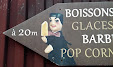
Too openly gluttonous, maybe, and anyway Lyon already has its literary restaurant mascot, the puppet Guignol, created in Lyon in the early 19th century.  Although here he has a popsicle, he is normally carrying a wooden club.  It makes a deeply satisfying thwack against the heads of other puppets.  “Should I hit him [the pirate] again, or has he had enough,” Guignol asked the children at the performance I saw.  Guess how the children responded.  Guignol is a version of Punch, but friendlier and much less weird.

That performance, at La Maison de Guignol, included a surprise guest appearance by another Lyon icon, not exactly literary, although he is responsible for a number of books.  Please see this article in the regional paper Le Progres for the origin of the puppet of Paul Bocuse.  The pirates, in this play, kidnap M. Paul for their ship’s mess, as is logical.  Bocuse had died just a few weeks before we saw the play, which was not stopping anybody.  They even added a line: “You can’t kill me, I’m already dead!”  French theater works fast, and is ruthless.

Images of Paul Bocuse are everywhere in Lyon, is my point.  Maybe they will fade away, but maybe not.  Maybe a hundred years from now, this will be the Platonic ideal of what a chef looks like. He is not a literary character yet, but might become one.  Still, the city’s branders should make room for Rabelais and Gargantua, for the legendary gluttons who swallow all of that great, bold, heavy Lyon food and wine.

Friday, February 6, 2009

Puppets, witches, and sharp, white teeth - more Theodor Storm novellas

Another reason I don’t just read Important Classics is that so many not-so-important books are so good. Everyone knows this already, I know.

Case in point, the novellas of Theodor Storm. I just finished Paul the Puppeteer and Other Short Fiction, another of Denis Jackson’s lovingly translated and annotated little Storm books. Three stories here: The Village on the Moor (1872), Paul the Puppeteer (1874), and Renate (1878). They’re all set in or near Storm’s home of Husum, and two are even in the same tiny town of Schwabstedt, out on the moors. One can visit Schwabstedt and see the ruined bishopric and the big farmhouse next to it, just like in the stories.

The three stories are of a piece. All three are about thwarted love affairs, each with a quite different ending. All three are told through some sort of filter – in The Village on the Moor, for example, is basically a mystery, with a judge piecing together the story, while Renate is told through the discovery of an early 18th-century memoir. All three, inevitably, include uncanny elements – a sort of werewolf in the first story (a girl with "sharp, white teeth"), a witch in the last, and marionettes, of course, in Paul the Puppeteer.* Marionettes are inherently weird:

“As the wind blew against the house and the small draughty windows, the silent company on the wire behind me began to clatter with their wooden arms and legs. I instinctively turned round and saw their heads waggling and their stiff arms and legs swaying about in all directions in the strong draught. When the injured Kasperl suddenly tossed his head back and stared at me with his white eyes, I thought it better to move a little to one side." p. 96

There are some echoes of the marvelous puppet theater at the beginning of Goethe's Wilhelm Meister's Apprenticeship. If there is any relation to Kleist's "On the Marionette Theater", essay, I don't see it, but I do not understand that piece well.

Because some of the themes and techniques of these novellen are so similar, the art of Storm's writing is highlighted. He returns to an idea because he's exploring it, not because it's a shtick. Storm wrote so many stories that their must be some poorer ones, but the consistency of those that have been translated is amazing. Lovely books. A shame they're not better known.

* To be clear: there's not actually a witch - the story is about superstition - or a werewolf. The marionettes, though, are a bit spooky.

Tuesday, December 18, 2007

Popup books and puppets - Redmoon Theater's Hunchback


Ma femme and I were lucky enough to see Hunchback in Chicago on Saturday, the Redmoon Theater production of Notre Dame de Paris. Redmoon is known for creating spectacles, often wordless or nearly so, with lots of odd homemade devices and off-kilter scaffoldings. The company creates amazing images, but I have found that their storytelling does not always amount to much.

The adaptation of Hugo took care of that problem. The story could hardly be stronger, and the acrobatics, the puppets, the masks, and the pop-up books were all used to tell the story, not replace it. I was most impressed when, after a half hour or so of nearly wordless action, the Author shows up on stage to deliver a lecture on medieval Paris architecture. This is actually right out of the book!*

Whoever had the first had the idea to put a giant pop-up book on stage, and then use it as a mini-stage for marionettes, was some sort of genius. A charming, intimate effect. After the performance, the audience is invited onstage, and can play around with the puppets themselves.

If you find yourself in Chicago before January 20, try to see this show.

* Anyone bogged down in Tolstoy's historical lectures in War and Peace can shift some of the blame to the architecture chapter of Notre Dame de Paris.