Showing posts with label VALLÈS Jules. Show all posts

Monday, August 4, 2014

Back from France - some notes

When I have returned from long vacations I have had trouble writing, so this will be a shallow, digressive post about minor bookish aspects of my trip, designed more to rev up the word-generating machine than to make a point.  Why would anyone want to read such a thing?  Follow that logic, though, and it’s the end of book blogging; extend the argument a bit more and it’s the death of criticism; then follows literature, the humanities in general, and, finally, civilization.  Working backwards, reading this post is a defense of civilization.

In a related attempt to defend civilization, France has a law banning the discounting of books, in effect protecting bookstores and publishers at the expense not just of French Amazon but also many book buyers.  One result of the law is more and better bookstores, marvelous bookstores, like Le Bal des Ardents or Librarie Passages in Lyon, the latter recommended to me by Emma of Book around the Corner, or the larger, deeper, crowded Librarie Kleber in Strasbourg.

I emerged from these stores weeping, or saying I was weeping, since I just meant it metaphorically.  How I would love to live near such a store.  With the books in English, I mean.

New topic.  We plan our travel loosely.  I knew we would be in Auvergne, the mountainous region in the center of France, but I did not know that we would visit Le Puy-en-Velay.  When I began to read The Child by Jules Vallès, the 1878 comic autobiographical novel about the abuse the author received at home and at school, I did not know that it was set in Le Puy-en-Velay.  Yet it is, and we in fact did spend a couple of days there, so I found I had directly if inadvertently prepared for my travels.

The town has some distinctive features:

The image is borrowed from Wikipedia.  On the left is an 11th, or really 14th, century church topping a pillar of volcanic rock.  On the right is the old city and its cathedral, the original starting point for the pilgrimage to Santiago de Compostela.  In the center is a colossal statue of the Virgin Mary planted on an even taller volcanic pillar.  The statue is made of melted Russian cannons.  Many of the tourists, including me, clamber up each of the pillars.  Many others seem to be happy to see them from below.

Vallès mentions almost nothing distinctive about the town.  Streets are steep, and at one point he mentions the unmistakable smell of the mold used by the blue cheese makers. Why doesn’t he mention that giant red statue?  Well, it did not appear until 1860, long after Vallès had moved elsewhere.  How about that aerial church - it was there?  Now I know the answer – he would almost never have seen it from any of his typical vantage points in the dense walled town.

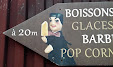
Le Puy-en-Velay comes off well enough in The Child that the town can easily embrace him.  Vallès’s misery was not their fault.  Signs mentioned him frequently.  This square contained the market described in the book; here is the street where he lived and the hospital, previously a church and a revolutionary meeting hall, where he was born.  I had not gone looking for Vallès, yet there he was, and there I was, accidentally ready to meet him.

Tuesday, June 24, 2014

Vallès & The Child's style and humor - When exposed to the light of day, it glints like a saucepan!

I think of 19th century prose style as elaborate, based on just a few writers, I know – Flaubert, Zola, Gautier, Nerval, Hugo, and so on, writers who can really pour it on when they want, who can twist and elaborate with the best in literature.  How strange to read a contemporary of baroque Zola write like this:

What’s this something that my uncle said was at the bottom of my bag?

Ten francs!

Since they come from him, I can accept them…

I’m rich all of a sudden! (129)

This is the signature style of The Child:  frequent ellipses, short lines, single-sentence paragraphs, and incessant exclamation points.  Not every other sentence, like here, but close.  A Victor Hugo signature is a long, intricate paragraph followed by one of a single line, maybe just a word or two, the trick of a preacher or dictator.  Jules Vallès is of course just falling into the imitation of a little kid.

Here the kid, in detention and forgotten, finds a copy of Robinson Crusoe, which he reads in an intense burst:

Hunger takes over: I’m absolutely ravenous.

Am I  going to be reduced to eating the rats in the hold of the classroom?  How can I make a fire?  I’m thirsty, too.  No bananas!  Ah, he had fresh limes!  And to think how I adore lemonade!


Click!  Clack!  Someone’s fiddling at the keyhole.


Is it Man Friday?  Or the savages?  (96)

No, it is merely the embarrassed teacher who had forgotten him for so many hours.  Those extra-wide breaks between paragraphs are from the text.  Chapters are chopped to fragments, even within a scene, as here.

Not that Vallès has not picked up some tricks from Flaubert or the Goncourt brothers or whomever he was reading.  The adult writer takes over to describe a bakery:

The owners are standing behind the counter weighing the round loaves and they too are wearing coats that are whitish or the color of rye.  In addition to the round loaves, there are cakes in the windows: brioches looking like plump noses or tarts like crumpled bits of tissue paper.  (32)

The novel has plenty of little rewards.

I should mention something about the humor of the book.  There is plenty, despite the poor narrator’s frequent beatings.  Much of it – most, maybe – comes from his mother, an updated, lively version of the miserly French peasant, social-climbing yet suspicious of everything outside here little sphere.  When her son wins a school prize, she is certainly not going to buy him a coat for the ceremony.

She rummages around in a large wardrobe that contains her wedding dress, some umbrella covers, remnants of skirts, odd scraps of silk.
Finally she scratches herself on a garish piece of material, so filelike in quality that it scrapes your fingers when you touch it.  When exposed to  the light of day, it glints like a saucepan!  A really lovely material inherited from my grandmother and which cost a “mint of money.”  (38)

And the coat is not the end of it, as the poor kid has to suffer through buttons, and a hat, and white stirrup pants “like a device for a clubfoot.” 

“MY SON,” announced my mother triumphantly, pushing me forward when we arrived at the entrance.  (40)

Maybe it’s not Mel Brooks, all right.  But the mother is a fine character.

Monday, June 23, 2014

My second is full of surprise and tears - a grim return from vacation with Jules Vallès's comic novel The Child

The book I’ll start with, now that I am back from vacation, is The Child by Jules Vallès (1878), a brutal childhood memoir with the names changed to make it a novel, “one of the funniest in French literature,” according to the back cover copy on the salmon-colored NYRB edition (2005), translated by Douglas Parmée, but then come self-serving blurbs by Émile Zola (“a book composed of the most exact, the most poignant human documents”) and Maurice Barrés (“He is the man who liberates us from the family, who liberates us from our father and our mother” etc.) that suggest, or warn, that as funniest novels go this one may not actually be all that funny, and may even be a little bit on the grim side.

Sorry, I’ve been away for awhile, and needed to stretch a little.  Anyway, The Child is an abuse novel:

I didn’t try to kill my father.  He would have liked to cripple me.  He kept screaming, “I’ll break every bone in your body!”

Oh no, you won’t!  You’re not going to break anybody’s bones.  I’m not going to hit you but you aren’t going to lay a single finger on me!  It’s too late, I’m too big now and too grown up.

JUST KEEP YOUR HANDS TO YOURSELF OR WATCH OUT!  (325)

Not so funny, but this is something like the emotional climax of the book, when the author, writing thirty years after the fact, abandons irony to reveal the continuing pain of his abuse by his father, a schoolteacher with a neurotic respect for the discipline of his profession, and his mother, a peasant with a cruel streak.

So my earliest memory starts with a beating; my second is full of surprise and tears.  (6)

I have gone back to the beginning of the novel.  The author moves from the author’s childhood in rural, scenic Le Puy-en-Velay to an eventual escape to Paris, where he becomes a well-known radical journalist.  In between, paradise is a stay in the countryside with his uncle, and hell is studying Latin and Greek, useless, all useless, while his parents alternately punish him.

My mother often comes down to pinch my ears and give me a clout.  It’s for my own good, so the more she slaps me, the more I’m convinced that she’s a good mother and I’m an ungrateful brat.  (12)

The book is dedicated “To all those who were bored stiff at school or reduced to tears at home, who in childhood were bullied by their teachers or thrashed by their parents” (3).  It is a fine member of the lively French anti-school genre, stretching back, at least, to Rousseau’s Émile and continuing today with Daniel Pennac.  And a lot of it of course is funny.  What a poor start I have made.  Tomorrow I will try to undo some of the damage.