Monday, June 28, 2021

Evelina and the comedy of manners - “It was impossible now to distinguish whose screams were loudest”

Business: the blog’s old “subscribe by email” function is being throttled on July 1.  I have moved every email subscriber over to a new service.  My hope is that the only change will be the format of the email, and that you, dear reader, will not have to do a thing, and that this will all be a nuisance to me and to no one else.  We’ll see.  Please let me know about problems.  Apologies in advance.


Pleasure: I read Frances Burney’s Evelina, or, The History of a Young Lady’s Entrance into the World (1778) alongside a Twitter group (#Evelina1778).  Evelina is a curious thing, a hinge in the history of the English novel.  It is nominally an epistolary novel, but moves much closer in form to a standard first-person novel (standard, I mean, for us, now) and in substance to Jane Austen.  Burney’s novel is simultaneously a vehicle to move the innovations of the English comic stage of the 1770s – Goldsmith, Sheridan – into the English novel.

Evelina is a seventeen year-old country mouse, timid and virtuous and beautiful, making her first visit to London.  She has a complicated, mysterious parentage that will move the plot along.  Maybe she is poor and illegitimate, and maybe not.  Guess, in the end, which.  In the meantime, she makes a tour of London entertainment with a variety of appalling friends and relatives, and fights off the unwanted attention, ranging from rudeness to sexual assault, of a variety of men.

To the first point, Evelina is a literal comedy of manners.  The governing conceit is that Evelina is unsophisticated but polite, while almost every other character, whatever their class status, is rude beyond belief.  The middle third of the book is spent with Evelina’s shopkeeper-class cousins (remember that Evelina is describing the scene in a “letter”):

The dinner was ill-served, ill-cooked, and ill-managed. The maid who waited had so often to go down stairs for something that was forgotten, that the Branghtons were perpetually obliged to rise from table themselves, to get plates, knives, and forks, bread or beer. Had they been without pretensions, all this would have seemed of no consequence; but they aimed at appearing to advantage, and even fancied they succeeded. However, the most disagreeable part of our fare was that the whole family continually disputed whose turn it was to rise, and whose to be allowed to sit still.  (Letter XLII)

The forks and bread are unusually material for Evelina, but the key, even new, observations are in the last sentence, about the rules of conduct and their violation.  Minutiae, but also the meaningful substance of much of the next two hundred years of the novel.  There is not much description in Evelina, not much stuff (aside from all of the different carriages, and their ownership, and who rides with whom, as important here as in Austen’s novels), but manners are described thoroughly.

To the other point above, the rules are meaningful and minute because however imperfectly obeyed they make civilization function.  Without them, men, especially, become animals.  Women are under constant threat of assault.  The freedom of women is tightly constrained, but the world outside the home, and sometimes inside, is awful.  This is a dark undercurrent for a comic novel.  The heroines of all three Samuel Richardson novels are kidnapped and threatened, or worse, and I wonder to what extent Burney, who is unlike her heroine a savvy city mouse, is deliberately invoking Richardson, her epistolary ancestor.  But I take the actual London to be a threatening place to an unaccompanied young woman.

The general ethos of Evelina is cruel, aside from the sexual menace.  The “prank” theme reinforces the cruelty.  One of the pranks of course involves the abduction of a woman.  One at the very end of the novel is based on a monkey dressed as a fop.  It goes on for many pages, just when I am ready to wrap up the book.  “It was impossible now to distinguish whose screams were loudest…” (Letter LXXXII).  It is not clear to me to what extent Burney means the pranks as pure comedy, however cruel.  Evelina is not so far from Don Quixote.

Tomorrow I’ll go into the literary history, what I meant by “hinge.”

Friday, June 11, 2021

I. J. Singer's bloodlands novel The Brothers Ashkenazi - the whole world was drenched in blood


I. J. Singer’s The Brothers Ashkenazi (1934-5 serialized in Yiddish, 1936 in English) is a big-sweep historical novel that begins with the takeoff of the weaving industry in Lodz and ends with the Russian Revolution and independence of Poland.  

Some features of the novel: textile factories, assimilating Hasidic Jews, possibly literature’s first depiction of a PowerPoint presentation (“Director Ashkenazi pointed to a chart which revealed that since his sinecure, the factory work force had grown from 3,000 to 8,000 men and women,” 301, tr. Joseph Singer).  One character spends his time “read[ing] Hasidic storybooks about squire who assumed the guise of werewolves in order to harm Jews and about the saints who used sacred blessings to frustrate these wizards and transform them into dogs and tomcats” (100).

But that stuff is not in this novel, which is also full of strikes, revolution, pogroms, and prison.  It is a real “bloodlands” novel, an account of the beginning of the 20th century Eastern European nightmare, especially in the second half, when “[t]he whole world was drenched in blood” (333).  And when the blood starts flowing, for any reason, the Jews suffer the worst.

The Brothers Ashkenazi is surprisingly Russian, not that it is much like any particular Russian novel.  Lodz is, at this time, ruled by Russia.  Revolutionaries get sent to Russian prisons, and German and Polish strikers are murdered by Cossacks.  A good chunk of the novel is set in Petersburg, in order to cover the Russian Revolution, with a few pages from the point of view of Lenin and another that of Czar Nicholas II:  

For a while he did nothing at all.  He followed his usual routine – played patience and dominoes, noted down the weather in his diary, and dined with his retinue.  When the telegrams grew too demanding, he behaved like any henpecked husband and took the advice of his wife, whom he considered his mental superior.  (339, Ch. 53)

A number of chapters essentially abandon the novel’s characters, replacing them with “the soldiers” and “ the rebels” and “the poor housewives.”  That’s pulled from the same chapter; when “the soldiers” refuse to fire on “the poor housewives,” that’s it for hapless Nicolas.  It’s the Russian Revolution in six pages.

It has been so long since I read James Michener that I fear I am wrong, but The Brothers Ashkenazi reminded me of Michener.  I don’t know who a contemporary equivalent might be.  I am expected to be similarly interested in the big history and the little, the true history and the fictional, which serves as something of an exemplar or vehicle, so what does it matter if the characters are one-dimensional and the writing full of clichés.

“Yes, true.  It’s all the Jews’ fault.  They started the was to make money….”

“They ought to be beaten.”

“We Ukrainians know how to handle Jews,” a lame soldier interposed.  “The rope is the only cure for a Jew.”

The others nodded in solemn agreement.

The wagon seemed to throb with blind hatred, ignorance, animal passions.  It choked Yakub like a poison gas, but it didn’t deter him from his mission.  The trains crawled along like a snail.  (394)

What I am trying to say is that this is not the kind of novel where I fuss too much over slow trains being like snails.

Now, that other simile.  I have wondered about this.  The Brothers Ashkenazi was a popular* novel in the United States, with a popular stage adaptation.  Readers of Singer’s novel were well prepared for what they would read in the newspaper over the next ten years.  There are numerous episodes which might lead the newspaper reader of 1940 or 1946 to think “Why, I read about exactly this, in that novel.”  A “poison gas” metaphor borrowed from a World War I battlefield turns into prophecy.  I think part of the power of the novel is that although in some sense a historical novel, it is about a history that is ongoing.

I would not mind reading a book or essay about how fiction had mentally prepared (well or badly) people for the events of World War II.

*  Rebecca Goldstein, introducing the 2010 edition of The Brothers Ashkenazi, writes that “published by Knopf in 1936, it went to the top of the New York Times best seller list, lingering there together with Margaret Mitchell’s Gone with the Wind” (p. xi).  Adam Hirsch makes much of the connection: “In 1936, two novels dominated the New York Times bestseller list.”  Except it is not true; Singer’s novel was never, as far as I can find, on the best seller list at all, and certainly did not “top” or “dominate” it (number two behind Mitchell was George Santayana's The Last Puritan).  I do not entirely trust this strange old website with the best seller lists, and I certainly did not check every week.  Still: false.  Popular but not that popular.

Tuesday, June 8, 2021

there weren’t many books anyhow, and she’d hardly read any of them - preparing to visit Edith Wharton's house

With any luck, I will, later this summer, visit The Mount, Edith Wharton’s home in Lenox, Massachusetts.  


Not bad, huh?

So I have been reading some Wharton, and hope to read a bit more before I set foot in the house.  Recently I read the novella Madame de Treymes (1906, about 60 pages in the Library of America edition) and Summer (1917, 150 pages).  They’re pretty good.

They both have kinda convoluted premises.  Let’s see.  Madame de Treymes is a Jamesian “American innocence versus European corruption” kind of thing.  The naïve American hero wants to marry the former Fanny Frisbee (!), now Madame de Malrive, if she can only divorce her morally poisonous French husband while keeping custody of her son, or as the French family thinks of him, the heir.  The path to the divorce goes through the sister-in-law, the Madame de Treymes in the title.  She is French, and also married to a corrupt French count, and to some degree corrupt herself, naturally, being French nobility.

The innocence versus experience business is ridiculous, Wharton doing James, but the James of thirty years earlier, and on the other hand who cares because she is having so much fun, as with the ludicrous Boykins, expatriate Americans too impenetrably ignorant to be corrupted by Europe, who “live in active disapproval of the world about them,” experiencing Paris like “persons peacefully following the course of a horrible war by pricking red pins in a map” (21).  

Or, for a simpler example, “one of the small gilt chairs which always looked surprised at being sat in” (same page).  A writer enjoying herself.  This Paris story has nothing to do with The Mount.

Summer does.  While creating the luxury of her estate, Wharton also got to know a bit of “the derelict mountain villages of New England”:

… grim places, morally and physically: insanity, incest and slow mental and moral starvation were hidden away behind the paintless wooden house-fronts of the long village street… (1002, Ch. 12 of A Backward Glance, 1933-4)


Ethan Frome
(1911) and Summer are both visits to these Berkshire hellholes.  Ethan Frome is famous for being so fatefully grim, like an American Hardy novel, but Summer is merely depressing, and surprisingly a bit creepy.  It is not strictly speaking the story of a girl groomed to be a much older man’s wife, but it has elements of that story.  The core story is more conventional: Charity Royall falls for the interesting young man who comes to town, in part on the merits and in part because her adoptive father figure has become a creep since his wife died; the nice young handsome boy turns out to be a dog; the father figure is a dog; men are dogs.

Wharton is explicit about male sexual desire and even about abortion in a way that surprised me.  Her scenes with the abortionist resemble those of Theodore Dreiser in An American Tragedy, but that book came out nine years later and everyone knew Dreiser wrote nasty shockers.  Perhaps Wharton, living in France, taking a break from her work as a genuine French war hero, felt a little freer than usual, but the novel was published in an American magazine with no problem, so what do I know.

The main setting is a town with “no shops, no theatres, no lectures, no 'business block'; only a church that was opened every other Sunday if the state of the roads permitted, and a library for which no new books had been bought for twenty years, and where the old ones mouldered undisturbed in the damp shelves” (161, Ch. 1).  Our heroine Charity is the teenage librarian, among the world’s worst librarians:

… she replied that there weren’t many books anyhow, and that she’d hardly read any of them.  “The worms are getting to them,” she added gloomily (163).

That is part of the “meet cute.”  The first chapter is openly comic, and suggests a different way the novel could have gone.  It is the second chapter that takes a more disturbing turn.

“Well, I guess you made a mistake, then.  This ain’t your wife’s room any longer.”

She was not frightened, she simply felt a deep disgust; and perhaps he divined it or read it in her face, for after staring at her a moment he drew back and turned slowly away from the door.  (170-1, Ch. 2)

Charity is one of those Strong Female Characters many readers say they want, but one who is defeated, crushed.

I don’t know that wandering around the gardens of The Mount will give me much insight into Ehtan Frome or Summer, or vice versa.  Quite a contrast.

Monday, June 7, 2021

Eudora Welty is difficult, Poul Anderson is easy

The hardest book I’ve read recently, and the easiest.  The hardest not in French, a separate category of difficulty.


Eudora Welty’s Delta Wedding (1946) is one of the first novels I really dismantled, studying it piece by piece.  This complex novel likely informs the way I understand fiction in ways I do not even know, but it certainly taught me that finding the patterns behind the surface is worthwhile.  The better understood work of art becomes more beautiful.  At least this kind of art.

The Golden Apples (1949) is a relative of Delta Wedding, but linked short stories, all set in the same little Mississippi delta town; how hard can it be, I thought?  And then the difficulties of the book defeated me again and again.  Comical, sometimes – oh no, I was supposed to be keeping track of that!  So I’ll write this off this attempt as something of a failure, except that it is useful preparation for my next reading, when I will be braced and alert and properly equipped.

It was a bit of a relief to poke into the Welty scholarship – don’t be afraid to ask for help! – and see The Golden Apples routinely described as her most difficult book.  By difficult I mean: layered patterning; concealed multi-directional references (the title, is that Hesiod or Yeats? Both); original symbolism; overlapping time; lots of characters; deferred information.  Mostly the latter, really.  Every basic who / when / what question will  be answered, but I may have to hold onto it for ten or a hundred pages.

It’s all the usual Modernist stuff, employed with a high level of art and craft.  Here’s the last sentence:

They heard through falling rain the running of the horse and bear, the stroke of the leopard, the dragon’s crusty slither, and the glimmer and the trumpet of the swan.

Next time, I’ll know what all of that means.  Next time.


I have a box or two of fantasy paperbacks, mostly well-known books, that are causing me anxiety (keep, sell, give away?).  I just re-read one of them, Poul Anderson’s The High Crusade (1960), with real pleasure.   It is a book written on principles opposite of Welty’s.  It is an easy book.  I am supposed to get it – all of it – right away.  I re-read this kind of book to repeat but not deepen the pleasure.

Given what it is, though, Anderson’s book is good fun.  Extraterrestrial invaders make the mistake of landing in a medieval village.  Soon enough, three knights and their yeoman archers and sturdy peasants have conquered an interstellar empire.  It is all preposterous but also episodically, logically inexorable.  The narrative pleasure is watching Anderson move the stakes up, notch by notch, until he runs out.

The High Crusade is an example of the genre of human triumphalism, a descendent of Aristophanes’s Birds (414 BCE), where the Athenians conquer Olympus through sheer exuberance.  Like the Aristophanes play, Anderson’s novel has elements that critique imperialism, but they are all swept away by the energy of the upstarts.  Empires are overthrown and replaced by new empires.  The overthrowing is so enjoyable that the replacement is barely noticed.

There are three more Anderson novels in that box, and come to think of it Tau Zero (1970) is also a human triumphalist book.  Anderson rigs things so humans conquer the next universe, the one that comes after the heat death of our universe.

If you see me reading old fantasy novels, you will know I am rummaging in the box.  They should go, mostly.  Like I need my own copy of The Martian Chronicles.  Like that book is hard to find if I want it.

Wednesday, May 26, 2021

No, more likely, he has failed somehow to read them rightly - Robert Coover, James Sallis, and Manuel Vázquez Montalbán


For some reason I paid $4.95 for Robert Coover’s Spanking the Maid (1982), although, if you can see the REGULAR PRICE, it’s $14!  For 94 pages!  This must have been twenty years ago.  Finally, I have read the book, as part of the ritual of getting rid of it.

Spanking the Maid is, as the title and cover suggest, a sadism and masochism novel, a struggle, possibly voluntary, possibly not, between a maid and her employer.  She is always making mistakes; he is consequently always spanking her, according to the rules of the manual.

The room is clean, the bed stripped and made, the maid whipped, why isn’t that enough?  Is there something missing in the manuals?  No, more likely, he has failed somehow to read them rightly.  Yet again.  (71)

Spanking the Maid is also, or I would say is primarily, a French New Novel by an American writer, about fiction about fiction about fiction, onward as far as you can stand.  Two characters, one setting (a bedroom with attached bath), with events repeated again and again, the perspective shifting from the maid to the employer and back, a few pages at a time.  The interest, the art, or alternatively the tedium, is in all the little variations in the events of the morning, all on the same template: the maid makes an error and is punished.  Again, perhaps as part of a sexual game, but perhaps not.  The woman eventually wins the game, for what that’s worth.

The internals rhymes and made/maid pun in the first sentence above are intentional and inventional – an intention/invention confusion is on the same page – and I would not have minded more of the linguistic play, more of the occasional Surrealist elements.  But mostly it is a text about repetition, like Raymond Queneau’s Exercises in Style (1947), with less style.  


Speaking of whom – I am switching to James Sallis’s The Long-legged Fly (1992):

One of the plates read W. Percy, M.D., another R. Queneau.  The third one just read B.S.  I punched the button beside it.  (86)

That is New Orleans private investigator Lew Griffin on a missing-person case, invoking two of his novel’s ancestors, French and Existentialist-American.  The Long-legged Fly is less a mystery novel than one of those anti-mysteries I enjoy, full of literature and parody and an utter lack of resolution.  It takes a severe meta-fictional turn at the end, guaranteeing that most mystery fans, as I understand them, will loathe the book, but the character who writes detective novels notes that “[t]he books are very popular in France” (172), and in fact Sallis’s Lew Griffin novels are more popular, if not “very” popular, in France than in the U.S.  The Long-legged Fly was Sallis’s first novel, so it was a little weird to see him prophesy so well.  But he knew what he was writing – again, an Americanized existentialist French New Novel – so it was not such a crazy guess.


I’ll cram in one more detective novel, Manuel Vázquez Montalbán’s Murder in the Central Committee (1981, tr. Patrick Camilleri), the fifth of the Pepe Carvalho series.  I felt I finally needed to read one of the novels that gave Andrea Camilleri’s Inspector Montalbano his name, so my interest was meta-fictional to begin with, before we find a murder suspect complaining that “Vázquez Montalbán can win the Planeta Prize” (60) – for an earlier Carvalho novel.

Or perhaps the suspect is praising the prize.  I'm not sure.  The Central Committee is of Spanish Communists, newly liberated from Franco’s repression.  Their chief is murdered, so our detective and his poor readers have to sit through a lot of theoretical Communist gibberish, and I do not want to say I understood it all.

In between, there is a lot of food, and some vivid sex.  Vázquez Montalbán writes with the kind of exuberant post-Franco excess I associate with Pedro Almodóvar, the sense artists seemed to have that they needed to catch up with the rest of Europe, in gusto, among other things:

Madrid markets provide a lesson in polychromic symmetry, with their plumed onion, metallic tuna-heads, glassy, finely dressed trouts, scraps of humanised cardboard boxes, oily Toro pastry, chorizos from Candelario, individually polished green beans from La Granja, porcelain chickpeas.  He bought some cooked tripe, capipota, frozen peas, the first fresh artichokes of the year, a head of garlic, almonds, pine kernels, a chunk of meaty tuna fish, a tin of anchovies, oil, onions and tomatoes.  (127)

I am not convinced the mystery as such is so special – it turns into more of a comic espionage anti-thriller – but the Madrid food is extraordinary.

Tuesday, May 25, 2021

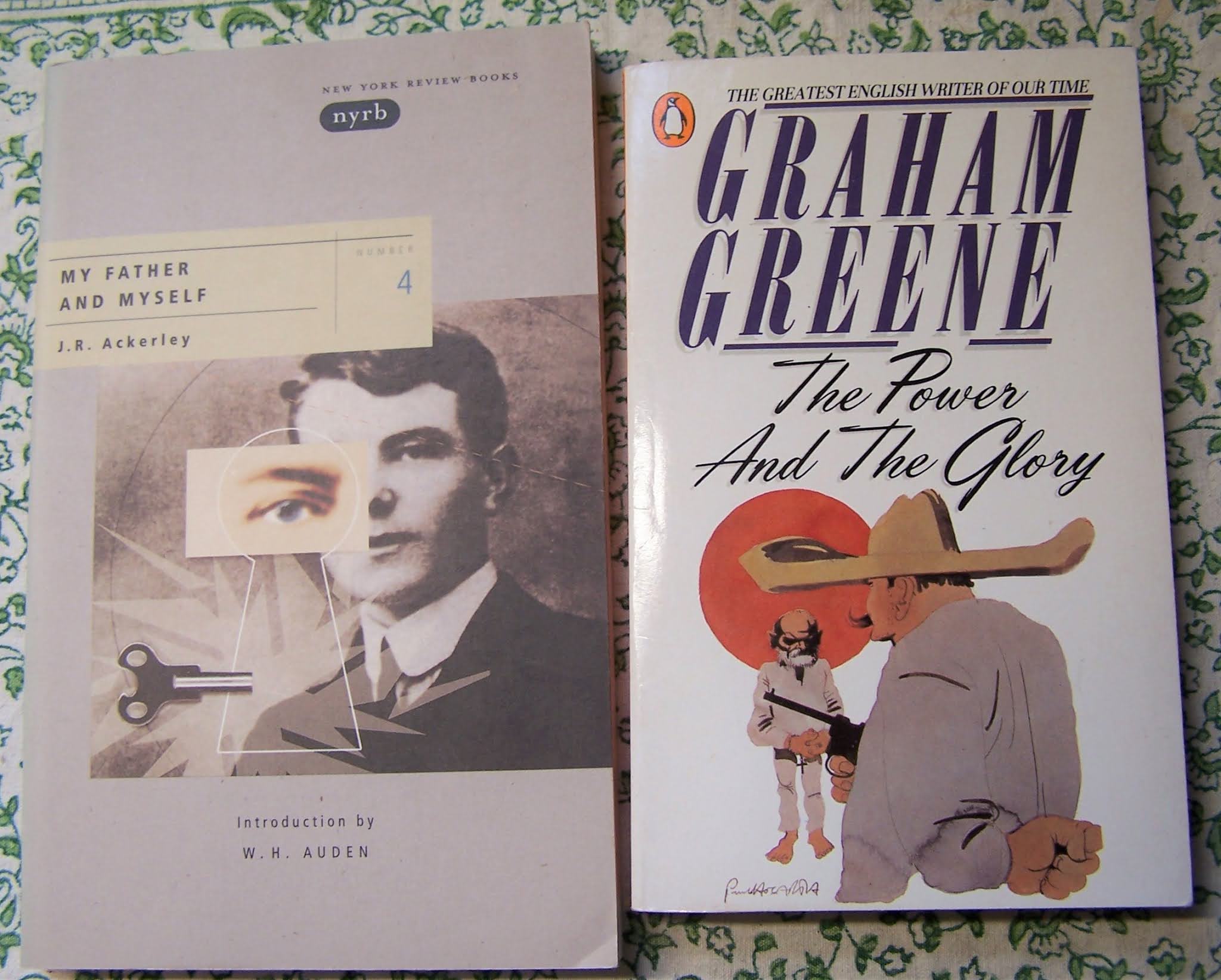
Enjoying some English prose - Graham Greene's The Power and the Glory and J. R. Ackerley's My Father and Myself


“The greatest English writer of our time” declares the cover of my copy of Graham Greene’s The Power and the Glory (1940).  It’s a 1982 Penguin, so I assume the “time” is circa 1982, but who knows.  It’s plausible, right, even without looking into the competition (I pick either Penelope Fitzgerald or Michael Moorcock, depending on mood).

Greene’s novels travel the world, feature a wide variety of characters, deal with big philosophical and social issues, have exciting forward-moving plots, and are written stylishly without seeming to fuss over style.  I can see how for some readers – maybe more in the past than now – Greene was the ideal novelist.  These are not my ideals, but I can see the fit.

The Power and the Glory is the one with the Mexican whiskey priest, on the run from the Tabasco police and a regime that is suppressing the Church and murdering every priest it can find.  And the state is also prohibitionist, even worse, especially for an illegal priest performing illegal masses using illegal wine.  As is often the case with Greene, this is all exaggerated, but true enough.  I guess the actual Tabasco state was not so thorough, but Greene’s character is the last priest, so even if a bad priest, a drunk with a child, he is by default a mythic figure.  Whether his courage or sense of duty or desperation also makes him a saint, a sinning saint, is one of the questions Greene works on.

Duty, faith, sin, death, plus chase scenes.  Greene is at this point an expert in what I think of as the flow of the novel, knowing when to shift from one character to another or from inside to outside a character’s head.   How to move characters from one room to another, or make time pass:

They fell silent and time passed, the shadow of the customs house shifted a few inches farther towards the river: the vulture moved a little, like the black hand of a clock. (I.1)

This is just the third page of the novel, so that blatantly symbolic vulture will not murder anyone for a while.  Greene is inventive with metaphor, as here with the first look at our hero the alcoholic priest:

He had protuberant eyes; he gave an impression of unstable hilarity, as if perhaps he had been celebrating a birthday, alone.  (same page)

The metaphors are a good part of the pleasant, mild strangeness that I find characteristic of Greene.

Look at that edition of J. R. Ackerley’s memoir My Father and Myself (1968), number 4 in the NYRB Classics series.  Think of how easy it was to collect them when there were only four.  Ackerley’s book has two strains.  First, it is a straightforward account of life as a gay man in England under a repressive legal regime, the only twists being the author’s neuroses, but who doesn’t have those.  In the introduction W. H. Auden, when not directly summarizing the book, seems mostly interested in exactly which sex acts Ackerley would or would not perform.  I though he was clear enough, so clear that it was easy to understand why the book was deliberately published posthumously.  Auden wanted more, though.

The second strain is the life of Ackerley’s father, especially some late revelations about his active sex life, including the strong possibility that he had for several years been the handsome “kept man” of a rich gay Count.  The memoir has an odd structure, in that Ackerley’s writes about his father’s early life first, then returns at the end, after his father’s death, to the information suggesting that everyone involved was homosexual, but I would guess that most readers figure it all out, and are meant to, right away, so the suspense is all in how Ackerley makes the discoveries.

My Father and Myself would be valuable as a gay memoir even if the father were a more ordinarily dull chap.  But he provides the narrative energy.

Ackerley’s style is the good English literary style of his time, possibly just a bit more direct to increase the rhetorical “hard truth-telling” effect, full of carefully placed phrases and clauses.  Picked almost at random:

I was a cherubic little boy with large blue starry eyes; my first nickname was “Girlie,” and at the public school older boys soon began to make advances to me.  (105)

Why is this better as one sentence than three?  The three clauses each contain information, but connecting them adds meaning.  A little more complexity, a little more meaning.  It is the kind of sentence I associate with Graves, Orwell, or Huxley, more intricate than the standard American equivalent, and always a pleasure to read.


Monday, May 24, 2021

Farewell to The Third Policeman and The Commitments - Dublin Soul was about to be born

Let’s say farewell to some books this week.


Isn’t that cover of The Commitments (1987) great?  It is even more or less accurate.  “Jimmy Rabbitte knew his music” (1) – he’s the blond kid holding the picture of James Brown.  He organizes a Dublin bar band that performs twenty-year-old American soul music.  A lot of the pleasure of the book comes from the representation of the performance of the music:


I do not expect anyone to read this page (105, source of the post’s title), but am using it as a visual object.  You can see what Doyle is doing, the simplified Joycean tools he is using.  I associate Joyce with interiority and complex referential patterns, but in Ulysses there is also plenty of people just goofing around in bars, the Dublin cacophony, and Doyle is in that tradition.  Lots of speech, lots of energy, lots of noise.

The particular song represented here is James Brown’s “Night Train” (1961), a key work of 20th century music, which, on this page, in this performance, by means of adding Dublin train stops to the song lyrics somehow converts an amateur bar band cover into an art work full of meaning to the handful of people lucky enough to hear it.  The Commitments is about – this is what it is actually about – how popular art creates meaning.  “Dublin Soul had been delivered.”

The 1993 movie, whatever its charms, completely omits “Night Train.”  Too complex, or something.


The Third Policeman is Flann O’Brien’s follow-up to At Swim Two-Birds (1939), ready to go in 1940 but not published until 1967 due to circumstances and incomprehension.

It was so faultless and delightful that it reminded me forcibly, strange and foolish as it may seem, of something I did not understand and had never even heard of. (Ch. 5)

It is Alice’s Adventures in Wonderland for grown-ups, where Alice is replaced by a philosophically-inclined Irish murderer and Wonderland is not a dream but something perhaps related.  There is a shared metaphysics, at least, and a similar Carroll-like love of mathematical paradox.  The quotation above is, in context, about a series of boxes-within-boxes that does not go on to infinity but gets close.  This line is about the transfer of atoms from bicycle to rider and rider to bicycle, making people half-bicycle and bicycles half-human:

‘Your talk,’ I said, ‘is surely the handiwork of wisdom because not one word of it do I understand.’ (Ch. 6)

It is just atomic theory.  It is so simple.

Perhaps it is because of the Alice template, just because I understand it better, but I personally find The Third Policeman quite a bit funnier and easier than the meta-fictional At Swim Two-Birds, where fictional characters take vengeance on their creator.  Parts of Policeman are just comedy sketches, proto-Python.  A separate novel, about an insane philosopher and his cutthroat commentators, develops in the increasingly long footnotes.  Goofy exclamations are everywhere: “‘Great holy suffering indiarubber bowls of brown stirabout!’” (Ch. 6).  My kind of humor.  Perversely, then, I plan to sell the book I like more and keep the other, since it is the latter I want to understand better.  It is probably just as funny, once I get to know it.

Farewell to these jolly books.

Thursday, May 13, 2021

Dismantling the library - if only for the delight it would have given me to get rid of them

Wuthering Expectations is not moving, despite its recent transformation from a blog to a newsletter, but the Amateur Reader, the actual human, meaning me, is.  From the prairie to the sea, perhaps.  What will happen to my books?  I am moving every one of them, but maybe not more than once.

In other words, I am deaccessioning.  Lightening the load.  Getting rid of a lot of books.  My current mindset is ruthless and brutal.

Lately I have been reading exclusively from my shelves, evaluating, often saying farewell.  Enjoy your new home, book.

Joseph Epstein wrote, in 2000 or so, about his own purge of his library, from around 2,000 books to 400, in “Books Won’t Furnish a Room” (collected in In a Cardboard Belt!, 2007).  The essay is really a way to play with his collection one last time, to wander around the shelves.  A last chance for nostalgia, or jokes.  “I wish I had owned some of the French literary theorists, if only for the delight it would have given me to get rid of them,” (102).  He keeps all of his Henry James, Proust, Santayana, and Beerbohm.  “I would love to tell you what the deeper meaning of my love for them is, but I cannot because I gave away my six volumes of the Collected Papers of Sigmund Freud” (105).

Epstein was influenced by his experience as an estate executor for sociologist Edward Shils, whose Hyde Park apartment, including the spare bathroom, was packed with 15,000 books.  “I hated to see [the collection] broken up, for it was in itself a work of art,” and Shils had “put them to the highest use” (98).  But they seemed “inert, cumbersome, almost grotesque” without Shils.  I was reminded of Epstein’s essay when James Wood published “Shelf Life” in the New Yorker in 2011, the account of his difficult struggle with his father-in-law’s mass of books.  He vowed not to leave the problem of his own library to anyone else.  I wonder how that has gone.  Patrick Kurp has a nice post about some similar essays as well as Epstein’s, on the job of what Kurp calls “you, the free-lance librarian.”  That is how it feels now, certainly.

My principles of deaccession, all of which are subsets of “know thyself”:

1.  Travellin’ light.  My “giant personal library” fantasy has been gradually replaced by a “divides his time” fantasy.  You know, in author bios, the writer who “divides his time between Paris, Florence, and Schenectady,” like a Henry James character?  Aren’t those writers the worst?  I want to be one of them, except in cheaper cities.  Store the remaining books in Schenectady, I guess.

2.  My library is more of a working library than most people’s, although less than yours, of course, but after fifteen years of internet literary criticism I have a good idea of which books do the work and which are never opened.  The slackers can go.

3.  Time has passed.  I pulled Roddy Doyle’s The Commitments (1987) off the shelves recently.  I had last read it 28 years ago, when the 1993 movie came out.  It’s almost a unique book in its energetic, meaningful use of pop music, and I was thrilled to read it again.  Love it. Out the door!  Farewell, book!  If I want to read it again 28 years from now – when I will be 79 years old – I bet I can find a copy, perhaps in a

4.  Library.  Epstein is not sure he wants to live in a library.  I agree – I want to live next to a library.  The Lyon Public Library was my home away from home away from home when I was in France.  I have become comfortable with the idea that professional librarians can manage and store my books for me.  Austen, Dickens, Faulkner, Nabokov, Morrison – you know, I tell myself, good libraries have those.  And a good public university library has more than that.

If I were moving away from libraries, I would be tempted to bring every single dang book with me.  But I would not because of

5. The internet.  It has changed everything.  I would never have guessed, in the 1990s, how easy it would become to search for images.  So most of my art books, gone.  Ordinary paperbacks of public domain books, gone.  In 28 years, the American public domain will have reached 1953.  Before I went to France, I trained myself to read books online, and it did take some training.  But now I have books on my computer, books on my phone, books everywhere.

In an ironic, aggravating footnote, I was not able to find my copy of Joseph Epstein’s In a Cardboard Belt!, which must be in the house somewhere, but is not with all of Epstein’s other books, presumably because I had it out for something else I wrote who knows when.  But the book is, yes, available on the internet, and I used the scanned copy to find the quotations I wanted.

I’m keeping my Epstein books.  Anything I bought in France.  Jack Kirby and Stan Lee’s Fantastic Four, yes, but Kirby and Lee’s Thor has already been sent to my nephews.  Library of America Henry James stays, but those beat up old Penguins, I don’t know.  The battered paperback Bleak House I bought for 18 cents (!) in 1990, which I have read twice and my wife has read once, that goes.  Got my money’s worth there.  I just pulled my old Penguin Balzacs, since I’m not allowed to read those in English anymore.  Maybe all of the translated French should go.  No, the Richard Howard Racines and Molières, those I’ll keep.

Maybe I’ll write updates like this all summer long.  I doubt this is so interesting, but it is sure taking up a lot of my mental energy.  “Sometimes reading supplies the most cunning of all means of avoiding thought,” Epstein worries (107).  Too true.  And now much of my thought boils down to “Yes or no?”  Mostly, no, no, no.

Wednesday, May 12, 2021

A D. H. Lawrence Women in Love note dump with some more general observations - the struggle to get out

I meant to write some kind of D. H. Lawrence summary whatnot after my “Lawrence-influenced writers of the 1930s and 1940s” mini-series.  This, a little late, is that.  I made the mistake of reading some of my earlier writing about Lawrence, where I found that I already wrote most or all of what I wanted to write this time.  Reminder to myself: no one remembers or cares.

Half of my motive is found in the notes I took on Women in Love (1920) and never used, just amazing  things.  Some are single-sentence distilled Lawrence:

He took off his clothes, and sat down naked among the primroses, moving his feet softly among the primroses, his legs, his knees, his arms right up to the arm-pits, lying down and letting them touch his belly, his breasts.  (Ch. 8, “Breadalby”)

It was evident she had a strange passion to dance before the sturdy, handsome cattle.  (Ch. 14, “Water-party”)

Ursula was afraid that he would stone the moon again…  “Why should you hate the moon?”  (Ch. 19, “Moony”)

Many readers may well hate this sort of thing.  “’Was it hate?’” Ursula’s moon-stoning companion answers, a good question. 

But there is also some good nature writing, and some interesting aesthetic theorizing, sometimes combined:

The heavy gold glamour of approaching sunset lay over all the colliery district, and the ugliness overlaid with beauty was like a narcotic to the senses. (Ch. 9, “Coal-dust”)

A number of lines, as with that last phrase, feel like self-description, or even self-critique (“’Women and love, there is no greater tedium,’ he cried,” Ch. 30, “Snowed Up”).  Meta-fiction:

He turned in confusion. There was always confusion in speech. Yet it must be spoken. Whichever way one moved, if one were to move forwards, one must break a way through. And to know, to give utterance, was to break a way through the walls of the prison as the infant in labour strives through the walls of the womb. There is no new movement now, without the breaking through of the old body, deliberately, in knowledge, in the struggle to get out.  (Ch. 14)

Sorry, I was wrong, there is lots of aesthetic theorizing, often explicitly that, like in the bonkers scene like where a group of nude men stand around a West African statue of a nude woman and baldly debate its status:

“Why is it art?” Gerald asked, shocked, resentful.

“It conveys a complete truth,” said Birkin.  “It contains the whole truth of that state, whatever you feel about it.”  (Ch. 7, “Fetish”)

That last line fits well with my own changing notions of Lawrence, and to be honest with art in general, that fussing much over whether I like or love or hate something is not interesting.  Following “the struggle to get out,” to express some kind of (personal and partial, not whole) truth, is of sufficient interest, even when the results violate good taste and good sense.

Lawrence sometimes writes well, and often badly*; sometimes likable and sometimes loathsome.  I take his greatest innovation to be the introduction of some unusual, even extreme, psychological states to English fiction.  The co-existence of love and hate is especially important, whether between lovers or parents and children.  Lawrence freed a number of later writers to represent more oddballs.  He made fiction broader.  Sometimes he seems to believe that his weirdos are typical, which can be exasperating.  His great “men versus women” theme brings out his best and worst ideas.  “Men, and love, there was no greater tedium” (see above).  I think one reason his writing about animals, in fiction or poetry, seems especially good is that even when it is about sex it gives him some distance.

Is this really any kind of summary?  Reading a lot of Lawrence has helped me understand other writers, and even his more dubious works have always given me something to think about.  Good enough.

* Lawrence sometimes uses rhetorical constructions that signify good writing to me, and often uses signifiers that I think of as “bad writing.”

Friday, April 30, 2021

Kay Boyle's short Lawrencian novels - leading their own strong violent life

Kay Boyle’s short novel The Crazy Hunter (1940) is about wealthy, horsey English people, and The Bridegroom’s Body (also 1940) begins:

The swannery had been established there, just on the edge of Lord Glourie’s grounds, because it was here the swans had come of themselves  since years, since centuries maybe, to feed on the weeds and to lead their own strong violent life in the lagoon. (143, page numbers from Three Short Novels, New Directions, 1958).

Soon enough a swanherd appears.  This is the only fiction I have read featuring a swanherd.


At some early point in The Crazy Hunter I thought “Isn’t Kay Boyle American?”  Yes, born in St. Paul, raised in Cincinnati, with the next major step a career as a Paris Bohemian, a “scenester,” almost, who pops up in most accounts of Americans in Paris in the 1920s.  Boyle’s life in the 1920s and 1930s was complicated and likely a lot of fun.

She did briefly live in England.  She must have sponged it up pretty thoroughly.  I would never have guessed that the author of these two stories was not English.  That is partly, though, because she so thoroughly sponged up D. H. Lawrence.  Her prose, characters, use of animals, and attitude are the most Lawrence-like I have seen outside of Lawrence.  See above, “strong violent life.”

St. Mawr (1925) is Lawrence’s little novel about a married couple who fight and fall apart over a horse.  In The Crazy Hunter, Nancy’s new horse, a gift from her father, has a stroke and goes blind.  The colder mother wants it put down, as anyone would; Nancy wants to keep it, ride it, and even train it to jump; the warmer, drunken, failed artist father supports his daughter to the point of self-destruction.  Lawrence’s gender roles have all been moved around here, but they are recognizable.  The mother – the parents have names but are often referred to by their roles, as “the mother” and “the father” – is not a villain but is understandably worried that show jumping with a blind horse is crazy and will get Nancy killed.

In The Bridegroom’s Body, the male swans try to murder each other over the females, and the male humans do not actually fight but certainly compete for a new young female who appears in their ecosystem.  What can animals do about their instincts.

The protagonist, Lady Glourie, not the woman everyone is fighting over, is watching a swan bathe:

He was just across the lake with the moon shining fully on him, and presently she began walking panther-swift and soft along the path that led her to where he bent and dipped and shook under the lambent dripping veils of mingled water and light.  Her eyes did not leave him; as if it was his own luminosity that drew her like a sleepwalker to him she moved, seemingly stepless, seemingly mindless, towards him. (198)

And “staining the incredible purity as blood might have stained it,” “[t]he great throbbing of his wings,” and so on.  It is in these sexually intense scenes that Boyle really leans on Lawrence’s style, although I think she is more self-consciously controlled.  Maybe.

They can’t stink more than stud-farms do of sex and monstrous matings and foalings brutaler than murders. (The Crazy Hunter, 34)

But that’s a character, the self-pitying father, sounding like Lawrence at his most ranting, not the narrator.

Looking in Leo Hamalian’s D. H. Lawrence and Nine Women Writers (1996), to make sure I am not seeing things, I find that Boyle herself says (p. 101) that the first Lawrence book she read was Studies in Classic American Literature (1923), perfect for a future American Lawrencian, which her mother sent to her in Paris from Cincinnati.  What a great mom! Boyle quickly read all available fiction, and poetry, and everything, and nodded to him constantly in her fiction of the 1920s and 1930s.

I should read more Boyle sometime, although I have no idea what.

Thursday, April 29, 2021

Hugh MacLennan's Canadian novel about novels - She knew she was supposed to admire these writers for their realism, but actually she loved them for their style

The last third of Hugh MacLennan’s Two Solitudes jumps from World War I to the 1930s, ending in 1939 with the start of World War II, and the main characters switch to Paul, the son of the aristocratic, enlightened Athanase and Heather, the daughter of the war widow from the chapter I praised yesterday.  Young people problems come to the front, like romance (the French/English division will be reconciled by love and patriotism) and jobs and writing the Great Canadian Novel.  A surprising amount of the novel is about novels.

Hemingway, for example, inescapable in 1947:

He [Paul] went into the kitchen and opened a can of beans, spilled the beans out into a saucepan and heated it on the stove.  Then he cut a slice of bread and buttered it, and poured himself a glass of milk.  The beans and milk tasted good.  (225)

That last sentence especially, even if the whole thing is stolen from “The Big Two-Fisted River” (1925).

If that seems thin – although it is directly stolen – let’s look at Heather selecting a book from “her collection of post-war writers”:

All of D. H. Lawrence was there, all of Aldous Huxley and Dos Passos, some Hemingway and the social works of Bertrand Russell.  She knew she was supposed to admire these writers for their realism, but actually she loved them for their style.  She could not bear a book that lacked style.

  (258)

On the next page, MacLennan spends a paragraph watching Heather read the first ten pages of A Farewell to Arms.  “It was vibrant, it was beautiful, it was life!”  MacLennan is listing his own influences here, all easily detectable long before this page, however paler they become in his own style.  Well, I have never read Russell.

Paul and Heather begin a love affair that moves the novel firmly into Lawrence territory, although my notes tell me that I lost the most relevant page numbers (what a useful note, thanks, past me).  Not that Lawrence was not visible early on (this is Paul’s older brother, an interesting character in his own right):

His hatred of his father collapsed in a longing for his father’s approval, never attained because stubbornness of pride made him refuse consistently to do a single thing his father wished. (38)

Admittedly, that’s a heck of a lot balder than Lawrence would ever write.  How about what may be my favorite single line in Two Solitudes:

Twice last autumn, on silent nights with a full moon, he had heard miles away the cough of a rutting moose.

  (51)

A moony, moosey echo of a favorite bit of Women in Love (1920):

The moon was transcendent over the bare, open space, she suffered from being exposed to it.  There was a glimmer of nightly rabbits across the ground.  The night was as clear as crystal, and very still. She could hear a distant coughing of a sheep. (Ch. 19, “Moony”)

Paul is also the name of the hero of Sons and Lovers (1913).  That made me laugh when I remembered it, although the characters are more like Rupert and Ursula in Women in Love, with their honeymoon trip along the Gulf of St. Lawrence full of resonances.

Paul has been writing a novel about the masses – “Could any man write a novel about masses?” (307) – but it is not going well.  “A novel should concern people, not ideas, and yet people had become trivial” (same page).  His great breakthrough, with Heather’s help, is to turn to a novel about Canada.  This is what happened to MacLennan, too.  This is, of course, a terrible idea, leading to the kind of kitsch I find on the very last page, where MacLennan feels it necessary to summarize the meaning of Canada.  Inevitably, the moony moose returns: “the moose came out of the forests on October nights and stood in silhouette against the moonpaths that crossed solitary lakes” (369).  It worked out all right for MacLennan, overall.  We do not see how it works for Paul.

A highly instructive novel. Thanks again, Dorian, for the recommendation.

Wednesday, April 28, 2021

She was each of the characters in turn - Hugh MacLennan's Two Solitudes

Dorian Stuber asked people to let him recommend a book; I asked; he pointed me to Hugh MacLennan’s Two Solitudes (1945), a novel that became a reference point – the title especially – for the differences between English and French Canada.  So poetic!  It’s from Rilke!  I assume that all such references are now to Bon Cop, Bad Cop (2006).


The first two-thirds of the novel are set during or just after World War I, when the English Canadians are gung ho to help their British countrymen fight the Huns, and the French Canadians are not.  You would think they would want to help the French, but no, the French have become godless lunatics who deserve their suffering.  The portrait of the Quebecois village in 1917 is like a trip back in time to the French 18th century, with a tyrannical village priest and characters named Polycarpe and Athanase.

Athanase is the central character of the first section.  He is a man of the Enlightenment, believing in knowledge and progress and probably not so much in God:

He looked at the print of Rousseau hanging beside Voltaire.  Rousseau was wearing a fur cap, and it made him look like an early French-Canadian colonist, almost a coureur de bois.  (75, 1945 edition)

Poor Athanase is ground to a powder, between his intolerant, backwards neighbors (prints of Rousseau and Voltaire cannot compete with that priest), and the greedy momentum of the English bankers who want to turn his Quebecois idyll into a factory town.

Two Solitudes is a family saga, with the son of Athanase and the daughter of another character using the last third of the novel to reconcile the two sides of Canadian culture.  I will leave that for tomorrow.  It turns out to involve the writing of the Great Canadian Novel.  Most of my notes are from the last third.

MacLennan’s novel is good with the culture clash, and good with Montreal – anyone interested in Montreal should read it, no question – but also quite good with death.  The death of the defeated Athanase, torn between three faiths, Catholic, Protestant, and atheism, is excellent, and anticipated by the best chapter in the first part of the book, when the focus shifts for just one chapter to a minor character, a woman whose husband is a soldier.  The post office has received an official letter, “from His Majesty the King, via the Canadian Ministry of Defense,” and everyone in town can see it.  Everyone knows what it means.

Then she began to walk very fast down the road to her father’s house.  All the stories she had ever read in which one of the characters received bad news of a bereavement began to chase each other through her mind.  Idiotically, they got out of control, they became herself.  She was each of the characters in turn, bravely keeping her personal grief from intruding on others, she was nothing but memories and the things which had made her what she was.  (129-30)

But at home, no one has seen the letter, and life is just flowing onward.  Only the widow knows what has happened.

The advantage of including it in a novel is that in the later part of the book, MacLennan can show how her husband’s death in combat poison her life, or perhaps how she chooses to let it poison her life, and tries to use it against her daughter.  But this ironic chapter could stand on its own as a terrific short story.

Tomorrow, D. H. Lawrence and the Great Canadian Novel.  Thanks for the recommendation, Dorian!

I borrowed the book cover from the irritatingly sparse Wikipedia entry.  That’s the Chateau Frontenac in Quebec City on the cover.  The characters in Two Solitudes never go to Quebec City.  It’s a Montreal novel.  Don’t ask me.

Tuesday, April 27, 2021

“Kh-i-r-r-r-f! S-s-s-s” - Call It Sleep, a note or two


Call It Sleep, Henry Roth, 1934.  What a book.  One of the great novels in many categories – a list: immigrant novels, Jewish novels, childhood novels, New York novels, education novels, dialect novels.  It is also a genuine example of a “lost classic,” mostly ignored on publication but a bestseller – a big bestseller – in the 1960s, when there was, however unlikely it seems now, a mass audience for Modernist Jewish novels.

David, a Jewish immigrant from Poland, is five, and in Brooklyn, when the novel begins and eight, in the East Village, when it ends.  His father is a printer and then a milkman.  His mother only leaves the tenement apartment to buy groceries.  She is devoted to her sensitive son.  Her “overwrought, phobic, and dangerously imaginative little boy,” as Irving Howe described David in his 1964 review of the paperback.  The father, who has what we would now call “anger management” issues, often hates his son.  Call It Sleep is a Joycean novel in a number of ways, one of which is that it is A Portrait of the Artist as a Child, and another of which is that each long episode moves towards a stream-of-consciousness intensity, the last episode turning into this:


Poor little David, in search of the light of God, has suffered a terrible accident.  Everything in italics is his monologue, off in some other state, possibly near death; the dialogue is a chorus, mostly men from a nearby bar, in various dialects; “Kh-i-r-r-r-f! S-s-s-s” is the sound of a policeman resuscitating David.  It just takes a little work, is all I’m saying, to keep everything straight.  The content of the text, David’s thoughts especially, works through all of the thematic material developed in the previous four hundred pages.

I read Call It Sleep almost thirty years ago, and the real surprise to me was how little stream of consciousness and Joycean cacophony there was.  Much of the novel is plainer.  “Aunt Bertha would show his mother some day how to make a sponge-cake.”  I picked that randomly.  I didn’t take any notes, for some reason.  Aunt Bertha, fat, earthy, vital, what a great character.  The energy level rises whenever she is in the scene.  The rhetorical mode moves towards stream of consciousness as each episode intensifies and reaches its climax.  Five year-old David gets lost in Brooklyn, or, later, at cheder, has a genuine religious experience.  That sort of thing.  That’s when the consciousness begins to stream.

No, there was one other surprise.  I had not read enough D. H. Lawrence long ago; this time I could see how Lawrence had – influenced, I don’t know – freed Roth to write about his parents in a particular way.  I doubt Roth would have allowed the son to so openly fear the father, the father to so clearly hate the son, the mother to love them all so deeply, without Lawrence’s example.  I mean, maybe he would have, who knows.  Call It Sleep is also full of obscenities, all of the words that I thought were forbidden in American fiction of the time.  Sometimes they are hidden a bit by dialect, but they’re here.

D. G. Myers wrote about Call It Sleep, and took notes. He emphasizes the Jewish aspect of the father-son combat, the tradition of the Jewish stories.

The Yiddish is in standard English.  The English of the Yiddish-speakers is in dialect.  The English of the Poles and Italians and Irish is in other dialects.  The Hebrew is in Hebrew.  This is what I meant by saying it was a great dialect novel.  The cacophony is one of its themes.

When I read it again in thirty years maybe I’ll take some notes.

Tomorrow, more D. H. Lawrence, this time in Quebec.

Thursday, April 15, 2021

Hiroshige, Bashō, Kawabata - some Japanese books - "Not the slightest chance."

Dolce Bellezza’s Japanese Literature Month celebrated its fourteenth year recently.  I read three books for it, but never wrote them up, likely because I have nothing to say about them.  Well, let’s clear the deck and just look at them.


That beautiful Hiroshige art book contains a big 1997 London Royal Academy of the Arts exhibit, 142 prints, mostly but not entirely landscapes.  The text, by Matthi Forrer, is translated from the Dutch (by Peter Mason), but still, this book counts as Japanese; sure it does.  One of the supplementary essays is Japanese.


The marvelous light and snow and mist effects are the highlight.  The strip of color along the top of the print, like an atmospheric effect, was an innovation of Hiroshige’s, in collaboration with his printer.  

But I will have to read another book about Hiroshige someday, one that focuses on his work doing covers and illustrations or novels.  Above we see the covers of Strange Tales of Nighttime Cherry Trees under the Eastern Moon (1836), “a three-volume novel of the gokān type” (30).  What do you think goes on in the novel?  Someday I will find out.


For all of Hiroshige’s landscapes, he rarely crosses the route taken by Matsuo Bashō in his hybrid poetry collection / travel book titled, by Donald Keene, The Narrow Road to Oku (1702).  Bashō visits the sites of his favorite poems, composing his own poems in response.  The book is as pure a love letter to poetry as I know. 

The Pine of Takekuma is truly a startling sight…  Many years ago, when a nobleman who had come down from the capital to serve as Governor of Mutsu, he cut down the Pine of Takekuma and used the wood for stakes supporting the bridge over the Natori River.  That may be why Nōin wrote in his poem, “No trace is left now of the pine.” (67)

But the pine has been replanted, so Bashō is looking at a tree which has replaced a tree that he knows from a poem about its absence.  And he includes two new poems about the tree, one by a friend given to Bashō when he began his journey, and one newly composed:


This is all so Japanese.  Every poem of Bashō’s is set aside from the prose text and accompanied with an illustration by Miyata Masayuki; this is as much an art book as poetry or travel or whatever it is.  An unusual book.

Yasunari Kawabata’s 1952 novel Thousand Cranes seems to me to be most useful for similar cultural reasons.  The older of the handful of characters are tea ceremony hobbyists, as was Kikuji’s late father.  A little soap opera – will Kikuji marry – takes place amongst the tea things, with lots of examination of antique pottery.  I felt I learned more about the place of the tea ceremony in Japanese culture from this exchange than from the entirety of Okakura’s The Book of Tea:

“You’ll be lonely by yourself.  Suppose you bring a few friends from the office.” [The speaker is one of the mistresses, trying to get Kikuji to marry.]

“Very unlikely.  Not one of them is interested in tea.” [Kikuji]

“All the better.  They won’t expect too much, and the preparations have been very inadequate.  We can all relax.”

“Not the slightest chance.”  Kikuji flung the words into the telephone.  (42, tr. Edward Seidensticker)

Kawabata’s readers often go on and on and on about his subtlety, the tiny gestures full of complex meaning, but at least in this book, plainly written and full of dialogue, he does not seem any more subtle than any number of significant writers.  He does achieve some interesting poetic effects, as when one of the characters commits suicide:

Kikuji sat by the telephone with his eyes closed.

He saw the evening sun as he had seen it after the night with Mrs. Ota: the evening sun through the train windows, behind the grove of the Hommonji Temple.

The red sun seemed about to flow down over the branches.

The grove stood dark against it.

The sun flowing over the branches sank into his tired eyes, and he closed them.

The white cranes from the Inamura girl’s kerchief flew across the evening sun, which was still in his eyes.  (65-6)

I wonder, in passages like this, which Bashō poem is Kawabata thinking of, which Hiroshige image is he evoking?